
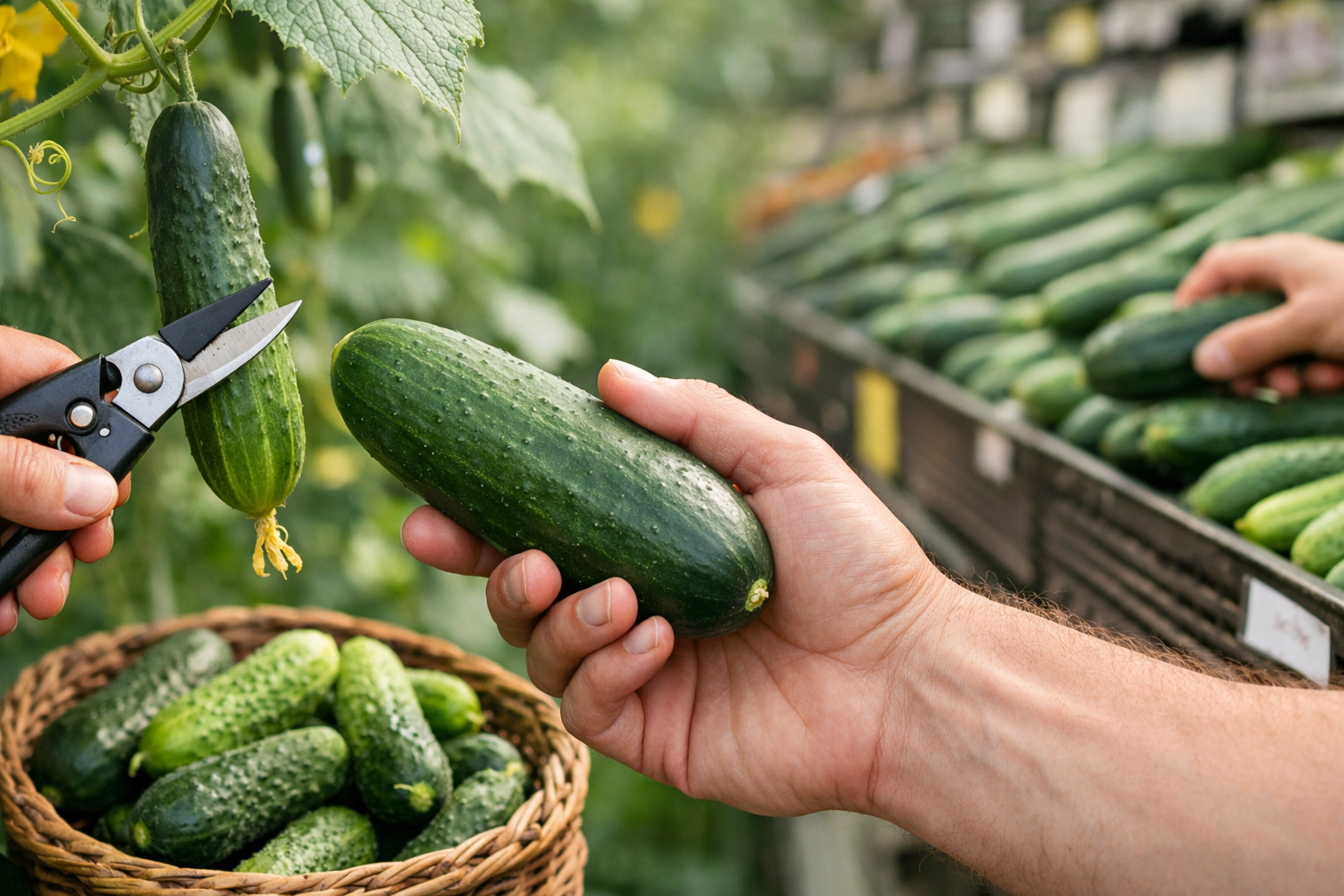
I’ve done the annoying version of cucumber season. You lift one leaf in the morning and there it is: a fruit that was “probably fine to leave another day” and is now halfway to canoe-paddle size. Then you go to the store later that week and stand in front of a bin of English, Persian, and Kirby cucumbers thinking, “Fine. Which one of these is actually good?”
If you’re asking “how do you pick a cucumber,” the short answer is this: on the vine, pick it when it is firm, the right color for the variety, and in the size window for that type. At the store, choose one that feels firm all over and looks evenly colored, hydrated, and free of wrinkles, soft spots, yellowing, or a swollen middle.
The generic answer sounds tidy but it breaks fast. A pickling cucumber should not be judged like a long slicer. A lemon cucumber is not trying to be dark green. And a cucumber that keeps getting bigger is not always getting better. That last bit gets people a lot.
- How to tell whether the question means harvesting or grocery selection
- The size windows that matter for slicing and pickling cucumbers
- Which signs actually predict good texture and which ones fool people
- How to harvest without roughing up the plant
- What to do with cucumbers that are a little early, a little late, or oddly shaped
- How to handle cucumbers after picking so the good call stays a good call
The 10-second cucumber check
| If the cucumber is… | Look for | Do this |
|---|---|---|
| Still on the vine | Firmness, right color, size window for the variety | Pick now if it is in range. Cut it off cleanly. |
| At the store | Firm skin, no wrinkles, no soft ends, no yellowing | Buy the one that looks hydrated and evenly shaped. |
| Showing warning signs | Yellow patches, bulging middle, big seeds, soft spots | Skip it or remove it from the plant and use only if quality is still decent. |
How do you pick a cucumber? Start with the two-way answer
There are really two versions of this question.
Version one: “When should I pick this cucumber off the plant?”
Version two: “How do I choose a good cucumber at the store or market?”
The cues overlap. In both cases, firmness, color, and shape do a lot of the heavy lifting. But the action is different. On the vine, you are deciding whether to harvest now or wait a bit. At the store, you are sorting fresh from tired.
That split matters because the wrong rule sends you in the wrong direction. Gardeners often wait for max size and shoppers often grab the biggest cucumber in the pile. Both moves sound reasonable and both can backfire.
Remember: for eating quality, a slightly early cucumber is usually a safer miss than a clearly overgrown one.
Check the type first so your size target makes sense
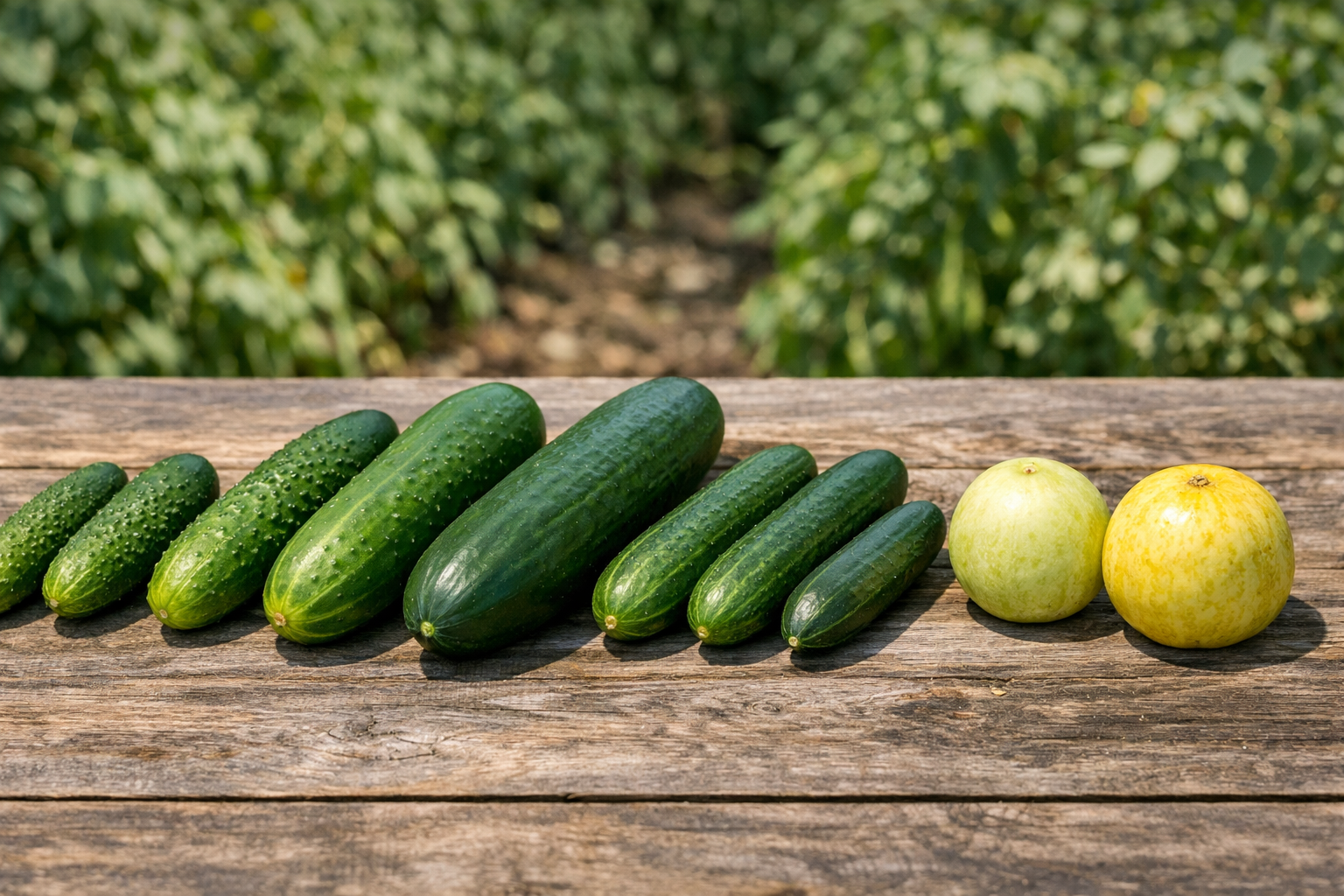
The Iowa State University Extension harvest guide gives the cleanest working ranges: pickling cucumbers are usually best at 2 to 4 inches and slicing cucumbers at 6 to 8 inches while still dark green and firm. It also says to harvest every 2 to 3 days. That tells you something useful right away. The target is not “largest possible fruit.” The target is “fruit in the quality window.”
That window shifts with the type you planted or bought.
| Type | Usual working size | What that size gets you |
|---|---|---|
| Pickling cucumber | About 2 to 4 inches | Tighter flesh, smaller seeds, more uniform pickles |
| Slicing cucumber | About 6 to 8 inches | Good crunch before the center gets watery and seedy |
| English or burpless type | Longer than standard slicers, often harvested before thickening | Tender skin and a cleaner bite |
| Persian cucumber | Short and slim | Thin skin and crisp texture with little fuss |
| Oddball varieties like lemon or round types | Use the seed packet or plant tag | Stops you from forcing a slicer rule onto a different cucumber |
If you still have the seed packet, trust that over the internet’s broad ranges. Breeders do not all build cucumbers to the same finish line. One plant can look “too small” by a generic chart and still be dead-on for that cultivar.
I learned this the clumsy way with a pickling variety. I waited for a few fruit to look more “substantial” and got cucumbers that were still edible but already losing that snappy middle. They looked better. They ate worse.
Read color, firmness, and shape before you decide
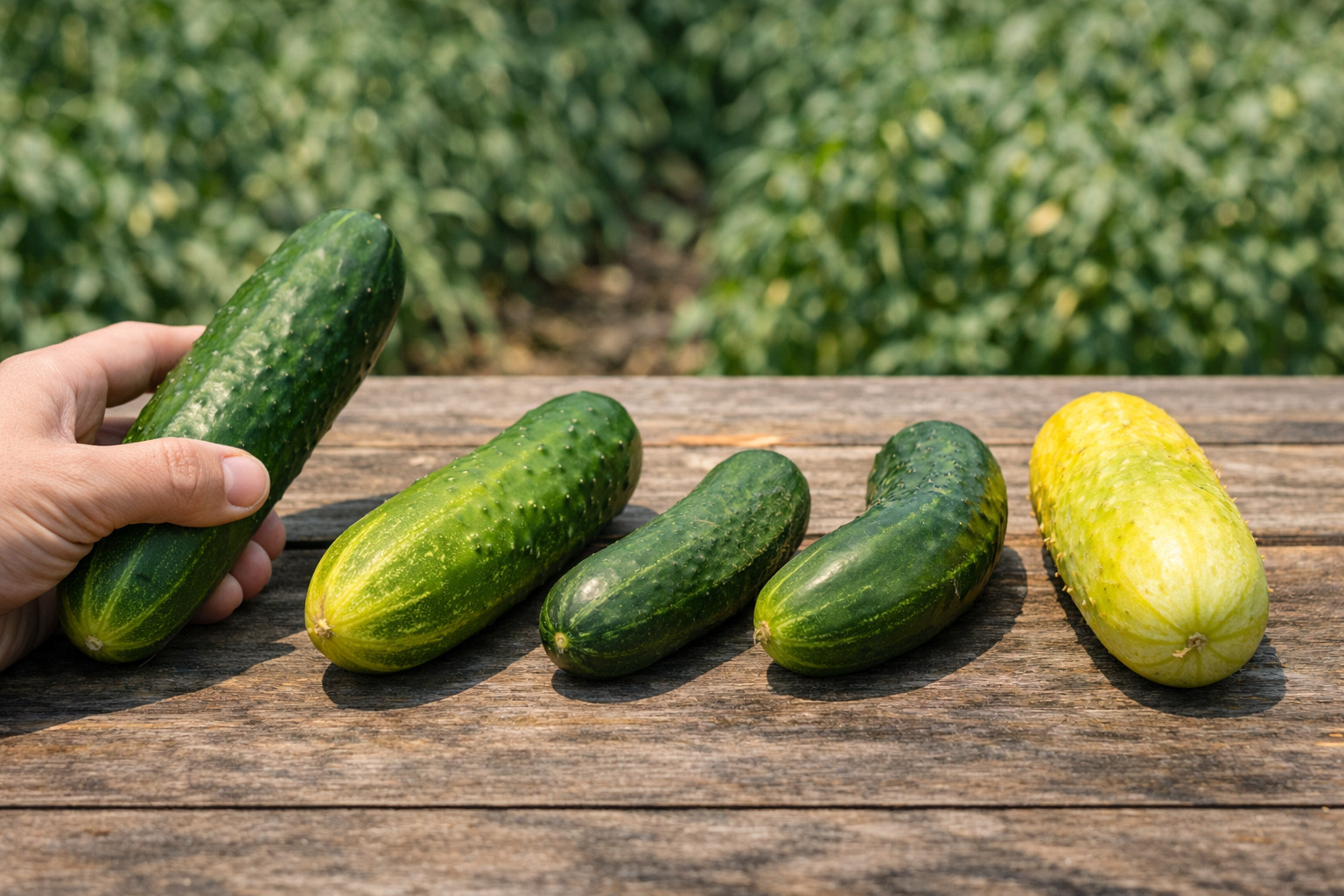
The UC Davis Postharvest Research and Extension Center keeps this nicely plain: good table or slicing cucumber quality is built around uniform shape, firmness, dark green skin, freedom from defects, and no yellowing. It also notes that cucumbers are harvested slightly immature, near full size but before seeds fully enlarge and harden. So your best cue is not one thing. It is a cluster.
Firmness first. A good cucumber feels taut, not bendy and not spongey at one end.
Then color. Most slicing and pickling cucumbers should look green and fresh, not faded and not yellowing. But “green” is not a universal law. Some varieties are pale, striped, white, or yellow by nature, so judge color against the variety, not against a supermarket standard.
Then shape. Even, straight enough, and well-filled is good. A swollen middle, a pinched neck, or a cucumber that looks puffed up can point to overmaturity or uneven growth.
People get tripped up by surface texture too. Bumps and prickles do not mean the fruit is unready. They often just mean you are looking at a pickling type or a young fruit with a rough skin. Rub or wash the spines off later. They are annoying, not diagnostic.
Note: yellowing is usually the plant’s way of saying, “This cucumber is heading past the sweet spot.” On a garden plant, that is a cue to remove it now rather than hold out for a miracle.
Cut the fruit cleanly and keep the plant producing
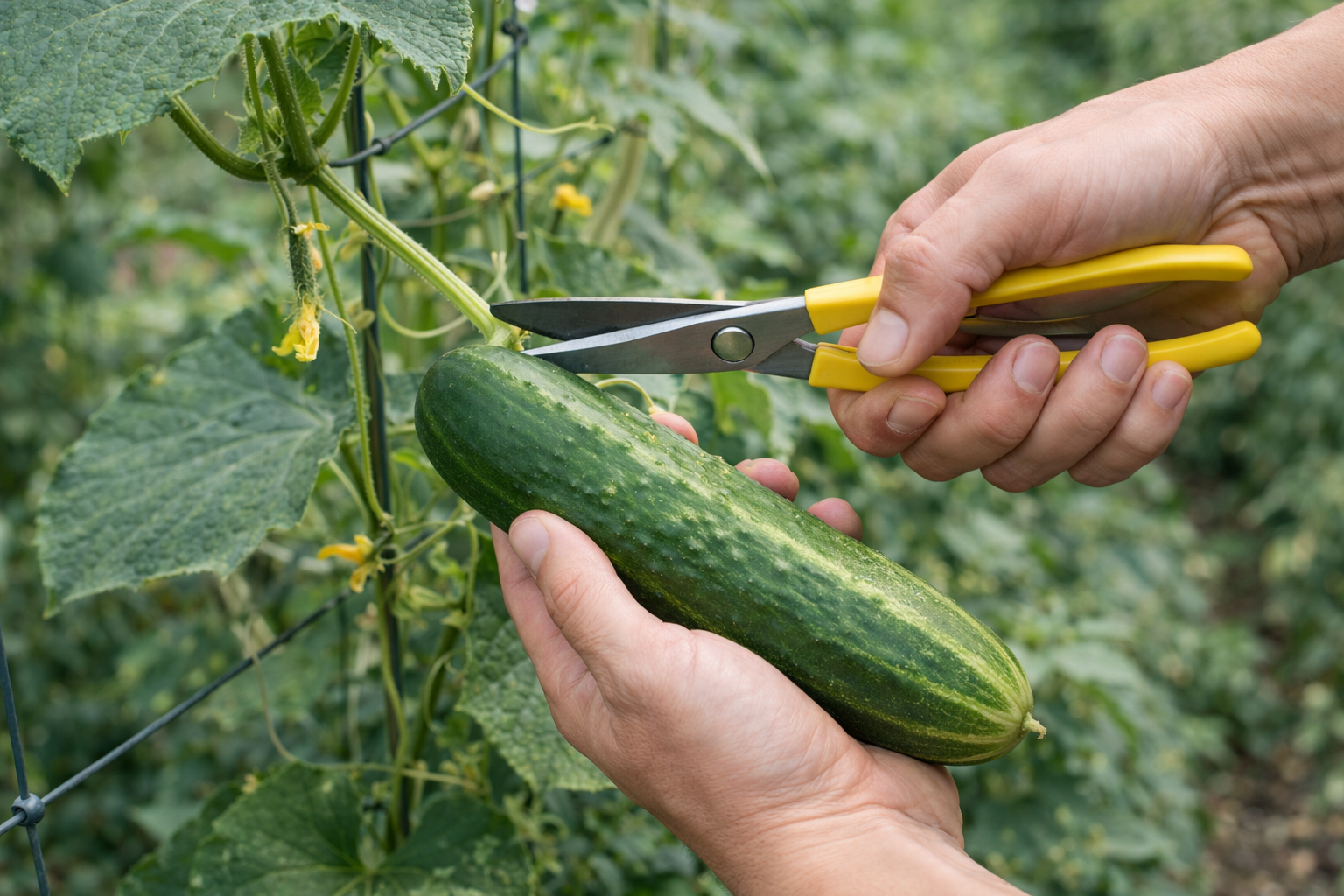
The University of Minnesota Extension guide says to harvest often, avoid disturbing the vine, and skip picking when the vines are wet because disease can spread more easily then. It also warns that very large cucumbers left on the plant can drag yield down. So harvest is not just about one fruit. It changes what the plant does next.
Cut, don’t yank. Use scissors, pruners, or a knife and leave a short bit of stem attached. Pulling can tear the fruit end, bruise the cucumber, or jostle the vine more than you meant to.
Support the fruit while you cut. Thin-skinned cucumbers mark up fast. A little care saves that “what happened to this end?” bruise you notice later at the sink.
Check vines often in hot weather. Every 1 to 2 days is not overkill when the plant is in full stride. Cucumbers grow with a kind of sneaky speed. They hide under leaves and then they are suddenly over the line.
Keep visibility on your side. A clean trellis setup makes it much easier to spot cucumbers before they get lost in the foliage. How to support cucumber plants for healthier vines and easier harvests lays that part out well.
Know what “too early,” “too late,” and “still usable” actually mean
This is where a lot of articles go vague. They tell you what “ideal” looks like and then leave you alone with the weird cucumbers.
Too early: the fruit is firm and healthy but still short for that variety. If you know the plant grows longer cucumbers, leave it and check again soon. The risk here is low. A slightly early cucumber is usually just a smaller cucumber.
Too late: the fruit is oversized for the type, seeds are enlarging, the skin is fading or yellowing, and the center may be getting watery. At that point, pick it anyway. Leaving it hanging does not pull it back into quality.
Still usable: a cucumber can be a little oversized and still be fine for salads, cold soup, or a quick pickle if the flesh is crisp and the seeds are not hard. Cut one open and let the inside make the call. If the center is sloppy and the seeds are big and obvious, eating quality has slid.
Oddly shaped: safe does not mean ideal. A crooked or rounded cucumber often points to pollination hiccups, watering swings, root stress, or variety traits. Why aren’t my cucumbers growing? helps with the slow-growth side of that problem, and why cucumbers turn round is useful when shape goes off-script.
The part worth remembering is simple: a cucumber does not become premium by lingering on the plant past its lane. It just gets older.
Use the store checklist for English, Persian, Kirby, and standard slicers
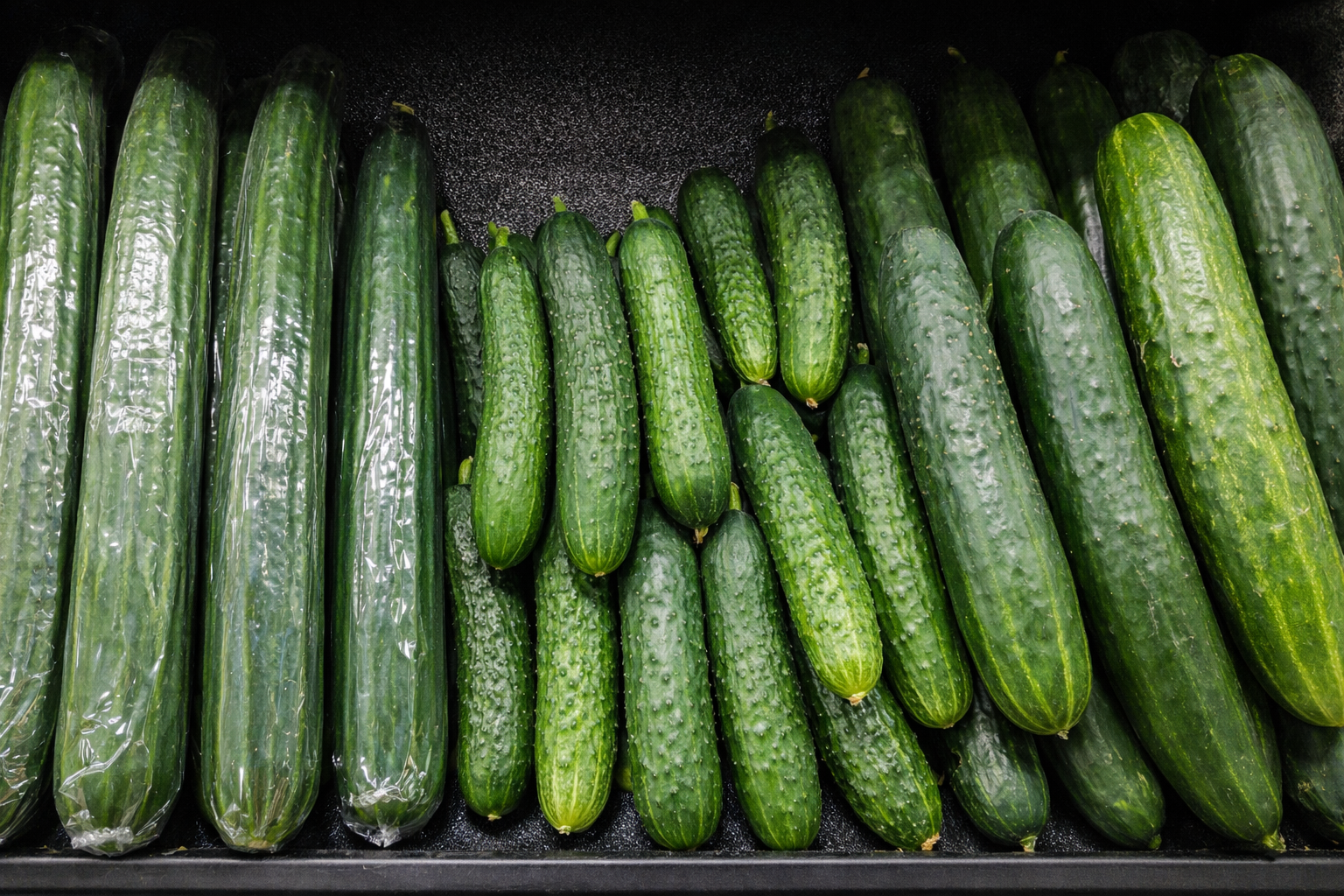
The University of Maine Cooperative Extension says the best store or market cucumbers are slender, firm, and dark green, and it warns against shriveled fruit, bulging middles, bruises, and dark spots. That is a very usable shopping filter because it lines up with what tired cucumbers actually look like in person.
Here is the fast checklist I use at the store:
- Pick up the cucumber. It should feel firm from end to end.
- Look at the skin. Wrinkles mean moisture loss. Soft spots mean damage or age.
- Check the middle. A bloated center can mean overmaturity and bigger seeds.
- Match the type. English cucumbers are long and slimmer. Persian cucumbers are short, tidy, and thin-skinned. Kirby cucumbers are chunky little bricks by comparison. Do not punish a Kirby for not looking elegant.
- Skip yellowing unless that variety is meant to be yellow.
For farmers’ market cucumbers, temperature matters more than people think. Fruit kept cool or shaded holds up better than fruit baking on a sunny table. Thin-skinned cucumbers show stress fast.
Pro tip: at the store, the biggest cucumber is rarely the smartest buy. A medium fruit with tight skin usually eats better.
Avoid the mistakes that make cucumbers bitter, seedy, or disappointing
Most cucumber letdowns are not mysterious. They come from a few repeat mistakes.
- Waiting for “just one more day.” This is how good cucumbers turn pithy and seedy.
- Using one size rule for every variety. A pickling cucumber is not behind schedule just because it is shorter.
- Judging by color alone. A cucumber can be green and still be overgrown.
- Twisting fruit off the vine. That rough harvest can damage the fruit end and shake the vine more than needed.
- Buying the puffiest one in the bin. Bigger is not a quality grade.
- Ignoring repeated misshapen fruit. One odd cucumber happens. A pattern means the plant is telling you something.
If you like rules you can act on, use these:
- If it is firm and in the normal size window for the variety, pick it.
- If it is yellowing or obviously oversized, remove it now.
- If it is still small but healthy and the variety runs longer, wait a little and recheck soon.
- If the store cucumber has wrinkles or a soft end, leave it there.
That is most of the game, honestly.
Handle cucumbers right after picking so good choices stay good
The FDA’s produce safety guidance says to wash produce under running water before eating or cutting, scrub firm produce like cucumbers with a clean produce brush, and dry it with a clean cloth towel or paper towel. That gives you the clean handling part. The storage part is more old-school than people expect: keep cucumbers dry, keep them cool, and use them while they still feel lively.
For home storage, that means a few plain habits work well:
- Don’t wash whole cucumbers before storage unless you plan to use them right away.
- Keep them dry.
- Use the refrigerator as a short stop, not a parking spot for two weeks.
- Keep them away from ethylene-heavy fruit like bananas and tomatoes when you can.
Once cut, wrap or cover the exposed end and use it sooner rather than later. If a cucumber turns slimy, badly soft, or moldy, that is not a “trim around it” situation. Toss it.
For a deeper storage guide, how to keep cucumbers from going bad without guesswork covers the fridge setup and the usual traps.
Use this one-minute cucumber decision checklist
When you are standing in the garden or holding one at the sink, run this quick list:
- What type is it? Pickling, slicing, English, Persian, Kirby, or something less standard?
- Is it in the normal size window? Not max size. The quality window.
- Is the color right for that variety?
- Is it firm all over?
- Do you see yellowing, wrinkles, soft spots, or a swollen middle?
- If it is still on the vine, will waiting help or hurt?
If most answers look good, pick it. If the warning signs are stacking up, don’t overthink it. Either harvest it now and use it if the inside still holds up, or skip it at the store and move on to the next one.
That is the whole trick. Read a few cues together instead of falling in love with size.
FAQ
Will cucumbers ripen after you pick them?
No. Cucumbers do not keep ripening into better eating quality after harvest the way some fruit does. They may soften, yellow, or lose moisture, but that is age and storage change, not a useful ripening phase.
Are prickly cucumbers safe to eat?
Yes. The little spines on many pickling cucumbers are normal. Rub them off with a towel or wash them off. Prickles are a skin trait, not a warning about safety or ripeness.
Why is my cucumber yellow even though it is still small?
That can happen from stress, poor pollination, variety quirks, or a fruit that is heading out of its best stage faster than expected. If the variety is not meant to be yellow, pick it and cut it open. A small yellow cucumber usually does not improve by staying on the plant.

Michael Rowan is the founder and lead writer at The Garden Playbook. He has spent 10+ years growing plants across a range of settings — from indoor houseplants and container gardens to raised beds and in-ground plots — adapting methods to different light levels, seasons, and growing conditions.
Michael focuses on practical, experience-based guidance grounded in fundamentals: soil health, watering strategy, plant nutrition, pruning and propagation, and integrated pest management (IPM). His work aims to help readers diagnose common problems (such as yellowing leaves, stunted growth, or pest pressure) and apply straightforward solutions that are realistic for home gardeners.
At The Garden Playbook, Michael develops tutorials and plant guides using a consistent process: documenting real outcomes where possible, explaining the “why” behind each step, and verifying higher-risk topics (such as plant toxicity or pest treatment options) against reputable horticultural references.