
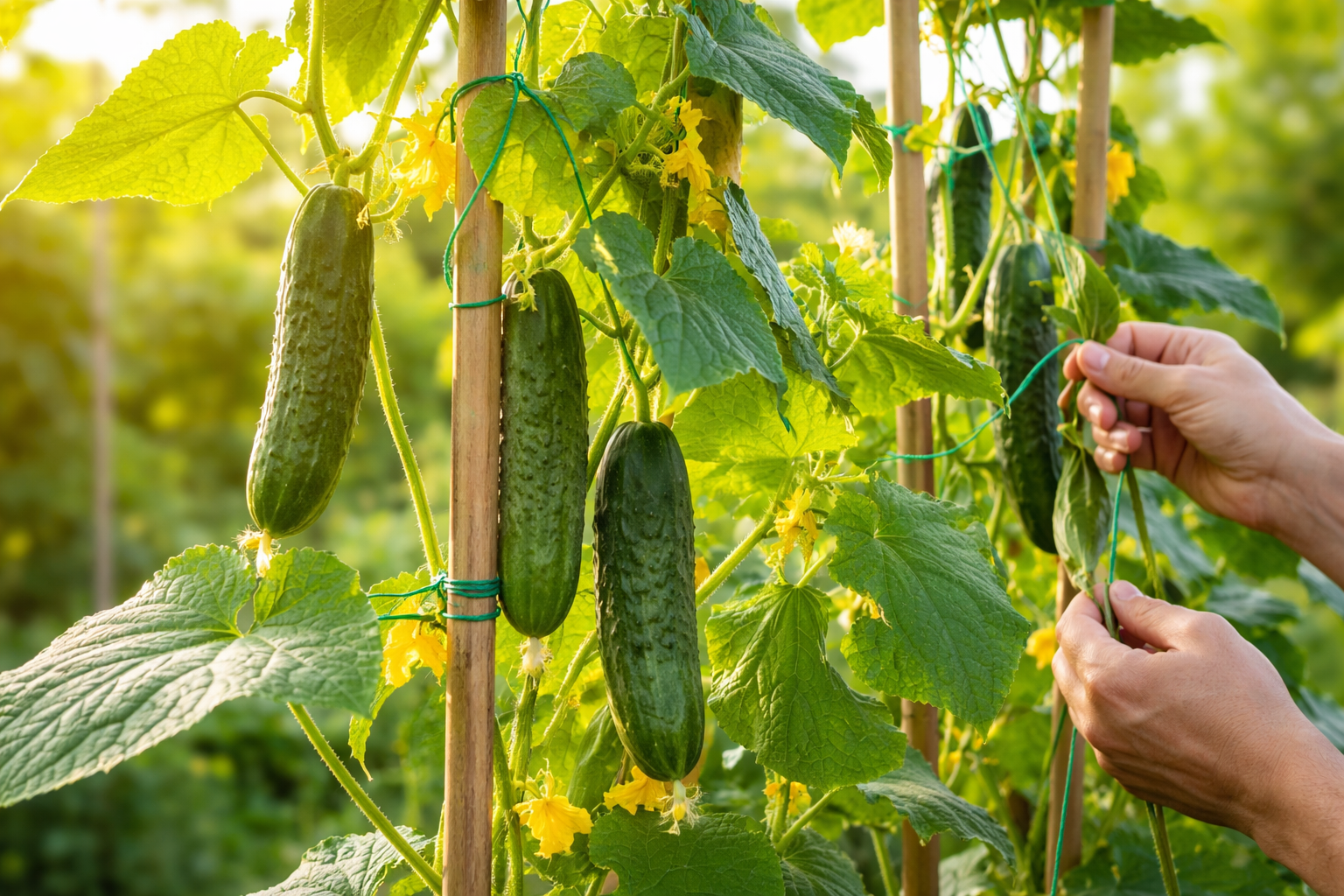
You usually notice this a week too late.
One morning the cucumber patch looks tidy. A few days later, the vines have slithered across the bed, a couple of fruits are resting on damp soil, and the whole thing has that “I’ll sort it out tomorrow” look. The plain answer is simple: most vining cucumbers do best on a sturdy trellis, netting, wire panel, or string support set up early. Bush cucumbers are a different story. Some do fine with light support, and some don’t need any at all.
That generic answer is true, but it’s half a map. The part people get stuck on is choosing the right support for the plant they actually have, the space they’re growing in, and the point in the season when they finally deal with it. A tall wire panel works beautifully in one bed and feels silly in a small container. A tomato cage can save one compact plant and fail badly with a vigorous slicer.
If you’re wondering how to support cucumber plants, here’s the short version: match the structure to the vine’s energy, not to whatever support happens to be in the shed.
- How to tell whether your cucumber needs real climbing support or just a little help
- Which support types are worth using, and where each one falls flat
- How to train vines without snapping stems or making a tangled mess
- What changes in raised beds, containers, fences, and tight spaces
- What to do if the vines already sprawled and your “early setup” window has come and gone
Fast Answer
| Your setup | Best fit | Watch out for |
|---|---|---|
| Vining cucumber in a bed | Wire panel, A-frame, or taut netting | Flimsy mesh that sags by midsummer |
| Vining cucumber in a container | Anchored trellis tied into the pot setup | Top-heavy support that tips with the pot |
| Bush cucumber | Short cage, stake, or no support | Using a giant trellis for a plant that stays compact |
| Plant already sprawling | Add support slowly and guide the vine in stages | Trying to force the whole plant upright in one afternoon |
How to support cucumber plants without overthinking it
Start with a basic split.
If your cucumber sends out long runners and keeps reaching, treat it like a climber. Give it a trellis, panel, netting, or a string setup with real tension. If your cucumber stays compact and bushy, support is optional. A short cage can keep fruit cleaner and lift leaves off the soil, but a full climbing system is often overkill.
That distinction clears up most of the confusion. People often ask whether cucumbers “need” a trellis. Some do. Some don’t. The real question is whether your plant will sprawl enough to create crowding, dirty fruit, awkward harvesting, or weak airflow. Once those problems show up, you’re no longer choosing a support for neatness. You’re fixing a growth habit.
Key takeaway: Choose the support based on how the plant grows, not on the word “cucumber” on the seed packet.
A handy rule is this:
- Vining cucumber + garden bed or raised bed: use a sturdy vertical support from the start.
- Vining cucumber + pot: use a support that stays upright with the container, not one that wobbles above it like a coat rack in a storm.
- Bush cucumber: light support can help, but it’s often optional.
If you only remember one thing, make it this: strength matters more than cleverness.
First decide what you’re growing: bush cucumber or vining cucumber
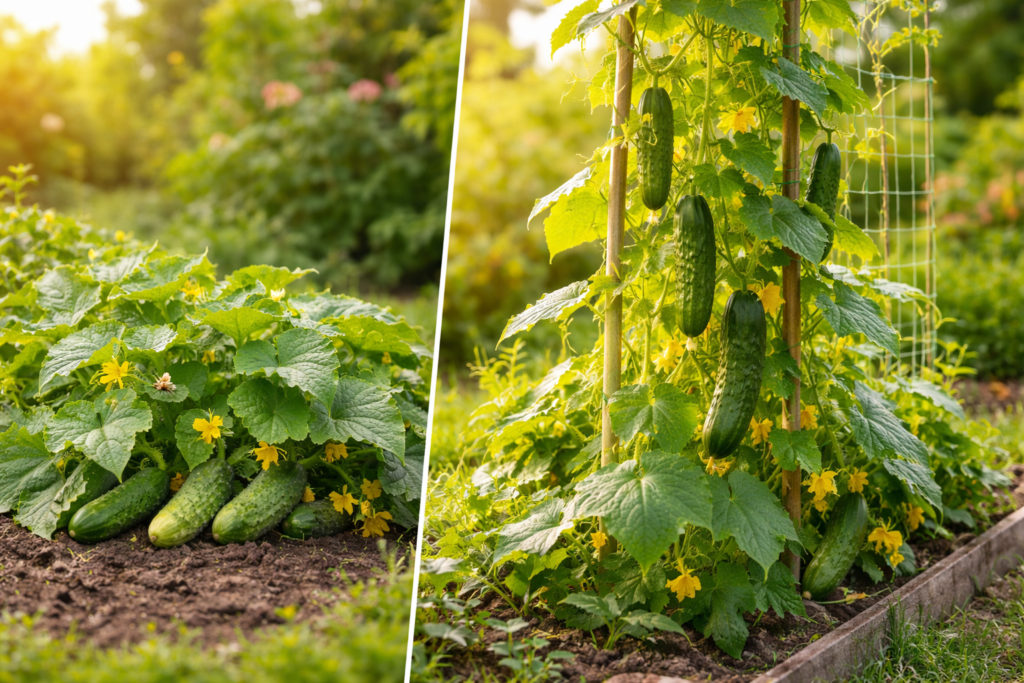
This is the fork in the road, and plenty of articles rush past it.
Vining cucumbers behave like they’re looking for a ladder. They keep pushing outward, they grab nearby structures with tendrils, and they become awkward fast when left to wander. Bush cucumbers stay tighter, lower, and more self-contained. The fruit may still rest on the soil, but the plant usually doesn’t try to occupy half the bed.
The University of Minnesota Extension separates cucumber growth habits the same way gardeners do in practice: some varieties are compact, and some are long-vining. That sounds obvious, yet it decides almost everything about support.
If your label is vague, watch the plant, not the marketing copy. Once you see quick runner growth and a habit of grabbing sideways, plan for climbing support. Don’t keep pretending it’s a compact plant just because the packet art looked polite.
Here’s the practical read:
- Bush type: good for containers, smaller beds, and gardeners who want less infrastructure.
- Vining type: better with vertical support, especially if space is tight or harvest ease matters.
A tomato cage that works for a compact patio cucumber can feel laughably undersized for a vigorous vining slicer by midsummer. That’s not bad luck. That’s the wrong match.
If you’re growing in a pot and still deciding how crowded to make the setup, this is a good point to check how many cucumber plants per container. Plant count changes the support decision more than people expect.
Common mistake: Treating every cucumber like it can be managed with the same little cage and a bit of hope.
The best support options, and who each one is actually for
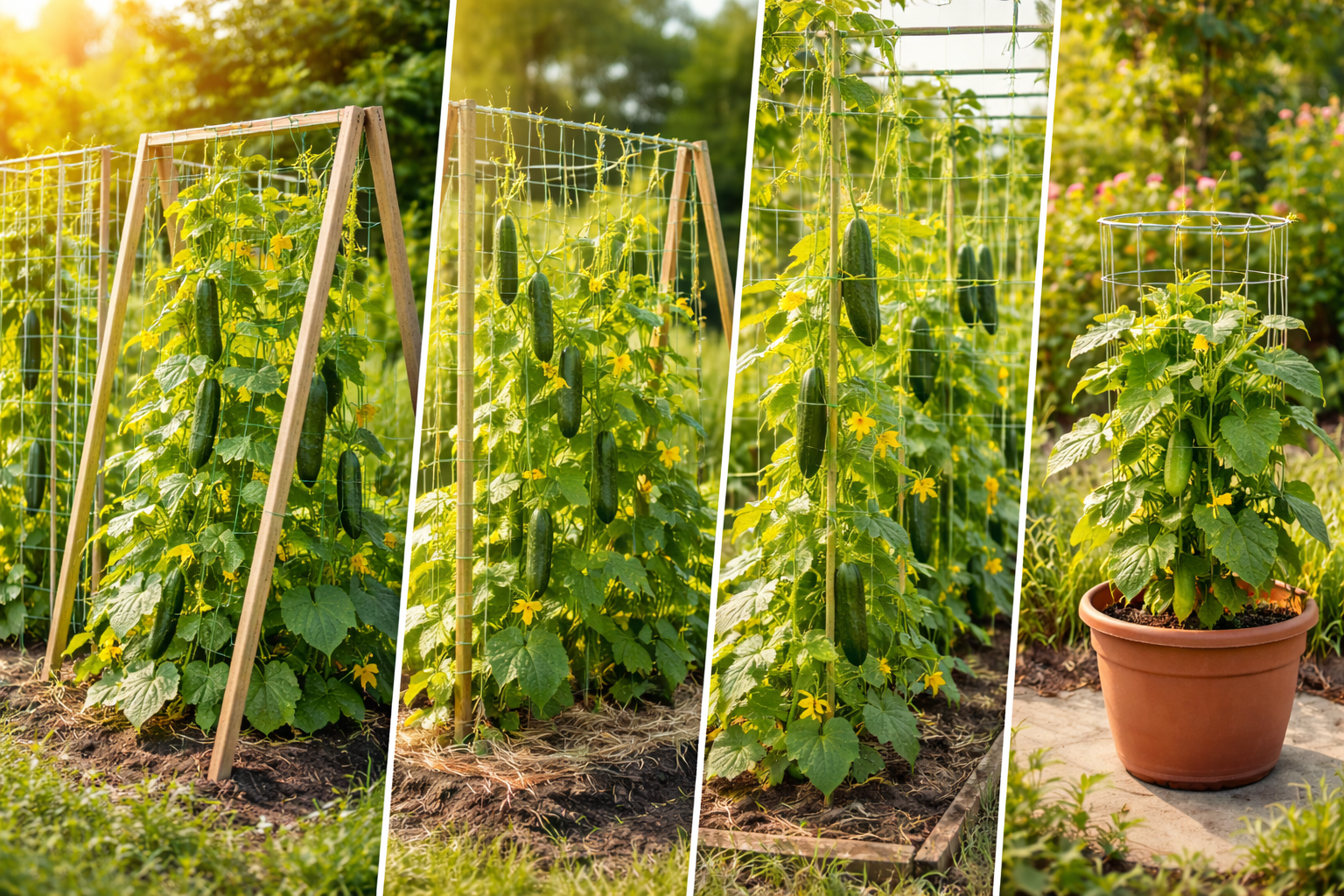
You do not need a Pinterest sculpture. You need a support that holds up under a season of growth and still lets you harvest without a wrestling match.
Wire panel or rigid metal trellis
This is the workhorse. It suits vigorous vining cucumbers in beds and raised beds. It stays upright, it gives tendrils plenty to grab, and it’s easy to reach through at harvest. The tradeoff is bulk. It stores like a stubborn piece of furniture.
A-frame trellis
Great when you want two growing faces and a tunnel-like shape. It works well in raised beds and kitchen gardens where access from both sides matters. The downside is footprint. It saves vertical room but claims ground space at the base.
Netting stretched between posts
Cheap, light, and useful if it’s pulled tight. That last part matters. Slack netting sags as the season builds, and then the whole thing becomes a green hammock. Fine for lighter loads. Less convincing for strong vines and long seasons.
Vertical strings
Best in greenhouses or anywhere you have an overhead anchor. This is tidy, space-saving, and lovely for controlled training. Outdoors, it only works if the top support is solid. A string hanging from a shaky frame is just theatre.
Tomato cage or single stake
Best for compact or bush types, or for one small plant in a container. For strong vining cucumbers, this is usually a compromise. Sometimes it’s a useful compromise. Sometimes it’s the gardening version of wearing shoes two sizes too small and pretending they’ll stretch.
Fence as support
Very practical if the fence is open enough for vines to grab and for you to harvest through. Fine option. Just watch light, airflow, and whether fruit ends up trapped in awkward spots.
A lot of home gardeners land in the 4 to 6 foot range for trellis height, which lines up with common home-garden guidance from experienced growers and extension-style recommendations. That height usually gives enough climb without turning harvest into ladder work.
Use this quick filter:
- Best strength: rigid panel, sturdy A-frame
- Best for small-space growing: vertical string or upright trellis
- Best budget option: taut netting on proper posts
- Best for compact plants: short cage or stake
- Easiest harvest: open panel with hand access
Common mistake: Picking the support that looks neat in spring instead of the one that will still look sane in late July.
Set it up early, or the plant will make the decision for you
The best time to install support is at planting, or very soon after.
That advice is not fussy. It’s practical. Once cucumber roots settle in and the vine begins to run, adding a big structure gets awkward. You risk root disturbance, stem damage, and the kind of patchwork fix that looks temporary because it is temporary.
The Royal Horticultural Society recommends vertical training for cucumbers where it suits the growing method, and that lines up with what works in the garden: put the support in first, then let the plant grow into it, not around it.
A few setup rules make life easier:
- Place the support close enough that young tendrils can find it without a long reach.
- Brace or anchor the base before the plant gets heavy.
- Keep harvest access in mind. A support that hides fruit behind a tangle is annoying by week three.
- Check that the top won’t sway in wind. Small movement becomes big stress once the vine loads up.
Adding support late feels a bit like buying bookshelves after the floor is already covered in stacks. You can still improve things, but the easy part has passed.
Key takeaway: Early support is less work, less risk, and usually a lot prettier.
How to train cucumber vines so they climb instead of collapse
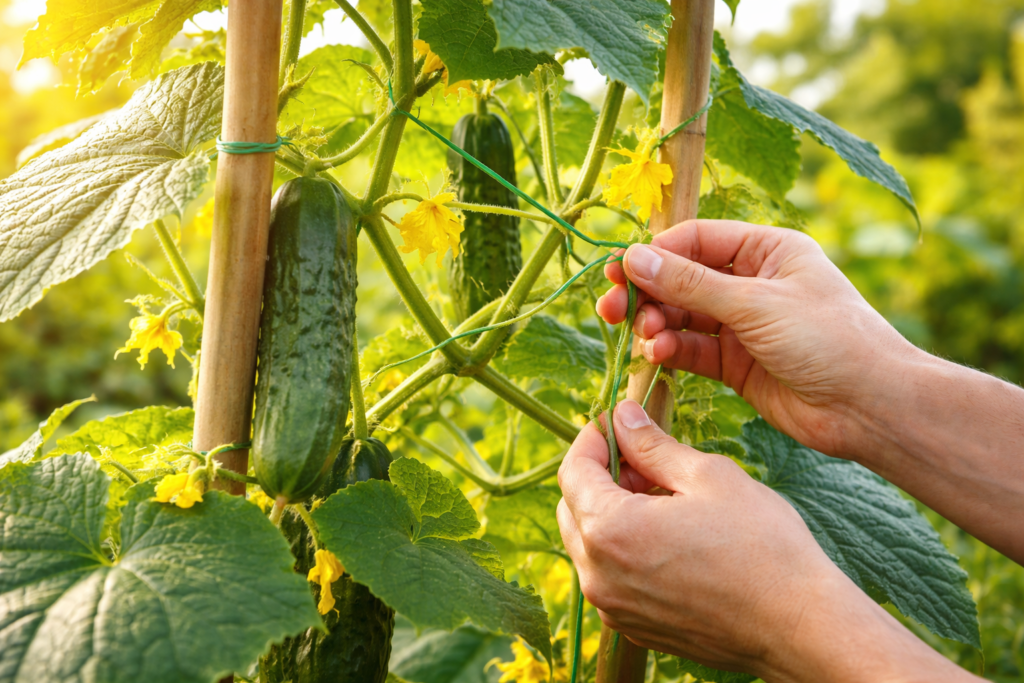
Cucumbers do climb, but young vines often need a nudge. Not a wrestling move. A nudge.
When growth is quick, check the plant every few days. Guide the main vine toward the support. If tendrils are already grabbing, let them do the job. If not, weave the vine gently through the structure or use a soft tie with slack. The stem should be held, not strangled.
This is where people get heavy-handed. They see the vine leaning the wrong way, so they bend it hard toward the trellis, cinch it in place, and crack the stem. Then the plant sulks. Fair enough.
A simple routine works well:
- Find the main vine and decide where you want it to climb.
- Guide it a little at a time. Don’t force a sharp bend.
- Use soft ties only where the plant truly needs help.
- Keep checking as new growth stretches past the old tie points.
Outdoor cucumbers in ordinary beds usually need less fuss than greenhouse cucumbers on strings. In a greenhouse or high tunnel, more active training and occasional pruning make sense because the whole system is tighter. Outdoors, many plants do fine with light guidance and then take over from there.
If you’ve ever asked, “Do I need to tie cucumbers up, or will they climb on their own?” the honest answer is this: they often climb on their own once they catch, but getting them to catch early can take a bit of hands-on steering.
Common mistake: Pulling a thick stem onto a support in one motion. Slow guidance beats dramatic correction every time.
Spacing, airflow, and why support is not just about saving space
Saving room is the obvious win. It isn’t the only one.
Once cucumbers climb, leaves dry faster, fruit stays cleaner, and harvesting gets easier because you can actually see what’s ready. Better airflow matters too. The University of Minnesota Extension notes that airflow and leaf wetness play a role in disease pressure in cucurbits. A plant trained upward has a better shot at drying out after rain, dew, or a sloppy watering session.
Spacing changes with vertical growing. Clemson’s cucumber guidance gives a useful frame: trellised cucumbers can often be spaced tighter than sprawling ones. A rough working range for many home setups is about 12 to 18 inches between vertically grown plants, while ground-sprawling plants usually need more room.
That doesn’t mean you should cram them together and call it clever. If the variety is aggressive, your climate is humid, or the bed already feels crowded, give the plants more breathing room. Tight spacing only works if the support does its job and the canopy stays open enough.
Think of vertical growing like stacking chairs in a small room. It creates space, but only if the stack stays orderly. If the chairs start sliding sideways, you’ve gained nothing.
Quick rules that actually help
- If the bed stays damp or shaded, lean toward wider spacing.
- If the variety is vigorous, choose stronger support and don’t crowd the row.
- If you’re growing vertically to save space, keep the foliage trained and harvest often.
- If airflow is poor, support alone won’t fix everything. Spacing still matters.
The support is doing more than holding vines up. It’s shaping the whole growing environment.
The right support for containers, raised beds, and small spaces
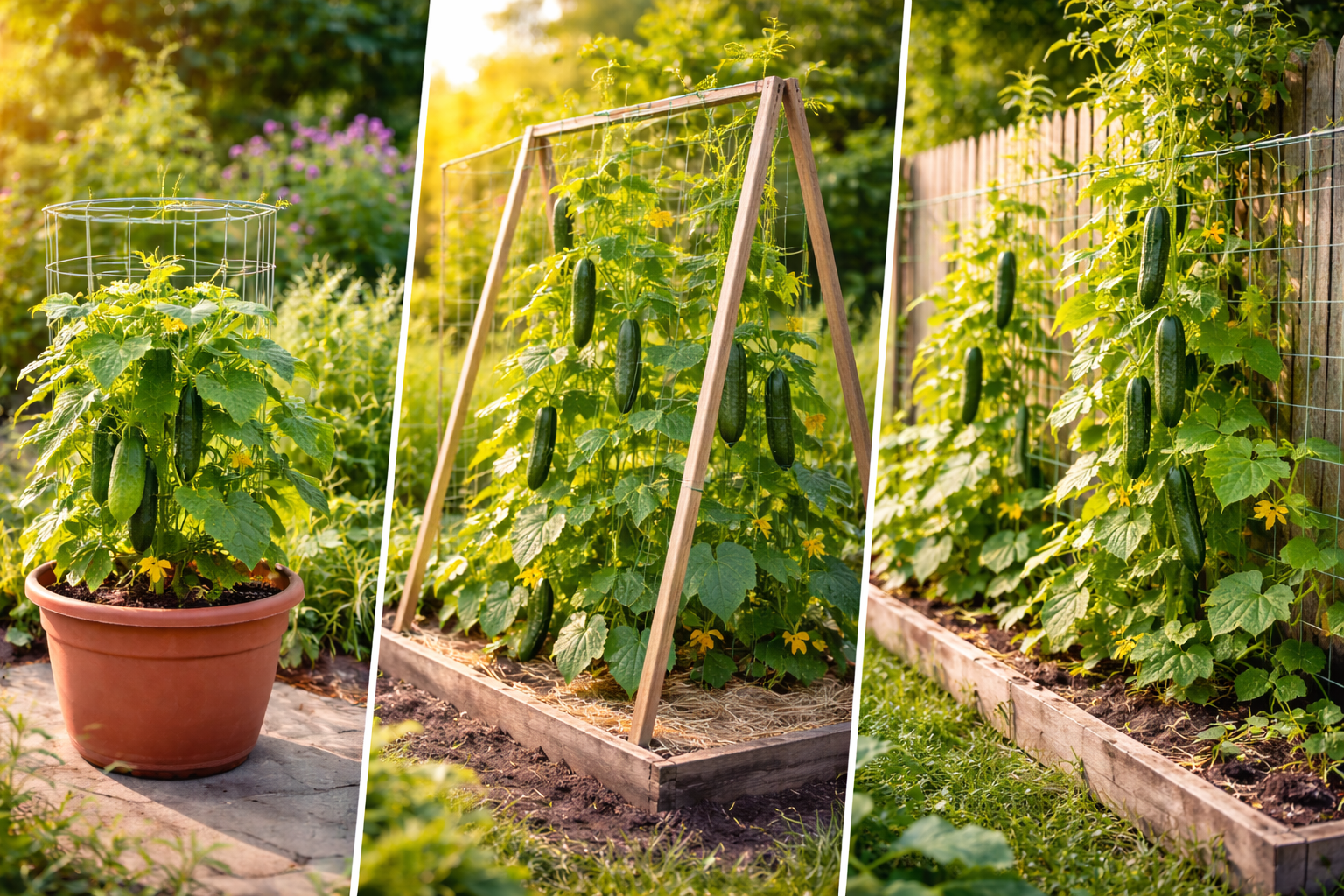
Support choice shifts once the garden gets smaller.
In a container, the structure has to work with the pot, not just with the plant. A tall vine on a light, top-heavy trellis can turn the whole setup into a wobbling problem. The support needs a secure base, and the container needs enough volume to keep the plant stable. If the pot is undersized, the trellis can look fine right up to the moment the whole thing starts leaning.
If you’re sorting that out, it helps to check what size container to grow cucumbers. Pot size and support strength are tied together more than most people expect.
For containers, good choices are:
- short to medium trellises anchored into the potting setup
- heavy cages for compact varieties
- single-plant vertical systems where the pot and support behave like one unit
For raised beds, the easiest wins are shared trellises, A-frames, and rigid panels fixed to the bed or to sturdy posts. You get better use of the bed edge, and you can train multiple plants along one structure.
For fence-line growing, the fence can do the heavy lifting if it has openings for tendrils and room for your hands. Harvest access matters here. A fence that traps fruit behind boards gets old fast.
For greenhouses or tunnels, vertical strings are hard to beat if you already have overhead support. Clean, controlled, and space-savvy.
Here’s the blunt version:
- Best for a small patio: compact bush cucumber with a cage or a short trellis
- Best for one vigorous plant in a pot: anchored upright trellis with a roomy container
- Best for a productive raised bed: rigid panel or A-frame
- Best for renters using existing structures: an open fence or freestanding support that does not need permanent fixing
Small spaces reward clean choices. The wrong support feels twice as wrong when every inch counts.
What not to do when supporting cucumber plants
Most support failures are not mysterious. They’re ordinary mistakes repeated in slightly different costumes.
Don’t wait too long.
The longer you wait, the thicker the stems get and the less cooperative the plant becomes.
Don’t use a support that is too short or too soft.
Cucumber vines do not stop just because the trellis gave up. They keep growing, then flop, twist, and spill over into a heap.
Don’t crowd the plants just because they’re vertical.
A trellis is not magic. If leaves are packed together and staying wet, you still have a crowding problem.
Don’t tie stems tightly.
Soft ties with room to grow are fine. Tight loops cut into stems and create damage you won’t enjoy looking at later.
Don’t assume every cucumber needs a fruit sling.
For cucumbers, the support structure matters far more than supporting each fruit one by one. Fruit slings come up more with heavier crops like melons. The University of Wisconsin’s vertical gardening guidance reflects that reality.
Don’t pretend “more twine” fixes a weak frame.
If the issue is structural, string is decoration.
Common troubleshooting questions usually trace back to one of those errors:
- “Why are my cucumber vines falling over?” Usually weak support, late training, or both.
- “My trellis is too short. Now what?” Guide vines over the top or sideways. Don’t rip the whole setup apart unless it’s failing.
- “Can I still add a trellis now?” Yes, but go slowly and accept that the rescue will look less tidy than an early setup.
Common mistake: Trying to fix a strength problem with clever tying instead of a better frame.
What to do if your cucumbers already sprawled, outgrew the trellis, or look overloaded
This is the part people actually need, because gardens are messy and timing is imperfect.
If the vines already sprawled, don’t try to force the whole plant upright in one go. That’s how stems snap and roots get disturbed. Improve the setup in stages.
- Place or reinforce the new support beside the plant as gently as you can.
- Lift one section of vine at a time.
- Guide the healthiest stems onto the support first.
- Tie only where the plant truly needs help staying in place.
- Let the rest settle before doing more.
If the plant has already reached the top of the support, you usually have three decent options: let it drape over, guide it sideways, or pinch only if space is genuinely tight and the plant is becoming unmanageable. For most home gardens, draping over the top is perfectly fine if the support is strong enough.
If the plant looks overloaded, ask what “overloaded” means. Heavy fruit? A weak frame? Too much leafy growth packed into one damp corner? Those are different problems. Don’t treat them as one blob.
There are times to leave part of the plant alone. If the stems are thick, brittle, and full of fruit, a partial rescue is better than a full rewrite. Lift what you can. Improve airflow. Keep harvesting. Accept a little untidiness. Gardens are living things, not showroom displays.
Edge cases matter here:
- Windy sites: rigid supports beat tall, flexy ones.
- Large-fruited varieties: frame strength matters more than anything fancy.
- Greenhouse strings: keep training up to date or the vine will become a knot with ambitions.
- Mixed plantings: if cucumbers are weaving through tomatoes or squash, rescue gets harder and airflow drops fast.
If the plant still looks weak after you improve support, the issue may not be the support at all. In that case, this guide on why cucumbers aren’t growing is the better next stop.
Key takeaway: A late rescue still helps. Just don’t expect a wild midsummer cucumber to behave like a neatly trained greenhouse plant by dinner time.
FAQ
Is a tomato cage enough for cucumber plants?
For bush cucumbers or compact plants, often yes. For vigorous vining types, usually not for long. It can work as a stopgap, but it often ends up too short and too weak once the season gets moving.
How tall should a cucumber trellis be?
Many home gardeners do well with something around 4 to 6 feet tall. That gives climbing room without making harvest awkward. If your variety is especially vigorous, the frame strength matters as much as the height.
Do cucumbers need individual fruit support?
Most don’t. Focus on giving the vine a solid structure. Individual slings are more often used for heavier fruits such as melons. For cucumbers, a strong trellis and decent training do most of the work.

Michael Rowan is the founder and lead writer at The Garden Playbook. He has spent 10+ years growing plants across a range of settings — from indoor houseplants and container gardens to raised beds and in-ground plots — adapting methods to different light levels, seasons, and growing conditions.
Michael focuses on practical, experience-based guidance grounded in fundamentals: soil health, watering strategy, plant nutrition, pruning and propagation, and integrated pest management (IPM). His work aims to help readers diagnose common problems (such as yellowing leaves, stunted growth, or pest pressure) and apply straightforward solutions that are realistic for home gardeners.
At The Garden Playbook, Michael develops tutorials and plant guides using a consistent process: documenting real outcomes where possible, explaining the “why” behind each step, and verifying higher-risk topics (such as plant toxicity or pest treatment options) against reputable horticultural references.