
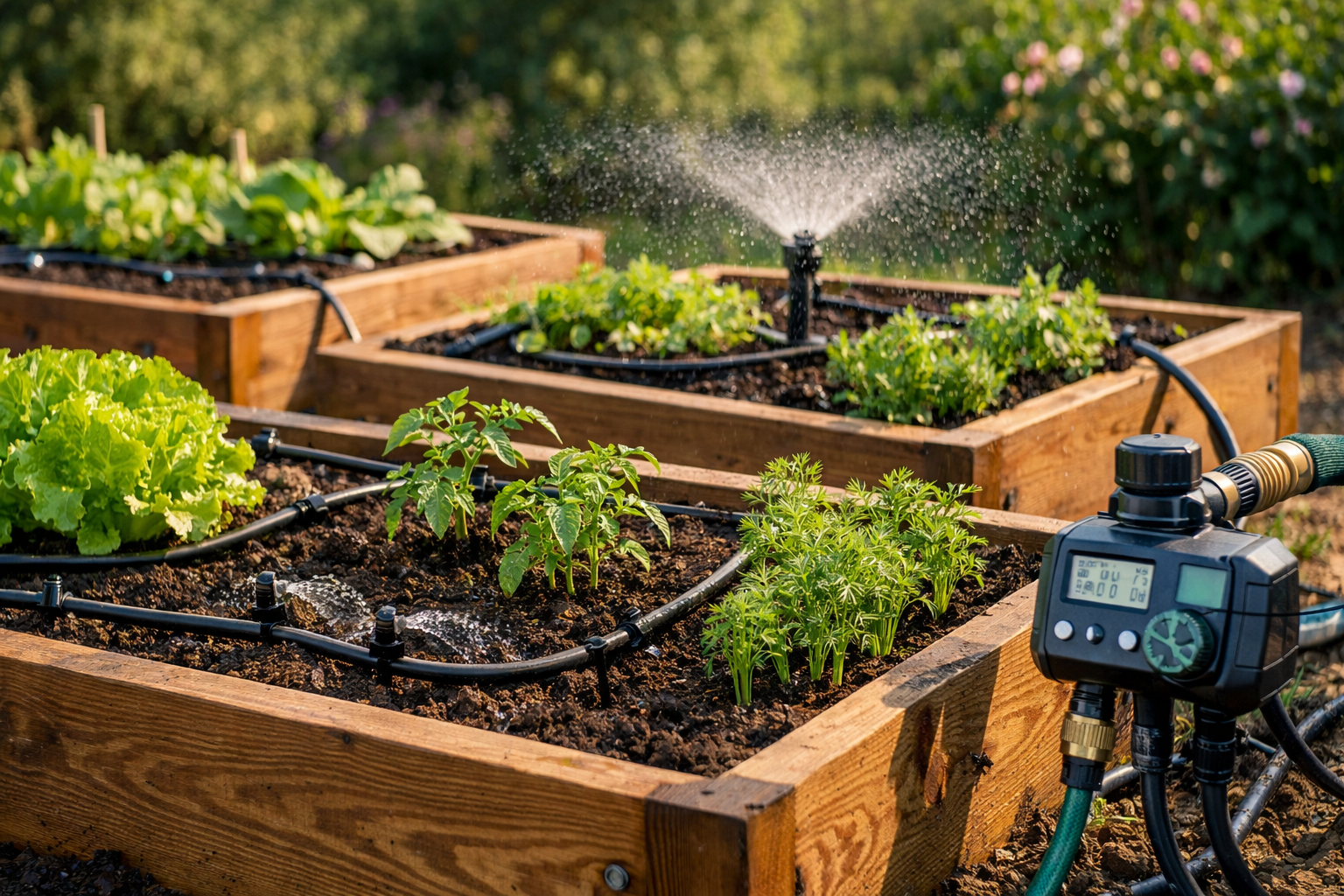
The annoying part is not dragging the hose. It is thinking you watered enough, then finding one corner of the bed bone-dry by late afternoon while the middle still feels cool and damp.
If you’re here for the short answer on the best irrigation for raised beds, use a drip setup with a hose timer, filter, pressure regulator, and a mulch layer on top. That is the clean default for most vegetable beds because water lands at the root zone instead of all over the leaves and paths. A single small, level bed is the main exception. In that case, a simple soaker hose can still make a lot of sense.
That broad answer is right. It is also incomplete. A 4×8 bed of lettuce and basil is not asking for the same system as six raised beds full of tomatoes, cucumbers, peppers, and patchy spacing.
- Which watering method fits your beds instead of just sounding good on paper
- When drip beats soaker hose, and when it really doesn’t
- How to set runtime without guessing or drowning the bed
- Which parts stop the usual headaches before they start
- The mistakes that quietly waste water and stress plants
- Three raised-bed kits worth a serious look
Best Suggestions Table
| Product | Best for | Action |
|---|---|---|
| Orbit 61014 Automatic Garden Box Irrigation System | One raised bed and the fastest all-in-one start | Check Price Review |
| Rain Bird GARDENKIT Raised Bed Garden Watering Kit | Most gardeners who want a proper drip setup | Check Price Review |
| Gardener’s Supply Snip-n-Drip Soaker Hose System | Odd shapes, simple installs, and low-fuss beds | Check Price Review |
Use the buttons to jump to the buying notes and full reviews fast.
At a glance
Choose drip if you have more than one bed, mixed crops, odd dry spots, or you want a timer to do the boring part.
Choose a soaker hose if you have one or two small, level beds and you want the easiest install with the fewest parts.
Choose ollas only for tiny beds, herbs, or backup moisture during travel. They are handy, but they are not a full answer for thirsty summer vegetables.
The best irrigation for raised beds, in one useful answer
The United States Environmental Protection Agency says microirrigation systems use 20% to 50% less water than conventional sprinkler systems. That matters here because raised beds dry faster than in-ground soil, and the whole point is to put water where plants can use it instead of throwing it into the air or onto leaves.
So yes, drip irrigation is the best default. It waters the root zone, it plays well with timers, and it scales from one bed to several without turning into hose spaghetti.
I have set up both drip and soaker systems in small kitchen gardens, and the pattern repeats. A soaker hose feels brilliant for about a week because it is so simple. Then the garden grows, one bed gets thirstier, one corner keeps drying out, and you start wishing you had a system that could be tuned instead of merely laid down.
Still, a single 4×8 bed on level ground is not a referendum on irrigation theory. If that is your setup, a decent soaker hose can be perfectly fine. It is cheap, fast, and forgiving enough for beginners.
Fast fit rule: One simple bed often does well with a soaker hose. Multiple beds, mixed crops, or travel plans push the answer toward drip.
Sprinklers sit at the bottom of the list for most raised vegetable beds. They wet foliage, miss the root zone in windy weather, and make watering feel finished before the soil is actually well soaked. Ollas are charming and useful in the right niche, but they are better as a tiny-bed or vacation helper than a full-system answer.
Drip irrigation vs soaker hose vs sprinklers vs ollas
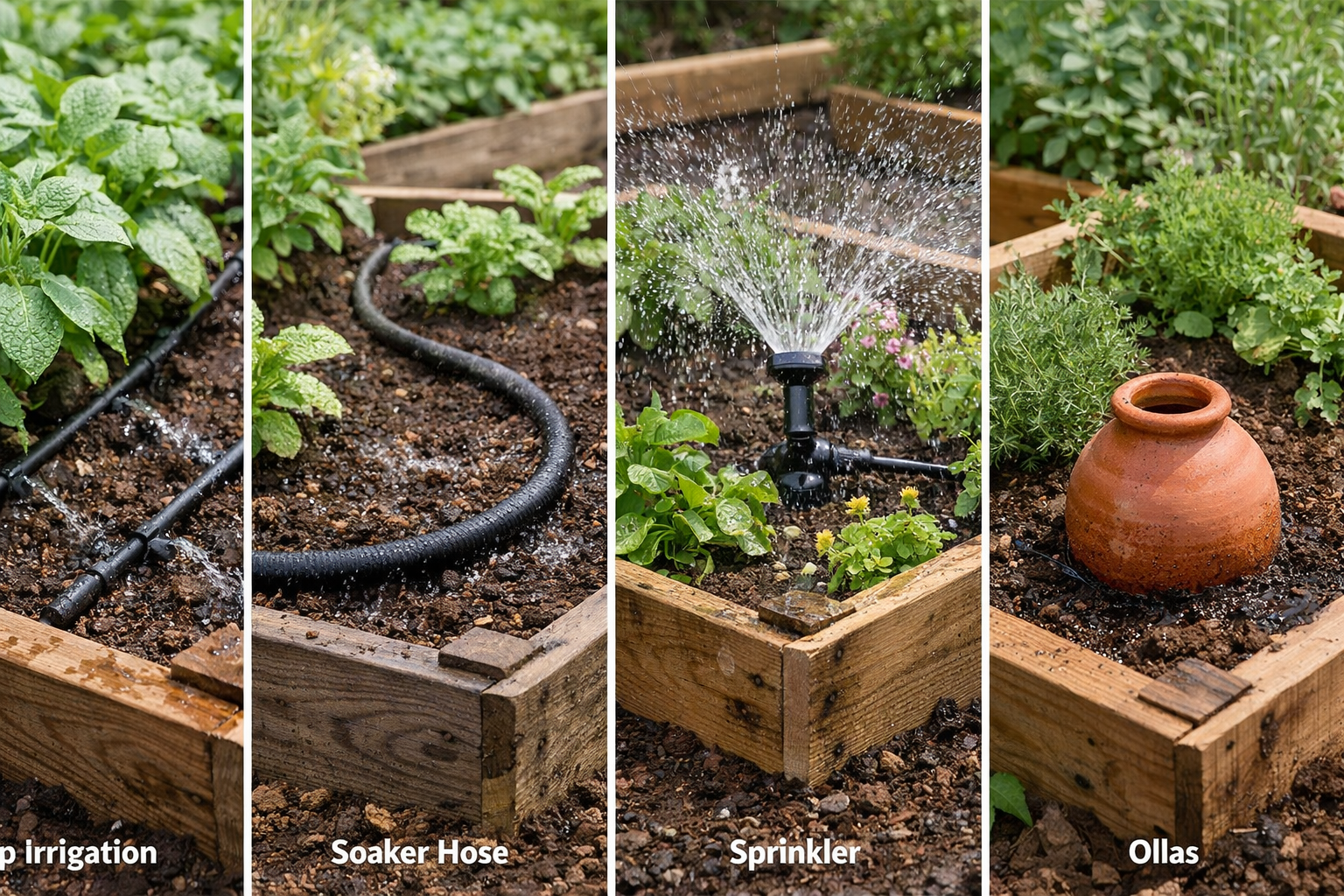
The cleanest way to compare these is not by asking which one is “best.” Ask what kind of headache each one prevents.
| Method | Wins on | Loses on | Best fit |
|---|---|---|---|
| Drip irrigation | Control, expandability, timers, mixed crops | More parts, more setup | Most raised-bed gardens |
| Soaker hose | Low cost, quick install, simple beds | Less precise, harder to tune, weaker on slopes | One or two small level beds |
| Sprinklers | Fast broad coverage | Wets leaves, wastes water, poor target control | Temporary seed-starting or emergency use |
| Ollas | Tiny spaces, steady moisture, low-tech backup | Limited coverage, refill chore | Herb beds, very small raised beds |
Drip irrigation wins once you care about control. You can route tubing where crops actually sit, run a watering grid in square-foot beds, and tweak the system later without ripping the whole thing up. That matters more than people expect. A raised bed rarely stays in its original neat little plan.
Soaker hoses win on speed. You roll them out, snake them through the bed, hook them up, and you’re basically done. That ease is real. So is the tradeoff. They are less exact, they are not as easy to balance across longer or more complex layouts, and they can be a little annoying once you start chasing even coverage.
Sprinklers still have a narrow lane. They can help with broad surface moisture when you are trying to germinate a bed of tiny seeds. Past that, they are usually the wrong tool for a raised vegetable bed.
Ollas are one of those ideas that seem too simple to work, then work nicely in a narrow slice of garden life. They are great in herb beds, compact setups, and travel weeks. They are not enough by themselves for a heavy summer planting of tomatoes and cucumbers.
Use this fit test to choose the right system for your beds
If you want a quick answer without comparing five product pages and three forum threads, run through these questions.
Count the beds and cut the decision in half
If you have one bed, you can lean simple. If you have several beds, simplicity starts to look a lot like repeat labor. That is the point where a timer-ready drip system starts paying you back.
Look at crop spacing instead of bed size alone
A bed packed with lettuce, basil, and scallions likes broad, even moisture. A bed with tomatoes, peppers, and a few basil plants wants more targeted watering. This is where emitter tubing or a drip grid earns its keep.
Be honest about how much tinkering you can tolerate
Some gardeners enjoy adjusting emitters and reworking lines. Some do not, and fair enough. If you want the fewest moving pieces, a soaker hose or all-in-one grid kit may fit better than a fully custom drip layout.
Factor in slope, heat, and travel
Sloped beds punish loose, low-control watering. Hot patios and exposed beds burn through moisture faster. Travel means a timer is no longer a nice extra. It becomes the thing that keeps your crops from going sideways while you’re gone.
Quick chooser
- One small level bed, low fuss: soaker hose or a simple closed-loop grid
- Two to six beds, mixed crops: drip system with timer
- Square-foot garden: grid or close parallel runs
- Odd-shaped bed: cut-to-fit soaker or flexible drip tubing
- Away often: timer-based drip first, olla second
One more thing. The crop choice can make a simple watering plan feel either easy or maddening. Beds planted with easiest vegetables to grow for beginners usually tolerate small watering mistakes better than a bed packed with thirsty fruiting crops from day one.
Build a raised-bed drip setup that waters evenly and stays easy to maintain
Start with the parts that stop headaches
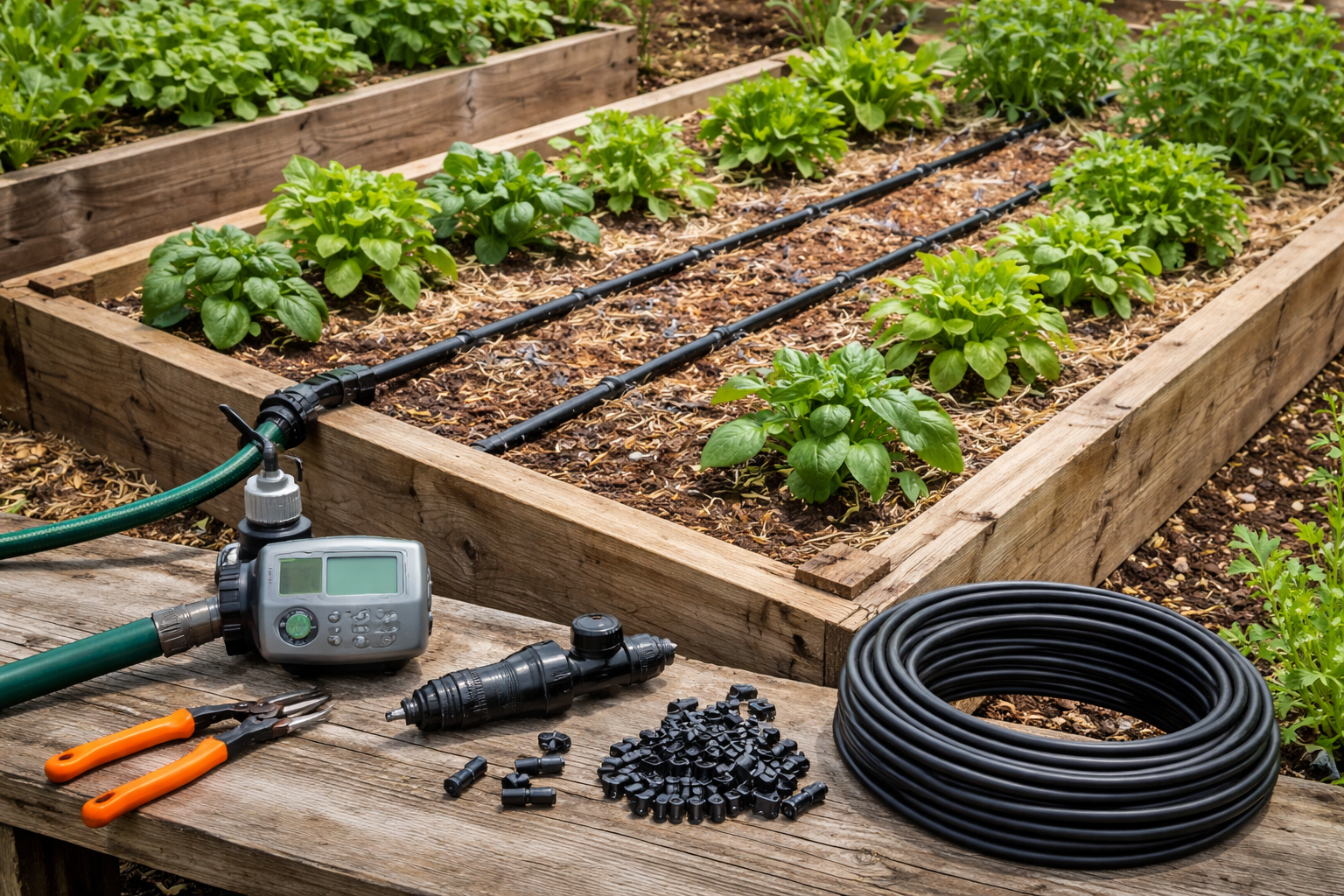
A raised-bed drip system does not need to look like a plumbing diagram. It does need a few boring parts that keep it from acting weird: a hose timer, a filter, a pressure regulator, and the tubing itself. Skip the filter and the line can clog. Skip the regulator and the system can spray or pop in ways that make you mutter at it.
For the bed itself, you will usually choose between emitter tubing, drip tape, and a watering grid. Emitter tubing suits mixed plant spacing. Drip tape works best when crops sit in tidy rows. A grid is fantastic for evenly planted raised beds because it spreads moisture across the whole box without much guesswork.
Lay out the wet zones before you cut anything
People often start with tubing length. Start with plant placement instead. Mark where the thirsty crops will live, where the shallow-rooted crops sit, and where you do not need much water at all. Then cut and place lines to match that map.
For a classic 4×8 bed, parallel runs across the short side often water more evenly than one long wandering line. A square-foot bed usually does well with a grid or close repeated runs, because the whole box is planted pretty evenly.
Use mulch as part of the system, not a bonus tip
Michigan State University Extension says a 3-inch layer of organic mulch reduces evaporation from the soil surface. That is not a small detail. A good mulch layer smooths out hot days, buys you time if you miss a cycle, and makes any drip or soaker setup behave better.
Note: Leave tubing visible enough that you can check for leaks and clogs, then cover the bed with mulch around it. Burying everything too deeply makes troubleshooting a pain for no good reason.
I like a setup that can be looked at in about ten seconds. If a line slips or a fitting leaks, I want to spot it fast, not excavate the bed like a tiny archaeology site.
Set your watering schedule by soil moisture, weather, and system output
The University of Minnesota notes that the average vegetable garden needs about 1 inch of water per week, which works out to about 20 gallons for a 4×8 raised bed. That is your starting point. Not your permanent timer setting.
The Royal Horticultural Society says early morning is the best time to water, and its vegetable guidance says to water thoroughly but not too often. Those two ideas matter more than any copied runtime you found on a random forum.
Use the simple gallons rule
One inch of water over one square foot equals about 0.623 gallons. So a 4×8 bed needs right around 20 gallons a week in normal conditions. A 4×4 bed needs about 10 gallons. That turns watering from vague minutes into real volume.
Runtime formula
Weekly gallons needed = bed square footage x 0.623
Weekly runtime = weekly gallons needed divided by system gallons per hour
Then split that runtime across the week based on heat, crop stage, and how fast the bed dries.
Check the soil before you chase the timer
Lift the mulch and push a finger a couple inches down. If the top looks dry but the root zone still feels evenly moist, your timer may be fine. If the surface is wet and the bed stays soggy down below, back off. Fruit set on tomatoes, peppers, and cucumbers often gets grumpy with big swings, so steady moisture matters more than heroic deep soaks followed by panic.
Adjust by growth stage, not just temperature
Seedlings and transplants need closer attention because their roots are still shallow. A mature tomato in mid-summer can handle a different rhythm. A bed of lettuce in a hot spell may need checking daily even if the formal schedule looks unchanged. That is normal. Gardens do not read timers.
Fast fit rule: If you are copying somebody else’s minutes, stop. Match water volume to bed size, then fine-tune by checking soil under the mulch.
The best raised-bed irrigation setup for one bed, several beds, square-foot gardens, and travel weeks
One bed and no patience for fiddly parts
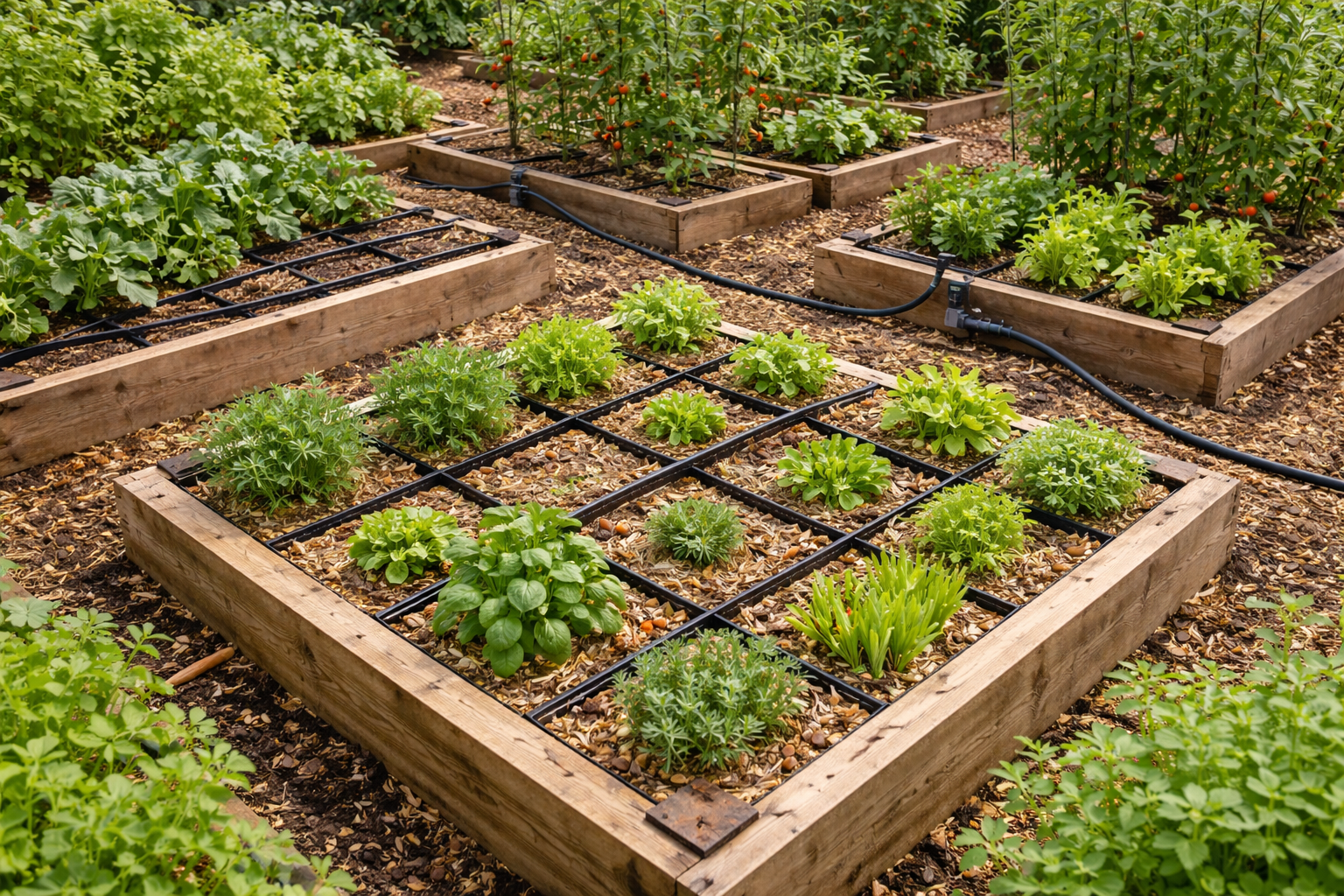
This is where simple wins. A soaker hose or a grid-style kit is usually enough. You can keep the layout neat, the part count low, and the watering reasonably even without falling into custom-build territory.
Several beds with mixed crops
This is drip country. Once you are watering tomatoes in one bed, herbs in another, and a dense square-foot bed nearby, you want the ability to route, split, and tune lines. A timer plus drip stops the daily shuffle from becoming the whole hobby.
Square-foot gardens
These beds punish lazy spacing. A single line down the center usually leaves edge squares thirstier than the rest. A grid, closed loop, or several short parallel runs does a much better job. If every square is planted, the watering pattern should act like every square matters.
Travel weeks and summer holidays
If you are gone often, drip with a timer is the best answer. Ollas can help in tiny beds, but they are not magic. A bed full of fruiting vegetables in heat wants a scheduled system, not a hopeful clay pot and a prayer.
Tomatoes and other top-heavy crops
Tomatoes do better when the root zone stays steadier and the foliage is not getting sprayed for no good reason. Pairing root-zone watering with solid support is a good combo, and the setup works even better when the plants are held upright on one of the best trellis for tomatoes instead of sprawling into the dampest part of the bed.
Raised-bed irrigation mistakes that quietly waste water or stress plants
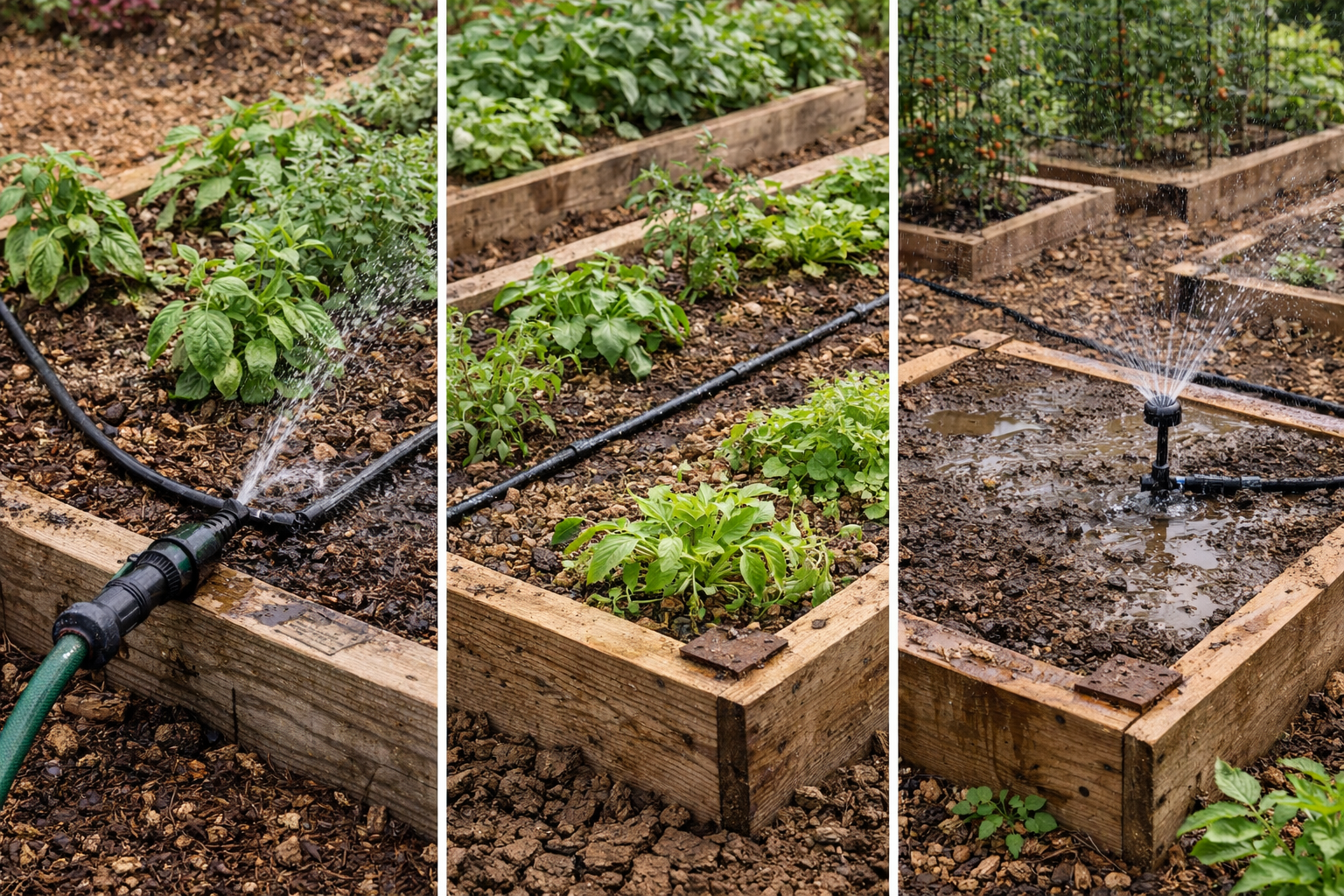
Watering by habit instead of by bed response
The timer says Tuesday, Thursday, Saturday, so the bed gets watered. That sounds organized. It can still be wrong. Weather shifts, plants size up, mulch breaks down, and a setup that worked in late spring can be too wet or too dry by July.
Skipping the filter and regulator
This is one of those mistakes that feels like saving time right up until the system starts acting messy. Drip gear likes lower pressure and cleaner water. Those little support parts are not glamour items, but they are the difference between calm watering and random nonsense.
Using the wrong pattern for the crop layout
A single line works for tidy rows. It works badly for a crowded salad bed planted wall to wall. The bed layout should decide the watering layout, not the other way around.
Leaving the bed bare and blaming the irrigation
When the sun is hammering the soil surface, the system has to fight harder just to hold steady moisture. Bare raised beds swing faster. Mulched beds are calmer. You can feel the difference with your hand, which is usually more persuasive than any chart.
Reading every wilt as thirst
Heat stress and water stress do not always look the same, but people treat them like twins. Plants can wilt in the afternoon and still have adequate moisture at the root zone. Check the soil before adding more water. Overwatering vegetables is slower and sneakier than underwatering, which is why people miss it.
Quick diagnosis
- Dry, crumbly soil a few inches down: add water or lengthen runtime
- Wet surface and soggy soil below: shorten runtime or reduce frequency
- Dry corners and happy center: change line layout, not just schedule
- Healthy leaves with brief afternoon droop: check again in the evening before reacting
Raised-bed irrigation kits and add-ons worth considering
For this kind of article, I care about five things more than flashy packaging: coverage that fits raised beds, even watering, the right support parts in the box, ease of setup, and whether the kit is easy to adjust once the garden stops behaving like the plan. That last one matters a lot. Gardens drift. Beds get replanted. A rigid kit that cannot adapt gets old fast.
The three picks below all make sense for raised beds, but they fit different gardeners. None of them is the “winner” for everybody, and that is the point.
Orbit 61014 Automatic Garden Box Irrigation System
Editorial rating: 4.5/5
This is the pick for the gardener who wants one box, one main bed, and the least annoying setup. Orbit built this kit around a closed-loop grid and a hose timer, and that combination makes sense for raised beds because it tackles the two beginner pain points at once: uneven coverage and forgotten watering. For a standard garden box, the system is tidy and fast to get going. You are not piecing together a timer, then guessing how to lay out a bunch of loose parts.
The reason I like it is not that it is fancy. It isn’t. It is that the kit is opinionated in a useful way. It nudges you toward even coverage in a single bed, and that is exactly where a lot of new gardeners get stuck. The tradeoff is flexibility. If you plan to branch into several beds, or if your crop spacing changes all the time, a more open drip setup will age better. But for one raised bed, or one main bed plus a few containers handled elsewhere, this is a very good starter. It is the kind of kit that gets used instead of half-installed and abandoned on a shelf.
Rain Bird GARDENKIT Raised Bed Garden Watering Kit
Editorial rating: 4.8/5
For most gardeners who already know they want drip, this is the strongest fit of the three. Rain Bird built the kit around a raised-bed footprint and pressure-compensating emitters, which is not just spec-sheet fluff. In practice, even watering across the bed is where good drip gear earns its place. A lot of cheap setups look interchangeable until you try to keep the near end and far end of a bed feeling the same.
This kit also lands in a sweet spot between structure and freedom. It gives you a real drip layout for a raised bed without turning the install into a DIY project that eats your whole Saturday. If you are growing mixed vegetables and want root-zone watering with room to tweak the pattern later, this is the one I would start with. The main catch is that it asks a little more from you than a grid-style all-in-one kit. You need to pay attention during setup, and that is fine. The payoff is a system that feels more like a long-term garden tool than a one-season shortcut. For a serious 4×8 bed, or a gardener who knows more beds are coming, this is the smartest buy of the group.
Gardener’s Supply Snip-n-Drip Soaker Hose System
Editorial rating: 4.3/5
This is the most appealing choice for gardeners who want the softness and simplicity of a soaker system, but still need something a little more customizable than a generic hose coiled in the bed. The cut-to-fit format is the whole story here. It suits odd-shaped beds, gaps between boxes, and layouts where you want water in one place and none in the walking path beside it.
I would not choose this over a good drip kit for a multi-bed kitchen garden with heavy summer crops. That is not its job. I would choose it for a gardener who wants an easy install, hates fiddly emitters, and has beds simple enough that broad slow soak beats precise plant-by-plant control. It also works well for people who tend to rework bed layouts a bit from season to season because you can cut and re-route without feeling locked into a rigid pattern. The weak spot is the same one most soaker-style systems have. You give up some precision and some long-term tuning. If that trade feels fair to you, this is a genuinely useful product. If you already know you want timer-driven control across several beds, skip ahead to full drip and save yourself the second purchase.
Short buying rule: Orbit if you want one-box simplicity, Rain Bird if you want the best all-around raised-bed drip setup, and Snip-n-Drip if odd shapes and easy customization matter more than precision.
FAQ
How many drip lines should go across a 4×8 raised bed?
Usually more than one. A single center line often leaves the edges drier than you want, especially in a fully planted vegetable bed. For a 4×8 box, parallel runs or a grid-style layout tend to give more even coverage.
Can a soaker hose run on a timer?
Yes, and that is often a good pairing for a small bed. The catch is that you still need to check the bed and adjust the schedule as weather changes. A timer does not fix uneven layout or poor moisture retention.
Do raised beds need water every day in summer?
Not always, but some do during hot spells, especially shallow beds, new transplants, or dense plantings on hot patios. The better question is whether the root zone is drying too fast. Check under the mulch and a couple inches down before adding more cycles.

Michael Rowan is the founder and lead writer at The Garden Playbook. He has spent 10+ years growing plants across a range of settings — from indoor houseplants and container gardens to raised beds and in-ground plots — adapting methods to different light levels, seasons, and growing conditions.
Michael focuses on practical, experience-based guidance grounded in fundamentals: soil health, watering strategy, plant nutrition, pruning and propagation, and integrated pest management (IPM). His work aims to help readers diagnose common problems (such as yellowing leaves, stunted growth, or pest pressure) and apply straightforward solutions that are realistic for home gardeners.
At The Garden Playbook, Michael develops tutorials and plant guides using a consistent process: documenting real outcomes where possible, explaining the “why” behind each step, and verifying higher-risk topics (such as plant toxicity or pest treatment options) against reputable horticultural references.