You see “basil companion plants” on every gardening list, tuck three or four herbs into one cute pot, and then two weeks later the basil looks sulky while the rosemary looks smug. I’ve done that one. It looks tidy on the patio and then turns into a tiny argument about water.
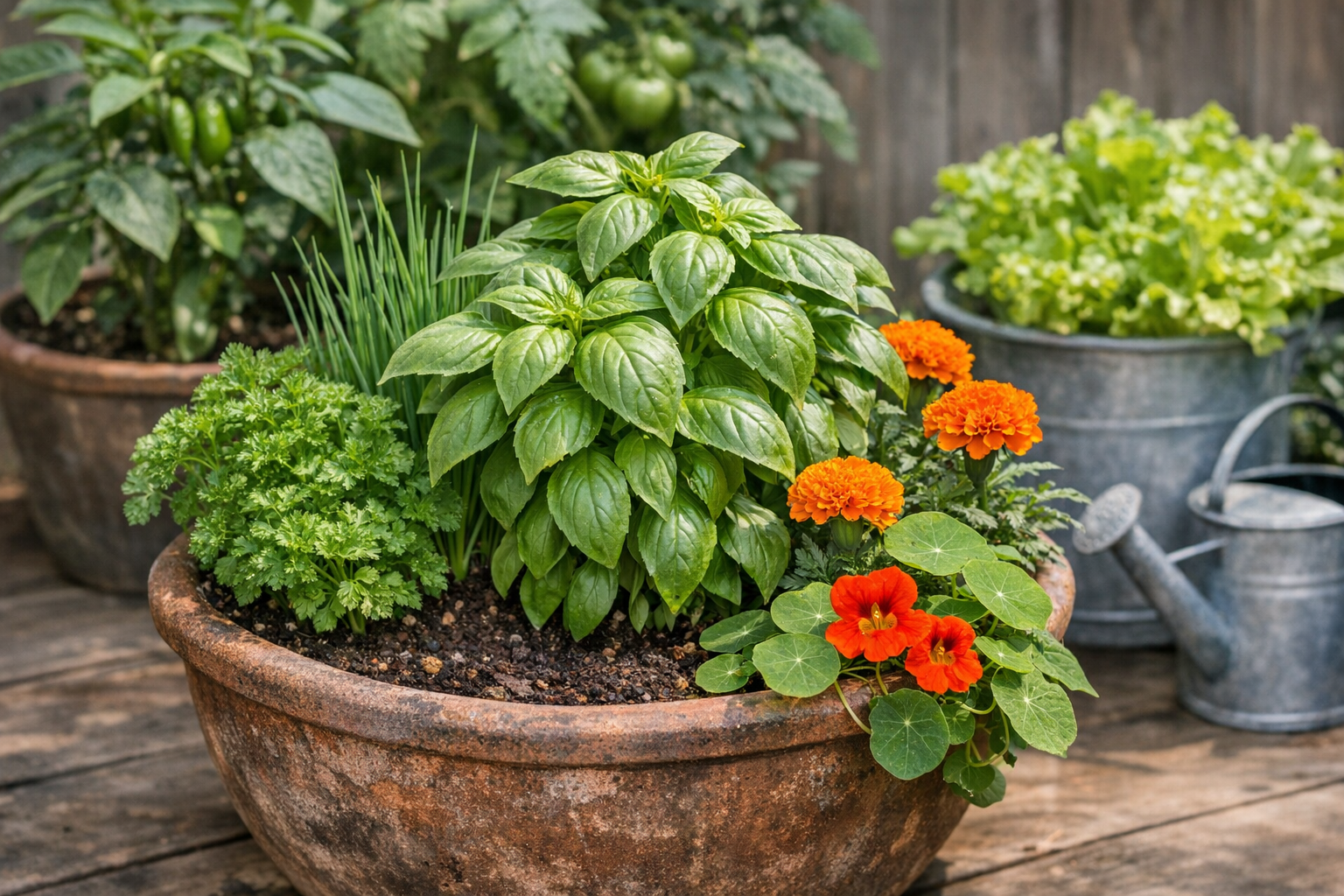
So here is the useful answer to what to plant with basil in container setups: basil shares a pot best with plants that like the same warmth, sun, and steady watering rhythm. In practice, that usually means parsley, chives, cilantro, loose-leaf lettuce, marigolds, and nasturtiums. In a truly large container, basil can also work with peppers and sometimes tomatoes. It usually does not share a small pot well with rosemary, thyme, sage, oregano, mint, fennel, or rue.
The tension is simple. A “good companion plant” is not always a good same-container plant. Container gardening changes the math because roots crowd faster, potting mix heats up faster, and watering swings hit harder.
- Which basil companions actually work in the same pot
- Which plants are better nearby in separate containers
- How container size changes what you can pair
- What not to plant with basil
- How to spot a failing combo before the whole planter goes sideways
Start here: pick basil companions fast
| If your setup looks like this | Best move | Skip this |
|---|---|---|
| One small herb pot | Basil alone, or basil with chives | Tomato, mint, rosemary |
| Medium trough or window box | Basil with parsley, cilantro, marigold, or nasturtium | A full “pizza herb” mix |
| Large summer container | Basil with pepper, or tucked into a roomy tomato planter | Anything jammed in shoulder to shoulder |
| You want easy care first | Match basil with annual, water-friendly partners | Dry-loving perennial herbs |
What to plant with basil in a container, the short answer that actually helps
If you want one quick answer, here it is: grow basil with parsley, chives, cilantro, lettuce, marigolds, or nasturtiums in the same container. Use peppers in larger containers. Use tomatoes only when the container is genuinely big enough to support both plants without turning the root zone into a hot, cramped mess.
The Royal Horticultural Society says basil does best in a warm, sunny, sheltered spot and often grows best in containers. The same guide says to keep the compost evenly watered and to space basil plants at least 10 cm apart in containers. That tells you two things right away: basil likes control, and basil does not enjoy being shoved into a crowded pot just because the tag in the nursery tray says “mixed herbs.”
So the generic answer, “plant basil with tomatoes and peppers,” is only half useful. You need one more filter.
Ask this instead: Would these plants be happy on the same watering schedule in the same amount of soil? If yes, the pairing has a shot. If no, keep them close by in separate pots.
Note: Basil is a better “roommate test” plant than people think. If the companion wants leaner, drier soil, basil usually tells on the pairing first.
Match basil with plants that want the same kind of life
The cleanest decision rule comes from herb care, not from old companion-plant folklore.
The UC Marin Master Gardeners draw a useful line between annual herbs and perennial herbs. They note that basil, parsley, and cilantro have moisture and nutrient needs similar to other annual edibles. In the same piece, oregano, thyme, and sage are described as more drought-tolerant and better suited to a more permanent herb grouping. That’s the whole game in one paragraph.
So if you’re deciding what grows well with basil in pots, start by sorting plants into three buckets:
- Same pot: similar watering needs, similar pace of growth, not a root bully
- Nearby pot: same sun, different watering rhythm
- Do not pair in one container: aggressive spreader or dry-soil specialist
I think of it like roommates. Basil is fine with someone who likes the same bedtime, same thermostat, same grocery bill. Basil is not fine living with someone who wants the windows open all night and never wants the sink full. That’s rosemary. Lovely plant. Different household.
Use these four filters every time:
- Water: Basil likes evenly damp potting mix, not repeated drought.
- Sun: Full sun is great, but one plant should not shade the other by midsummer.
- Roots: Fast, bulky roots in a small container create stress fast.
- Lifespan: Annual herbs and annual vegetables often pair better than basil plus a long-term woody herb.
Pro tip: “Good companion” and “good same-pot partner” are not synonyms. That one distinction saves a lot of basil.
Choose companions by container size, not wishful thinking
Container size decides more than the plant list does. A pairing that behaves in a wide trough can fail in a round pot that looked roomy at the garden center.
Oregon State University Extension advises choosing a container slightly larger than the combined rootballs of the plants so roots fit with a bit of extra room. The same guide points out that poor drainage and extra soggy space can push roots toward rot. In a separate container guide, the Royal Horticultural Society recommends a basil container at least 20 cm wide and deep. So the safe reading is plain: one basil plant already needs meaningful root room.
If you’re pairing basil with anything, container size has to move up the decision tree.
Small pot: Keep basil alone, or pair it with one compact partner such as chives. This is the point where many gardeners overreach. A small patio pot looks like it can hold three herbs. It really can’t for long.
Medium trough or window box: Basil with parsley, cilantro, marigold, nasturtium, or a little loose-leaf lettuce works better here. These are the containers where basil companion planting in containers starts to make sense.
Large container: Basil with peppers can work well. Basil and tomatoes can work too, but only if the tomato container is already large enough for the tomato on its own and basil is not stealing the last pocket of root space.
If you’re sizing from scratch, this basil pot size guide gives a solid baseline for one plant. If the container barely meets the minimum for basil alone, don’t turn it into a shared planter.
Quick rule: If you can’t picture both plants at mature size without leaf-on-leaf crowding, the pot is already too small.
Pick the easiest basil companions first: parsley, chives, cilantro, and lettuce
Not every basil pairing has to be clever. The easiest wins are usually the best ones.
The UC Marin guidance above is useful because it backs up what a lot of gardeners notice in practice: basil, parsley, and cilantro behave like annual edibles that want similar feeding and a steadier watering rhythm. That makes them much easier to manage together than basil plus a dry-loving Mediterranean herb.
Parsley is one of the safest answers if you’re asking what to plant with basil in container gardens. It grows at a manageable pace, looks tidy next to basil, and doesn’t demand a completely different care routine. The catch is light. Don’t let mature basil shade it into a thin little tuft.
Chives are even easier. Their upright habit takes very little horizontal space, and they don’t bulldoze the container. In a mixed herb pot, chives often act like the quiet one that makes everyone else look neater.
Cilantro can work well with basil in spring or early summer. But it usually bolts sooner in hot weather, so this is not always a full-season pairing. If your summers run hot, treat cilantro as an early-season partner rather than a long marriage.
Loose-leaf lettuce is underrated here. In a larger planter, it can fill low space around basil early in the season. Then you harvest it out before basil reaches its summer stride. It’s a smart temporary companion, not a forever one.
For day-to-day basil care, this sweet basil in a pot guide lines up well with that same idea: keep the plant warm, give it drainage, and don’t let the watering swing from dry to swampy.
Most likely cause of failure here: not a “bad companion plant,” but one plant shading the other earlier than expected.
Use peppers, tomatoes, and edible flowers when the pot is big enough to earn it
This is where most articles get a little lazy. They list tomato, pepper, marigold, nasturtium, and basil together as if they all belong in one random pot. They don’t.
The University of California Agriculture and Natural Resources gives a better real-world example. In its container gardening article, it describes an edible container using tomato as the “thriller,” basil, chives, and marigold as fillers, and trailing nasturtium as the spiller in an appropriately sized container. That wording matters. Appropriately sized is doing a lot of work there.
Basil and peppers: This is usually the easiest large-container pairing. Both enjoy warmth, sun, and regular watering. Peppers do not create the same shade wall that a vigorous tomato can.
Basil and tomatoes: Great garden neighbors. Same-container partners only in a roomy setup. The University of Florida IFAS guide says basil seedlings should be thinned to about 10 inches apart, and regular pinching keeps them compact and branching. That spacing clue tells you how quickly basil claims room. Add a tomato to a small container and the basil often gets crowded at the root zone, shaded up top, or both.
Basil with marigolds or nasturtiums: This is often the neatest edible-ornamental mix. Flowers add visual balance without the same root pressure that a second big edible crop brings. Nasturtium especially works nicely as the trailing piece in a broader planter.
If you want the basil-plus-tomato look, the container has to be sized around the tomato first. A small or moderate pot is the wrong place to test your optimism. For that part of the puzzle, this tomato container guide is useful because it frames pot size around water buffering, not just whether the plant technically fits.
My bias here: for most beginners, basil beside the tomato pot is smarter than basil under the tomato in the same cramped planter.
Keep these plants out of basil’s container, even if the label says “herbs”
Some pairings fail for boring reasons. That’s useful. It means you can dodge them.
The UC Marin herb guidance says oregano, thyme, and sage are more drought-tolerant and need less extra fertilizing than basil, parsley, and cilantro. That is the reason basil and rosemary, basil and thyme, or basil and sage often struggle in one container. The problem isn’t personality. It is care mismatch.
Rosemary: wants sharper drainage and a drier rhythm than basil. Put the two together and you usually overwater one or underwater the other.
Thyme and sage: same problem, just less dramatic at first. The pot can look fine for a while, then basil starts to sag between waterings or the woody herb sits in soil that stays too wet.
Oregano: less fussy than rosemary, but still happier on the drier side once established. In mixed herb containers, oregano also has a habit of sprawling where it pleases.
Mint: technically one of basil’s better “nearby pot” neighbors. As a same-pot plant, though, mint is a takeover artist. It doesn’t need much time to turn a shared herb pot into a mint pot with witnesses.
Fennel and rue: commonly appear on lists of what not to plant with basil. If you grow either, keep them separate and keep the container plan simple.
If you’re sorting herbs into the right containers by watering style, this rosemary-in-a-pot guide makes the contrast pretty obvious: real sun, fast drainage, and fewer waterings than your basil instincts want to give.
Worth doing: keep dry-loving herbs in one zone and water-friendly herbs in another. It saves time, and the plants stop fighting your routine.
Build the container so the pairing works past week two
A basil planter often looks best right after planting and worst right when summer gets serious. The setup is usually why.
The Royal Horticultural Society says basil likes a warm, sunny, sheltered location and evenly watered compost. Oregon State University Extension says containers need good drainage and advises emptying saucers so roots do not sit in extra water. That’s your setup checklist before you even pick the second plant.
Use a loose potting mix so roots can breathe.
Container soil that stays heavy and compact makes basil sluggish fast. A clean potting mix with drainage built in is much safer than garden soil scooped into a decorative pot.
Leave enough air around the plants so disease pressure stays lower.
The RHS and UF/IFAS guidance both point toward spacing and regular harvesting. That translates into this: don’t pack basil shoulder-to-shoulder with leafy companions. Crowding traps humidity and turns a fresh pot into a stale one.
Water by feel so the pot stays steady, not soggy.
The easiest working rule is simple: touch the top inch or two of the potting mix. If it feels dry, water thoroughly until excess drains from the bottom. If it still feels damp, wait. This matches general container guidance from UC ANR too, which notes that pots heat up faster and lose water faster than in-ground beds.
Pinch basil early so it branches instead of stretching.
The RHS says picking shoot tips keeps basil bushy and productive, and UF/IFAS says pinching the growing points helps keep it compact and extends harvest. That matters even more in mixed containers because a taller, leggier basil shades companions sooner.
For container material and setup details, this basil pot guide and this basil size guide are a good pairing. One helps you choose the pot. The other helps you picture what a mature basil plant actually asks from the space.
What to check first: If the saucer is full, the mix is dense, and the leaves are packed in tight, don’t blame companion planting yet. Fix the container setup first.
Diagnose a failing basil combo before you tear the whole pot apart
Most failed pairings aren’t mysterious. The symptoms usually point to the setup.
If this, check that
| What you see | Most likely cause | Next step |
|---|---|---|
| Basil wilts fast, companion still looks fine | Root crowding or a pot that dries too fast | Move basil to a larger pot or reduce the number of plants |
| Yellow leaves and stale, cold-feeling mix | Too much water, poor drainage, or saucer water sitting under roots | Improve drainage, empty saucers, space waterings better |
| Mildew or limp growth in a lush planter | Crowding and low airflow | Thin the pot, harvest aggressively, keep foliage drier |
| One plant takes over the whole container | Mismatch in growth speed or spread | Separate the bully plant and reset the layout |
| Basil flowers too soon and leaf growth slows | Heat stress, dry swings, or missed pinching | Pinch tips, keep watering steadier, harvest more often |
The nice part is that most of these are fixable. Basil is honest. If it is in the wrong pairing, it usually tells you fast.
One more thing. A lot of companion planting articles promise pest control and stronger flavor as if that part is settled. There are cases where mixed planting helps, and flowers can draw useful insects into the space, but don’t lean on the folklore alone. Better spacing, good drainage, steady watering, and a plant mix that shares the same rhythm usually matter more in containers.
If your basil looks rough while the companion still looks cheerful, don’t assume basil is delicate. A lot of the time the basil is just the first plant to complain about a bad roommate situation. Fair enough, honestly.
FAQ
Can basil and mint grow together in a container?
They can for a short stretch in a large pot, but it usually gets annoying. Mint spreads fast, competes hard, and changes the balance of the container. Basil and mint are better as nearby plants in separate pots.
Can basil and parsley grow together in one pot all season?
Yes, this is one of the safer same-pot pairings if the container is large enough for both plants to mature without crowding. Give them full sun, drainage, and enough space that basil doesn’t shade the parsley into a weak clump.
Can basil and rosemary grow together if the container is large?
Size helps, but it does not fix the main conflict. Rosemary likes a drier, sharper-draining rhythm than basil. In one container, you usually end up watering for basil and annoying the rosemary, or watering for rosemary and stressing the basil.

Michael Rowan is the founder and lead writer at The Garden Playbook. He has spent 10+ years growing plants across a range of settings — from indoor houseplants and container gardens to raised beds and in-ground plots — adapting methods to different light levels, seasons, and growing conditions.
Michael focuses on practical, experience-based guidance grounded in fundamentals: soil health, watering strategy, plant nutrition, pruning and propagation, and integrated pest management (IPM). His work aims to help readers diagnose common problems (such as yellowing leaves, stunted growth, or pest pressure) and apply straightforward solutions that are realistic for home gardeners.
At The Garden Playbook, Michael develops tutorials and plant guides using a consistent process: documenting real outcomes where possible, explaining the “why” behind each step, and verifying higher-risk topics (such as plant toxicity or pest treatment options) against reputable horticultural references.