
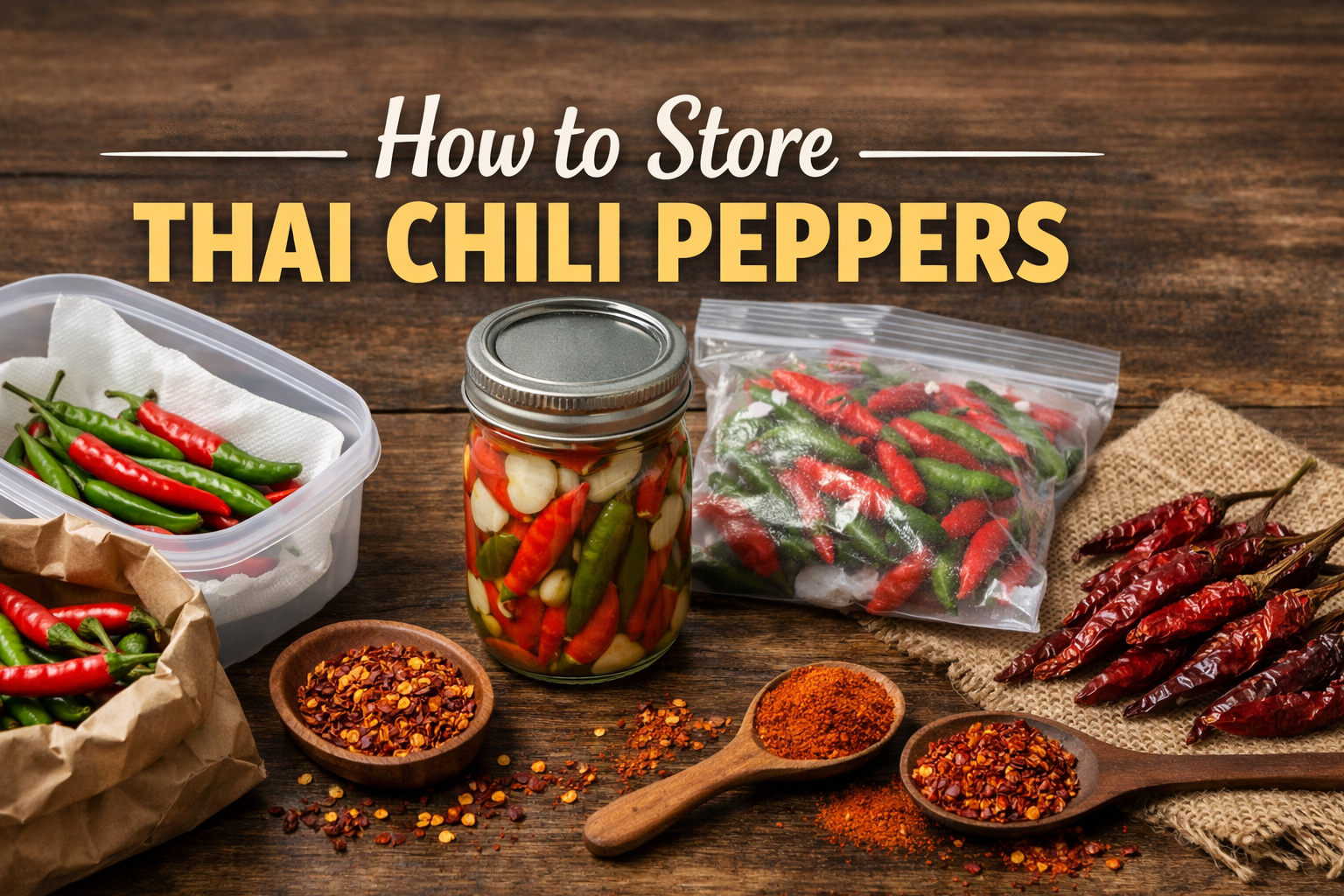
Thai chilies have a way of going from perfect to tired in one lazy week. You buy a handful for one curry, use four, and the rest sit in the drawer until they look older than they are.
The plain answer to how to store Thai chili peppers is this: keep whole peppers dry in the fridge for the next week or two, freeze them for cooked dishes later, dry them for flakes or powder, and pickle them only when that tangy finish is actually part of the plan. That broad answer is right. It is also incomplete.
The best storage method changes with one thing most articles rush past: what you plan to do with the peppers. Fresh crunch, sharp raw heat, freezer convenience, shelf-stable dried chilies, ready-to-use pickled heat, they are not the same job.
- How to pick the right storage method in under a minute
- How long whole and cut Thai chili peppers actually last
- When freezing is smart and when it wrecks what you wanted
- How to dry or pickle peppers without turning them into a science project
- What spoilage looks like before it becomes a bad decision
Fast pick: use this and move on
| Need | Best move | Why |
|---|---|---|
| Using them this week | Refrigerate whole and dry | Best shot at keeping fresh texture |
| Using them in curries, stir-fries, sauces, or pastes later | Freeze whole | Keeps heat and flavor with very little prep |
| Want pantry storage | Dry them fully | Great for chili flakes, powder, and rehydrating |
| Want ready-to-use spicy condiment | Pickle with a tested recipe | Changes the flavor on purpose, not by accident |
Choose the storage method that matches when and how you’ll use them
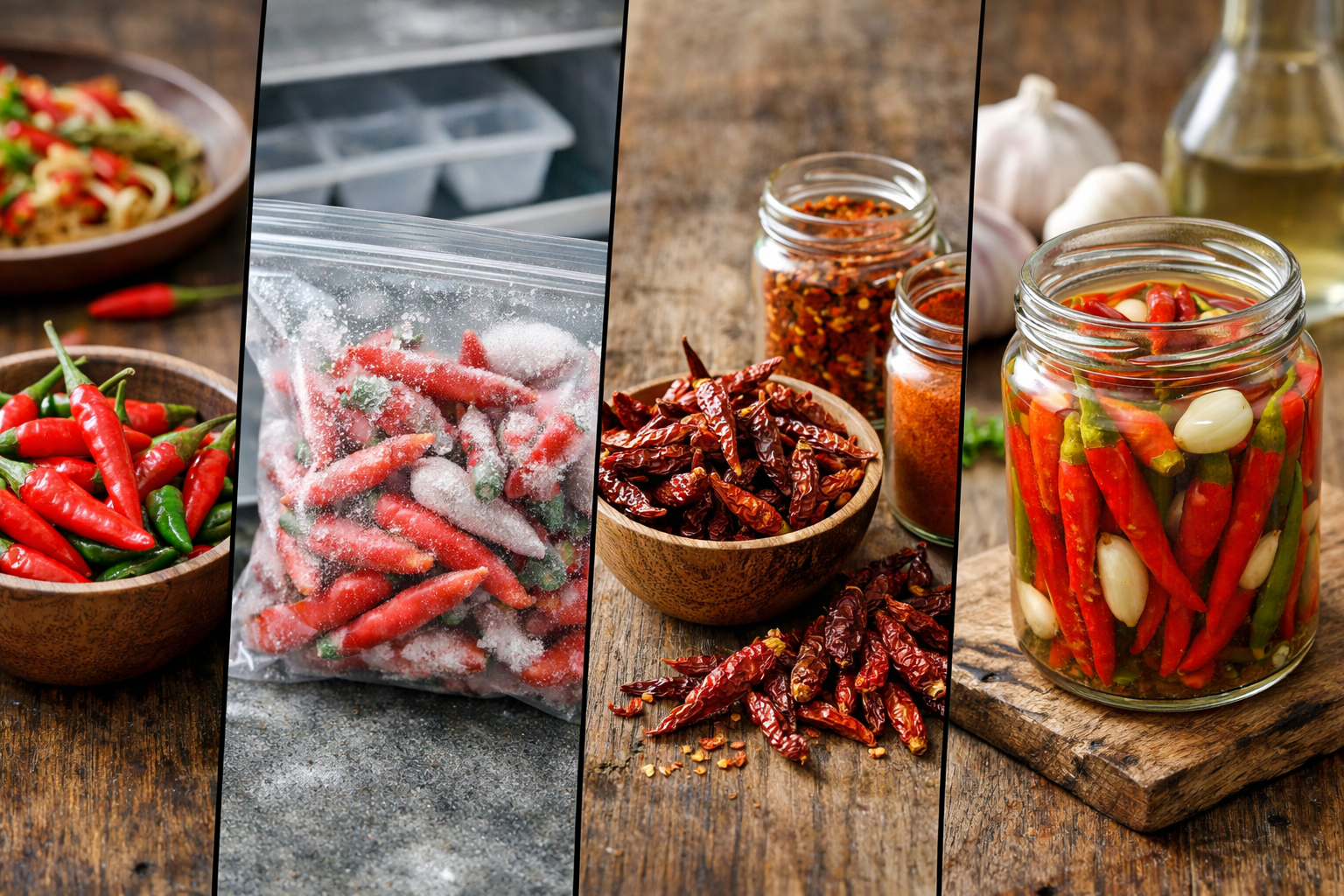
Start with timeline. Then check texture.
That order sounds almost too simple, but it fixes the usual mistake. People store Thai bird’s eye chilies for maximum shelf life when what they really cared about was how the pepper would behave in the pan or on the plate.
Use the fridge when the peppers are heading into meals over the next several days and you still care about them feeling fresh. Think sliced over noodles, minced into a dressing, or chopped into a quick stir-fry where you want the pepper to act like a fresh pepper.
Use the freezer when the peppers are there for heat first and texture second. Frozen Thai chilies are excellent in curry paste, soups, stir-fries, sambal-style blends, and braises. I do this a lot with garden extras because these little peppers freeze better than people expect. They do not come back crisp, though. That part is non-negotiable.
Dry them when the goal is a pantry ingredient. Whole dried chilies, chili flakes, and chili powder make sense when the fresh texture is no longer the point.
Pickle them when you want a different outcome on purpose. Pickled chilies are terrific. They are just not a stand-in for fresh Thai chilies any more than a cucumber pickle stands in for a raw cucumber.
Remember: choose by use before shelf life. A frozen pepper that keeps its heat is still the wrong pick for a raw garnish.
Refrigerate whole peppers for the best short-term freshness
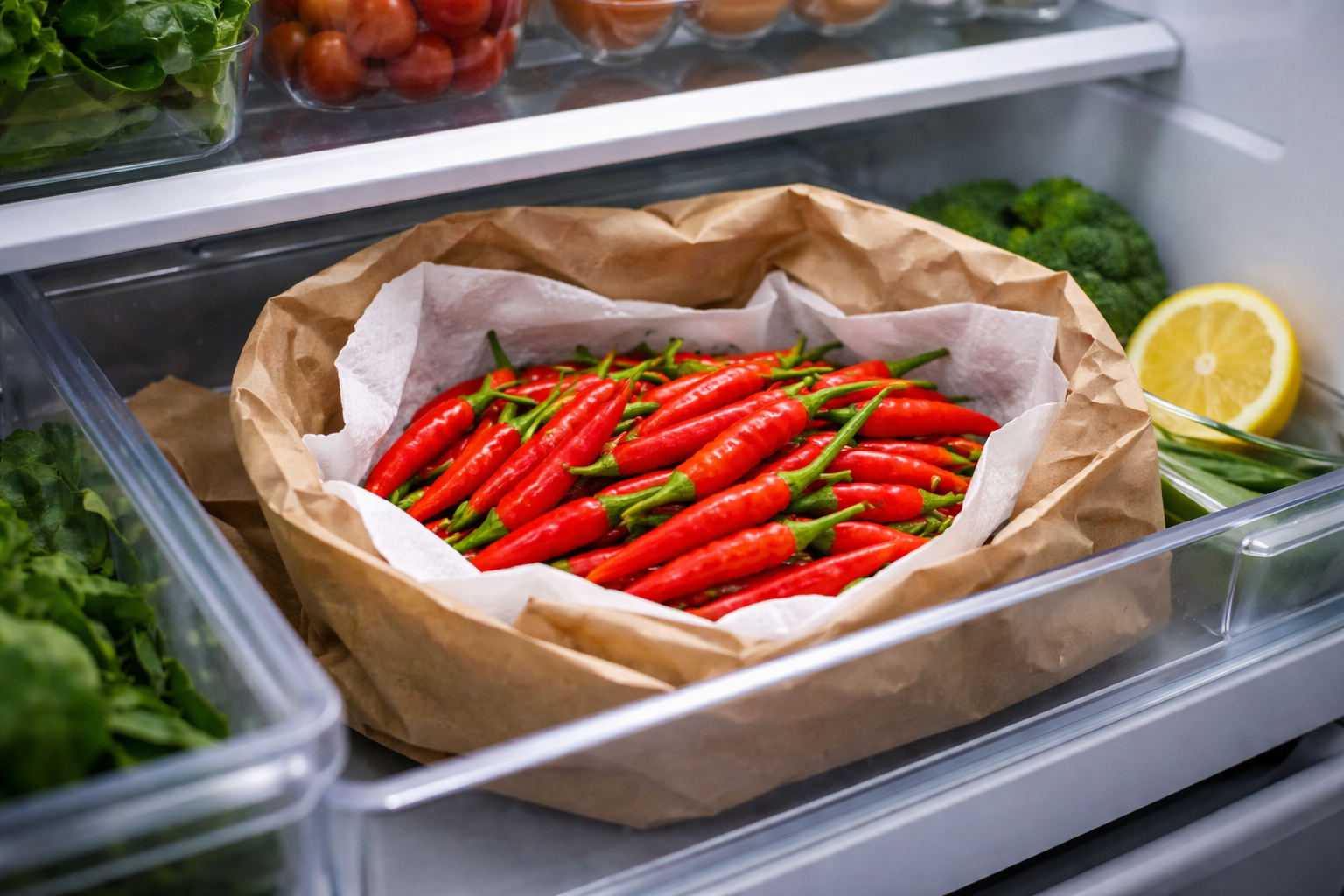
The USDA says refrigerators should hold at 41 F or below, and it notes that temperatures swing warmer near the door. That is why whole Thai chili peppers keep better in the crisper drawer or deeper inside the fridge, where the cold is steadier.
Michigan State University Extension says hot peppers can keep in the refrigerator for 2 to 3 weeks. In a home kitchen, that is the upper edge, not a promise. A pepper that was just picked or just bought from a busy market has a shot at that range. A pepper that already sat on display, then in a grocery bag, then on your counter while dinner got delayed, not so much.
Here is the setup that usually works best:
- Keep the peppers whole
- Keep them dry
- Skip washing until right before use
- Store them in a paper bag, perforated produce bag, or loosely closed container lined with a dry towel
- Keep them away from raw meat and obvious moisture sources
The dry part matters more than the bag type. Seal damp peppers in an airtight container and you’ve basically built them a tiny steam room. That is when sliminess sneaks in fast.
The USDA also flags ethylene gas from ripening fruit as a storage problem for vegetables. So, when there is room, don’t crowd fresh Thai chilies next to apples, melons, or tomatoes in the fridge. It is not a five-alarm emergency. It is just one more little shove toward softening and decay.
Note: a slightly wrinkled pepper is often still fine for cooking. A slimy pepper, leaking pepper, or moldy pepper is done. No debate needed.
One quiet wrinkle here: commercial guidance for fresh chiles tends to favor storage a bit warmer than a typical home fridge. So home refrigeration is still the right move, but it helps explain why Thai chilies can go from taut to tired sooner than the neatest chart suggests.
Freeze peppers whole so the heat lasts for months
The National Center for Home Food Preservation gives the freezer method in one blunt line: wash and stem the peppers, package them with no headspace, seal, and freeze. That tells you something useful right away. Thai chilies do not need a fussy, multi-step treatment to freeze well.
For small peppers like Thai bird’s eye chilies, freezing whole is usually the cleanest move. Dry them well after washing, slide them into a freezer bag, press out the extra air, label the bag, and freeze. That’s it. No blanching. No special ceremony.
When I freeze them, I usually leave them whole because it saves time and it keeps the mess down. Later, I pull out one or two straight from the freezer and slice them while they are still firm. It is oddly satisfying, and a lot easier than trying to chop a thawed, floppy chili.
What freezing changes is texture. The heat stays. The flavor stays close enough that most cooked dishes won’t care. The snap disappears. So use frozen peppers for:
- curries
- stir-fries
- sauces and chili pastes
- soups
- marinades
Skip frozen peppers for raw slices, crisp garnish, or any job where you wanted that fresh little bite.
For quality, it is smart to use frozen peppers within about 12 months. They stay safe longer at 0 F, but the flavor and texture don’t keep improving in exile.
Pro tip: flash-freeze on a tray first only when you want loose pieces that won’t clump. For whole Thai chilies, bag-and-freeze is usually enough.
Dry peppers completely so they become a pantry ingredient
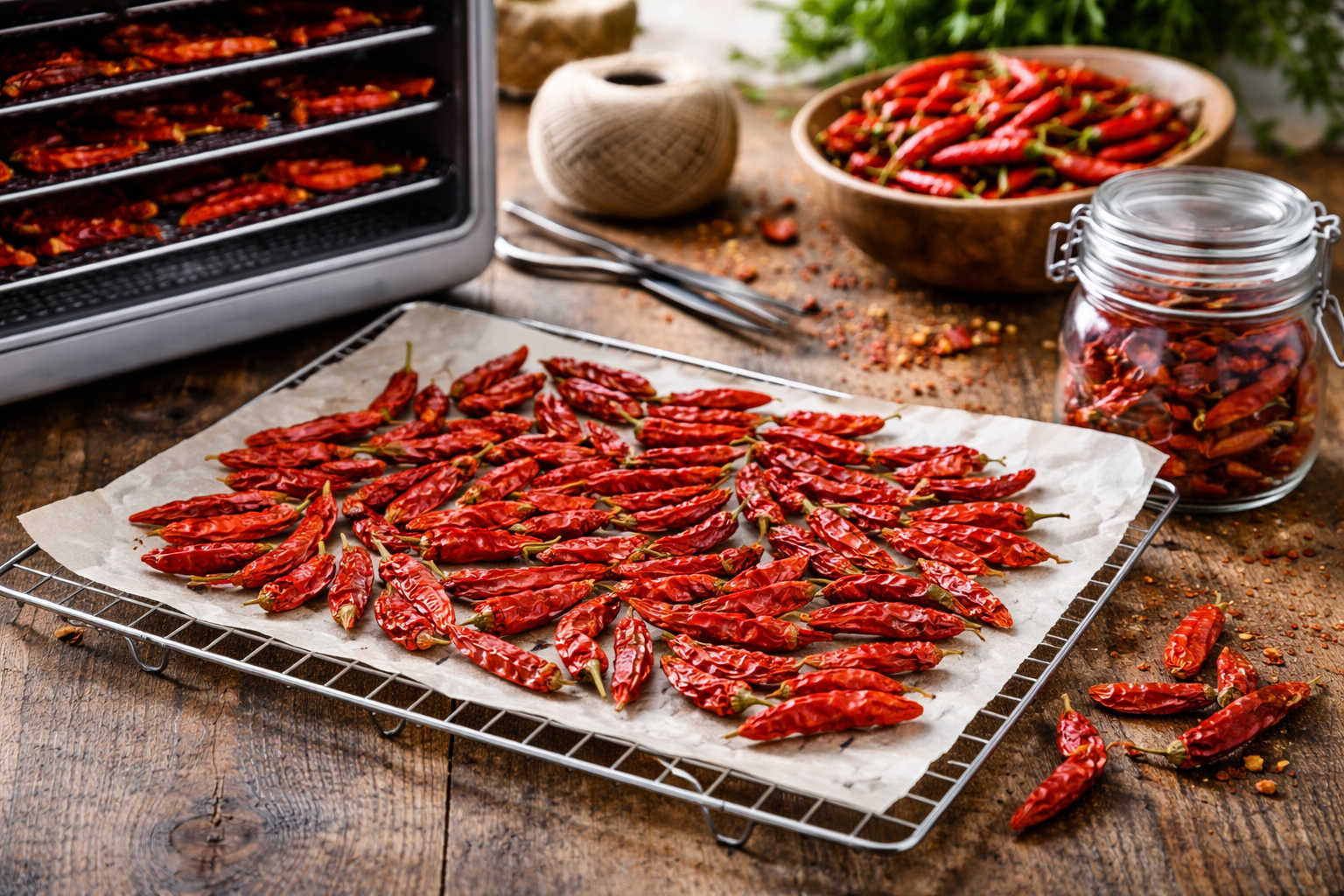
Drying works best when the question is not “How do I keep these fresh?” but “How do I turn these into something I will actually use later?” That is a better question, honestly.
Michigan State University Extension recommends a commercial dehydrator or an oven for hot peppers, and it gives a practical oven reference of 200 F for roughly 8 to 12 hours, with checking along the way. That range tells you the bigger truth: drying time moves around with pepper size, humidity, and how much moisture was in the fruit to start with.
You have three workable options:
- Air-dry in a warm, dry, well-ventilated space
- Use a dehydrator for the most reliable result
- Use a low oven when you want to get it done in one day
Air-drying sounds romantic right up until you try it in a damp kitchen. Then it feels like waiting for laundry to dry in a bathroom with the shower running. In dry climates, strung peppers can work well. In humid homes, a dehydrator or low oven is the sane option.
Halve the peppers or slit them if you want faster, more even drying. Wear gloves while handling a big batch. Capsaicin has a nasty way of lingering long after the chopping is done, and touching your face half an hour later is a poor reward for thrift.
The stopping point matters. Store dried chilies only when they are fully dry, crisp, and brittle. “Mostly dry” is where mold sneaks back into the story. Once they are fully dry, keep them in a sealed jar away from light. Use them whole, crush them into chili flakes, or blitz them into chili powder.
Note: leathery peppers can fool you. They feel dry on the surface while hidden moisture hangs around inside.
Pickle or can peppers safely when you want ready-to-use heat
This is the branch where flavor changes on purpose. Pickled Thai chilies are sharp, bright, and great in their own right. They are not trying to imitate fresh chilies, and that is fine.
Michigan State University Extension lays out the line clearly: pickled peppers can be water-bath canned because the vinegar provides the acidity, while peppers that are not pickled must be pressure canned to avoid botulism risk. That is the distinction that matters.
So the quick rule is this:
- For refrigerator pickles, use a tested recipe and keep them chilled
- For shelf-stable pickled peppers, use a tested canning recipe with the right acid level
- For plain canned peppers, pressure canning is the only safe route
The same Michigan State guide gives a typical pickled pepper formula with 5% vinegar and 1/2-inch headspace. That is not trivia. That is why a recipe like this works in the jar and a casual “looks acidic enough” jar from a social post can go sideways.
One more thing, because this shortcut keeps popping up: peppers in oil are not a casual room-temperature storage hack. Oregon State University Extension warns that low-acid vegetables in oil can create the oxygen-free conditions that let botulism bacteria grow. Commercial products solve that by acidifying under controlled conditions. Home cooks need to follow tested directions exactly or keep the mixture refrigerated for short-term use only.
For another plain-English preservation piece built around tested methods instead of guesswork, this guide to canning cherry tomatoes safely covers the same basic logic from a different angle.
Store cut peppers quickly so they stay usable and safe
Whole peppers buy you time. Cut peppers do not.
Ask USDA says cut fruits and vegetables should be refrigerated in covered containers or frozen. That tracks with what happens in real kitchens. Once you slice or mince Thai chilies, you’ve exposed moisture and surface area. The clock speeds up.
So once the peppers are cut:
- Get them into a clean covered container within 2 hours
- Use them in about 3 to 4 days
- Keep them in the main body of the fridge, not the door
- Add a dry paper towel only when condensation is becoming a problem
This comes up a lot with meal prep. You mince a few Thai chilies for tomorrow’s stir-fry, then another task pulls you away, and the little pile just sits there on the board because it seems too small to matter. It matters. Cut produce is simply less forgiving.
Remember: chopped chilies are for near-term use. Freeze extras when the prep batch got away from you.
Check spoilage signs before you cook the batch
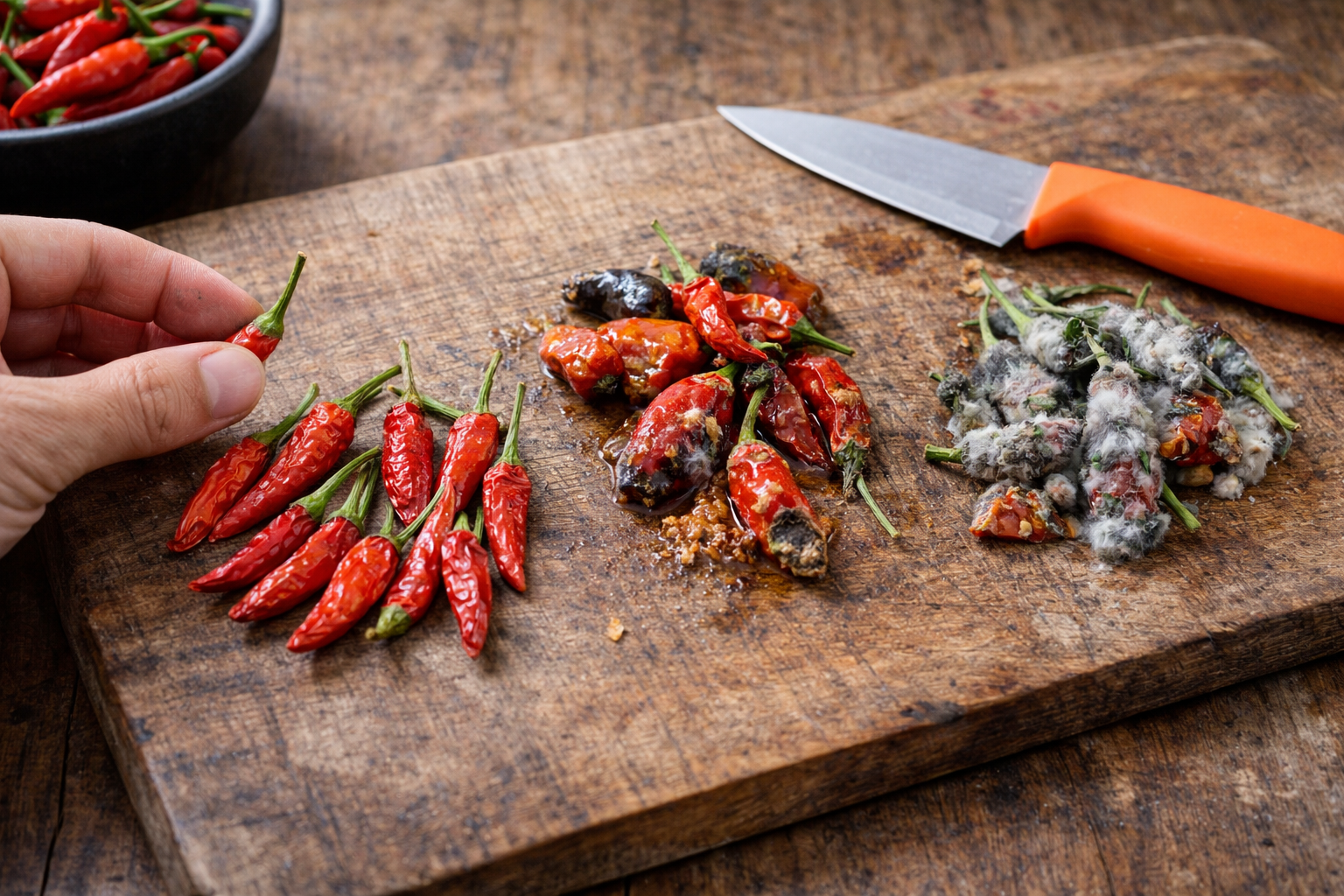
The useful line here is not fresh or spoiled. It is usable or done.
A wrinkled Thai chili is often still usable, especially for cooked dishes, drying, or blending into a paste. It may have lost some snap and some water weight. That is quality loss.
A pepper that is slimy, leaking, moldy, or sour-smelling is not a rescue project. That is spoilage.
This is where people talk themselves into nonsense. They see one soft spot, tell themselves they will trim around it, then remember too late that peppers are thin-walled and small. There is not much clean margin to work with. Once rot or mold has started on a little chili, the smart move is usually the trash.
Quick check before you cook
- Wrinkled but dry? Usually fine for cooked use
- Soft but not wet? Use soon in a cooked dish or skip it
- Slippery, sticky, or leaking? Toss
- Visible mold? Toss
- Sharp sour smell? Toss
Ugly is not always unsafe. Wet rot is another story.
Avoid the storage mistakes that shorten shelf life
Most failed pepper storage comes down to three things: moisture, bad expectations, and shortcuts.
- Washing before fridge storage. Clean peppers sound like good housekeeping. Damp peppers stored cold go downhill faster.
- Sealing in condensation. A tight container full of trapped moisture invites slime.
- Using the fridge door. The door gets more temperature swing, so peppers soften sooner.
- Freezing peppers meant for raw use. Frozen Thai chilies are great in cooked food. They are lousy as crisp garnish.
- Trying to air-dry in a humid kitchen. When the room is muggy, drying turns into slow decay.
- Leaving chopped chilies out because they are tiny. Small does not mean low-risk.
- Improvising peppers in oil. This one can move from lazy shortcut to food safety issue fast.
- Keeping too many in the fridge because the chart said 2 to 3 weeks. Storage windows are not guarantees. They are best-case ranges.
There is one more mistake I see with home-grown peppers. People get a sudden flush from one or two plants, then try to preserve every pepper the same way. That is backwards. Split the batch. Keep the best ones fresh. Freeze a handful whole. Dry the wrinkly-but-sound ones. Pickle only the amount you will actually enjoy.
That mixed plan usually beats the one-method-for-everything plan.
And if the source of the overflow is a patio pot that suddenly got ambitious, Thai-type peppers are one of the container-friendly kinds that can surprise you with a concentrated harvest.
FAQ
Do red Thai chilies store differently from green Thai chilies?
Not by much. Red peppers are riper, so they can feel a touch softer and may not keep quite as long as very firm green ones. Store both the same way: whole, dry, and cold for short-term use, or frozen for longer storage.
Should the stems stay on when you refrigerate or freeze Thai chilies?
For refrigeration, leaving the stems on is fine and often easier. For freezing, either works. Many people stem them first for convenience, but freezing whole with stems is not a problem if that helps you move the batch into storage faster.
Can you freeze Thai chilies after they already started to wrinkle?
Yes, as long as they are still sound. A wrinkled pepper with no slime, mold, or sour smell is often still good for cooked dishes, so freezing can still make sense. Once the pepper is wet, leaking, or moldy, skip it.

Michael Rowan is the founder and lead writer at The Garden Playbook. He has spent 10+ years growing plants across a range of settings — from indoor houseplants and container gardens to raised beds and in-ground plots — adapting methods to different light levels, seasons, and growing conditions.
Michael focuses on practical, experience-based guidance grounded in fundamentals: soil health, watering strategy, plant nutrition, pruning and propagation, and integrated pest management (IPM). His work aims to help readers diagnose common problems (such as yellowing leaves, stunted growth, or pest pressure) and apply straightforward solutions that are realistic for home gardeners.
At The Garden Playbook, Michael develops tutorials and plant guides using a consistent process: documenting real outcomes where possible, explaining the “why” behind each step, and verifying higher-risk topics (such as plant toxicity or pest treatment options) against reputable horticultural references.