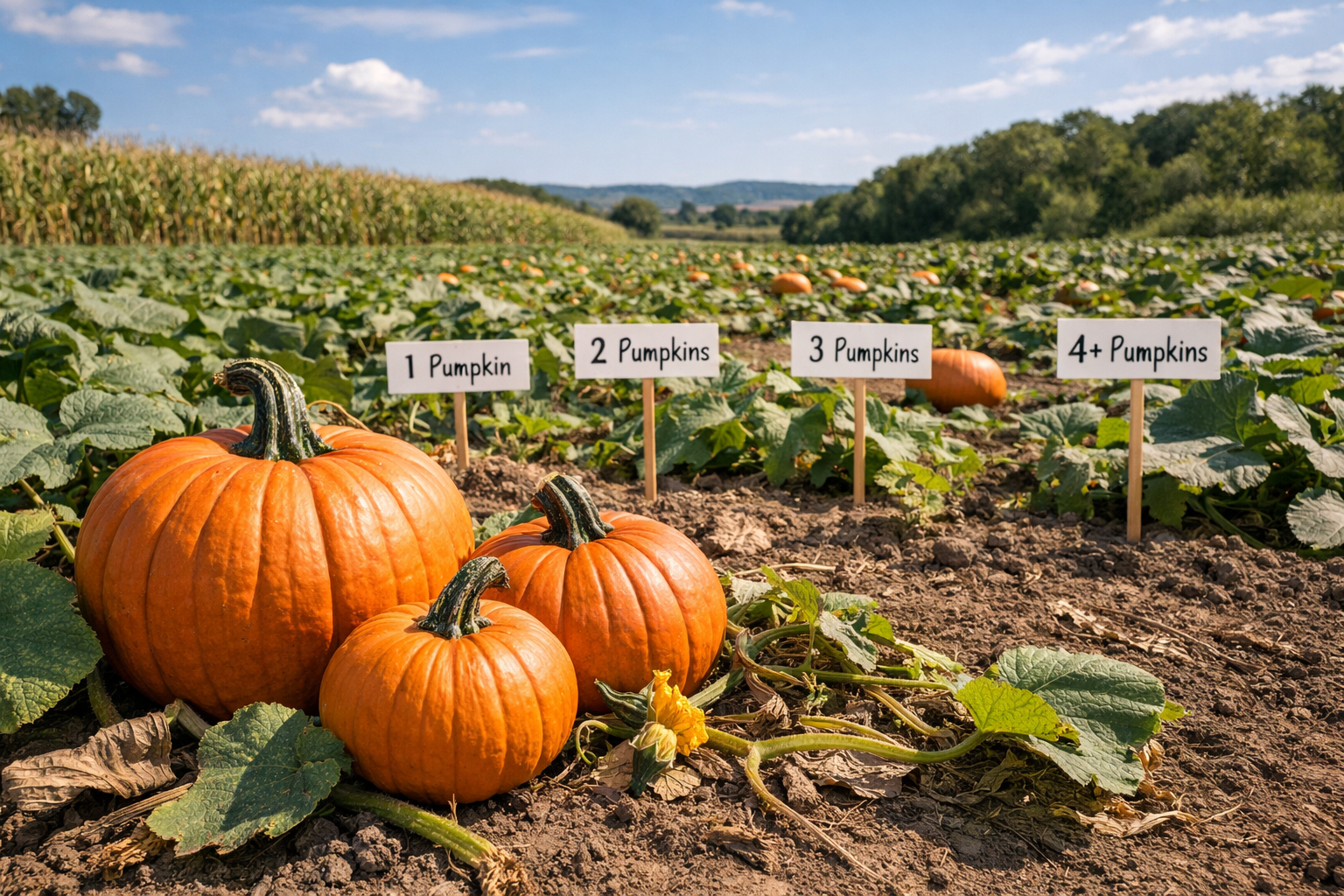
Most gardeners ask this after the vines start running and the first flowers show up: are you looking at a porch full of pumpkins, or two lonely orange balls in October?
The short answer to how many pumpkins per plant is this: most standard plants finish about 2 to 5 pumpkins, mini pumpkin varieties can carry 5 to 12 or more, and giant types are usually grown for one fruit. But that headline answer hides the part that actually matters. A mini pumpkin vine, a pie pumpkin plant, and a giant pumpkin are not playing the same game.
I’ve made this mistake with carving pumpkins myself. The vines looked huge, the flower count felt promising, and I mentally claimed half a dozen Halloween pumpkins before the plants had earned any of them. By late season, the patch gave me two good carving pumpkins and a third that never quite sized up. The vines were healthy. My expectations were the bit that was off.
Here’s what changes the count, and what you’ll leave knowing:
- What is normal for giant, carving, pie, and mini pumpkins
- Why blossoms and baby fruit are not the same as finished pumpkins
- When thinning fruit helps, and when it just cuts your harvest for no good reason
- How spacing, water, and pollination change the final number
- How many plants to grow for the harvest you actually want
At a Glance: Quick yield guide
| Pumpkin type | Finished pumpkins per plant | Best move |
|---|---|---|
| Giant | 1 | Thin hard and feed the vine for size |
| Large carving | 1 to 3 | Give them room and do not count every early fruit as a keeper |
| Pie or standard | 2 to 5 | Aim for steady growth and even moisture |
| Mini | 5 to 12+ | Pick a small-fruited variety and avoid over-thinning |
The useful rule: bigger fruit means fewer finished pumpkins.
How Many Pumpkins Per Plant? The Short Answer by Type
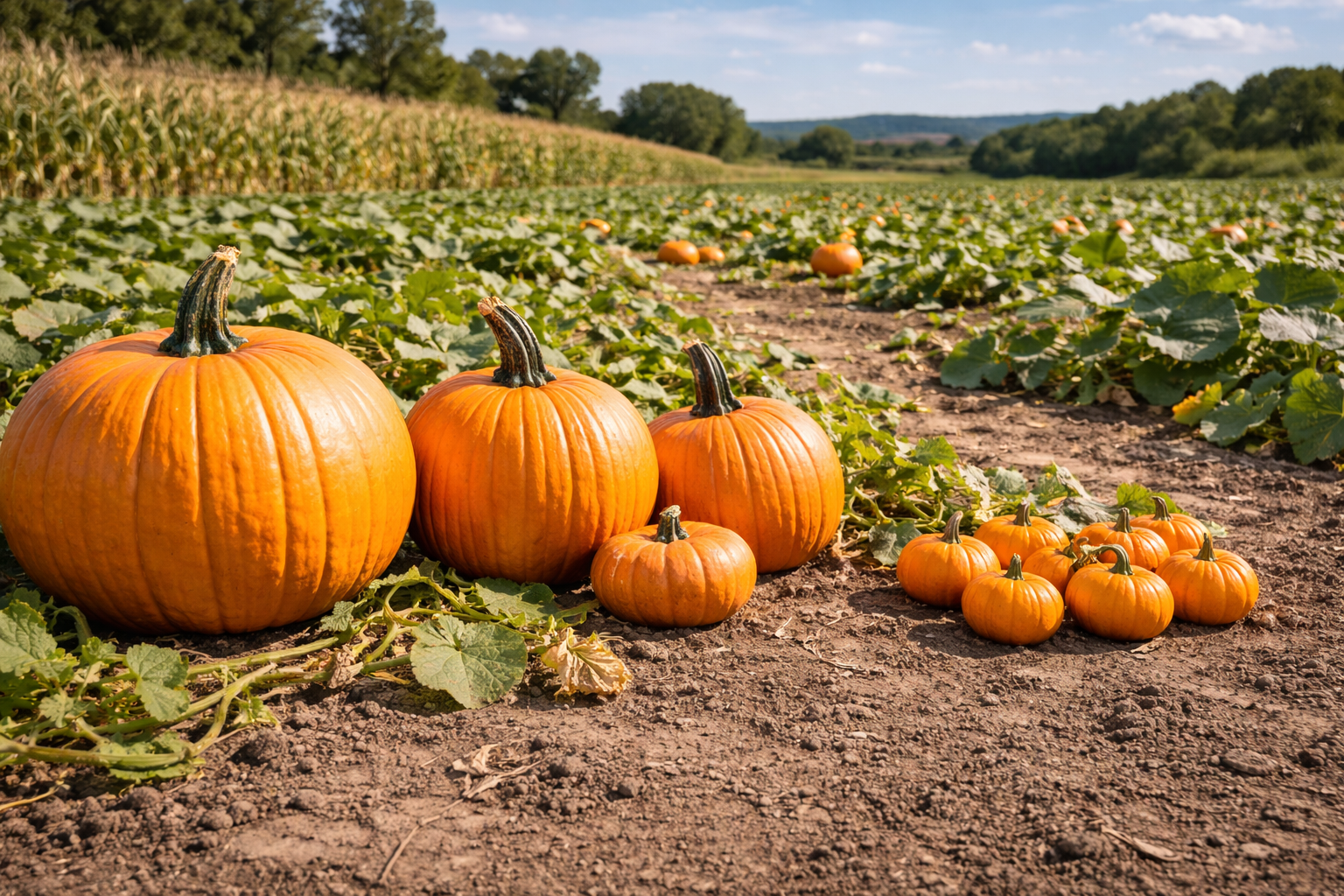
The clean answer changes with the kind of pumpkin you’re growing.
For giant pumpkins, one fruit per plant is normal because those vines are pushed toward size, not count. For large carving pumpkins, expect about 1 to 3 solid fruits on a healthy plant. Standard pie pumpkins and medium types often land around 2 to 5. Mini pumpkins can go much higher, often 5 to 12, and sometimes more when the season is long and the plant is happy.
Colorado State University’s pumpkin variety trial shows why the range swings so much. In that listing, Jack Be Little averaged about 6.9 ripe fruits per plant, while large carving types like Howden Biggie and New Rocket came in well under one ripe fruit per plant in that trial. That is a better way to think about yield: not “pumpkins are pumpkins,” but “fruit size sets the ceiling.”
And one thing trips people up every year: finished pumpkins are not the same as flowers, baby fruit, or every swelling ovary you spot in July. Count mature harvest, not wishful fruit set.
Remember: If you’re growing a big jack-o’-lantern type and you finish the season with two good pumpkins, that is not a failed plant. That is often a pretty normal one.
Why One Pumpkin Plant Can Give You 1 Fruit or 10
Variety is the first lever, and it is a big one.
A mini pumpkin vine is built to finish a lot of small fruit. A giant pumpkin plant is built like a bodybuilder with one event on the calendar. Same crop family, very different assignment. Once you see it that way, the wide yield range stops looking weird.
Growth habit matters too. Bush and semi-bush plants stay tighter, which can help in smaller gardens, but long-vining pumpkins usually have more leaf area and more room to support fruit over a long season. Then the season length steps in. Many pumpkin varieties need roughly 90 to 120 days to mature, so a late planting or early frost can leave you with fruit that started well and never crossed the finish line.
This is where gardeners sometimes talk past each other. One person says, “My plant made eight pumpkins.” Another says, “Mine only made two.” That sounds like a contradiction until you realize the first was growing minis and the second was growing a carving type the size of a beach ball.
If you want a quick rule, use this one: the heavier the pumpkin is meant to be, the fewer you should expect per plant.
The Simple Size-versus-Count Rule for Choosing How Many Pumpkins to Keep
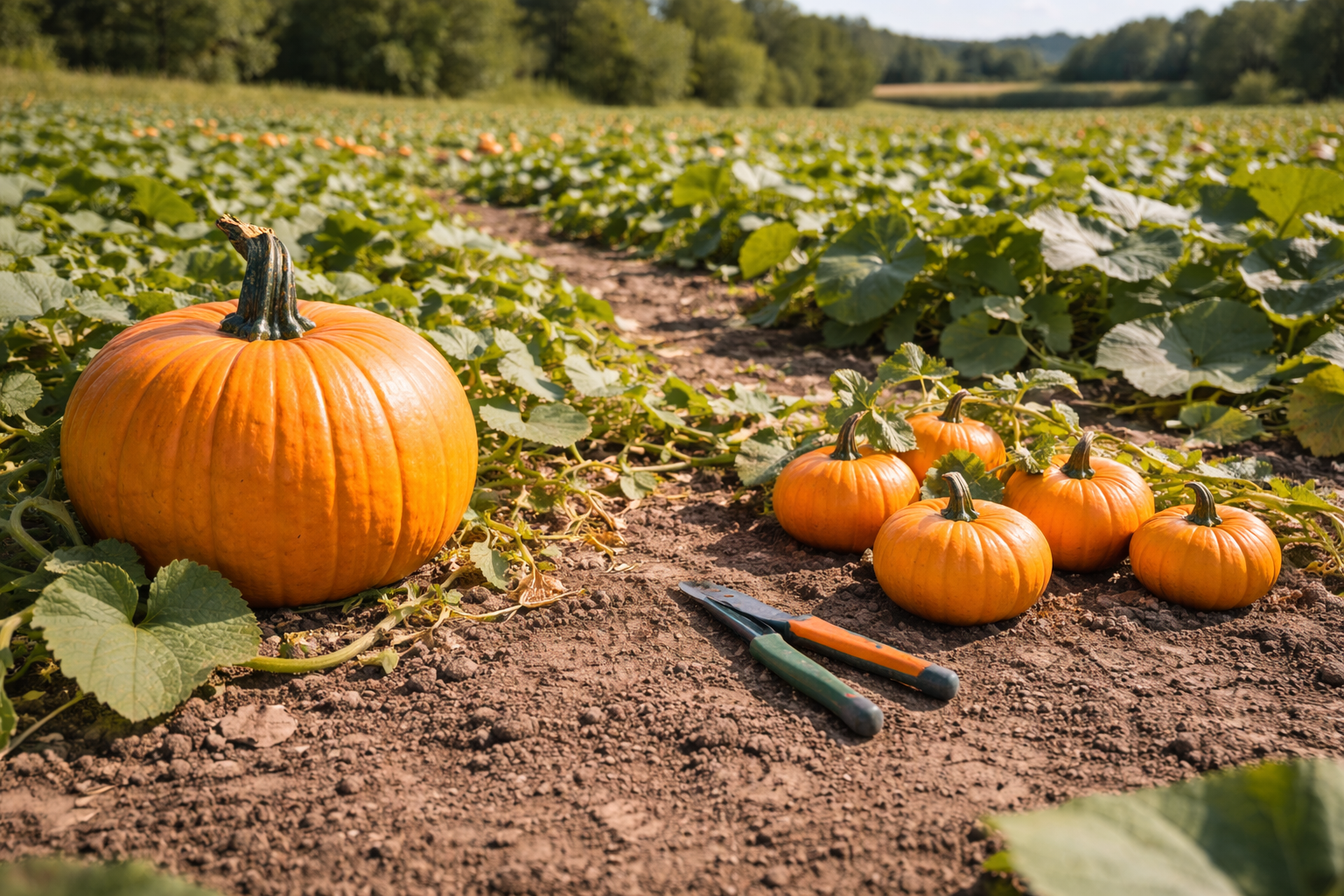
You usually get to choose one of two wins: more pumpkins, or bigger pumpkins.
That is not perfectly absolute, but it is close enough to guide your pruning. A vine has a finite amount of leaf area, root uptake, and season left. Spread that across many fruit and each one gets a smaller slice. Concentrate it into fewer fruit and size jumps.
If the goal is a giant pumpkin, keep one. If the goal is a few good carving pumpkins, many gardeners thin down to two or three strong fruit once the plant is clearly carrying them well. If the goal is lots of mini pumpkins for decoration, back away from the snips. Over-thinning a small-fruited variety is one of those tidy-looking mistakes that leaves you with a smaller harvest and no real upside.
Use this decision rule
- Want the biggest possible fruit? Thin to one.
- Want a balanced harvest for carving? Keep a few strong fruit and remove weak extras.
- Want lots of minis? Leave more fruit on the plant and focus on keeping the vine healthy.
I like to wait until fruit are clearly set and growing before I thin hard. Early in the season, a pumpkin can look promising and then stall. Cutting too soon can make the choice for the plant before the plant has really made it.
Space, Water, and Sunlight Rules That Decide Your Yield
Once variety sets the rough range, growing conditions decide whether the plant lands near the top of that range or limps in near the bottom.
Start with space. Compact or bush pumpkins can be planted more tightly, often around 18 to 24 inches apart with 4 to 6 feet between rows. Miniature pumpkins are often spaced around 2 feet apart with 6 to 8 feet between rows. Long-vining pumpkins need real elbow room, often 2 to 5 feet between plants and 6 to 8 feet between rows. In a University of Connecticut pumpkin spacing trial, tighter spacing pushed fruit count up while average fruit size dropped. That tradeoff matters more than the raw number.
Then comes water. Utah State University Extension recommends deep, infrequent watering of about 1 to 2 inches per week, then easing off as fruit ripens. That matches what pumpkin vines seem to like in the garden too: not a daily sip, but a real soak that reaches the root zone.
Steady moisture matters more in raised beds because they dry out faster. If the patch is in a box or framed bed, a simple drip setup is usually the cleanest answer. This guide on the best irrigation for raised beds lays out the setup that fits that job well.
Sunlight is less complicated. Pumpkins want full sun. The more shade you give them, the more you ask the plant to support heavy fruit on a weak food budget.
And watch nitrogen. Lots of rich, late nitrogen can push lush leaves and runners when you’d rather the plant settle into flowering and fruiting. Big leaves look impressive, sure, but leaves don’t become jack-o’-lanterns.
Note: Crowding does not just make the patch messy. It cuts airflow, raises disease pressure, and forces the vines to compete for water right when fruit are sizing up.
Why Pumpkin Plants Bloom but Do Not Set Fruit
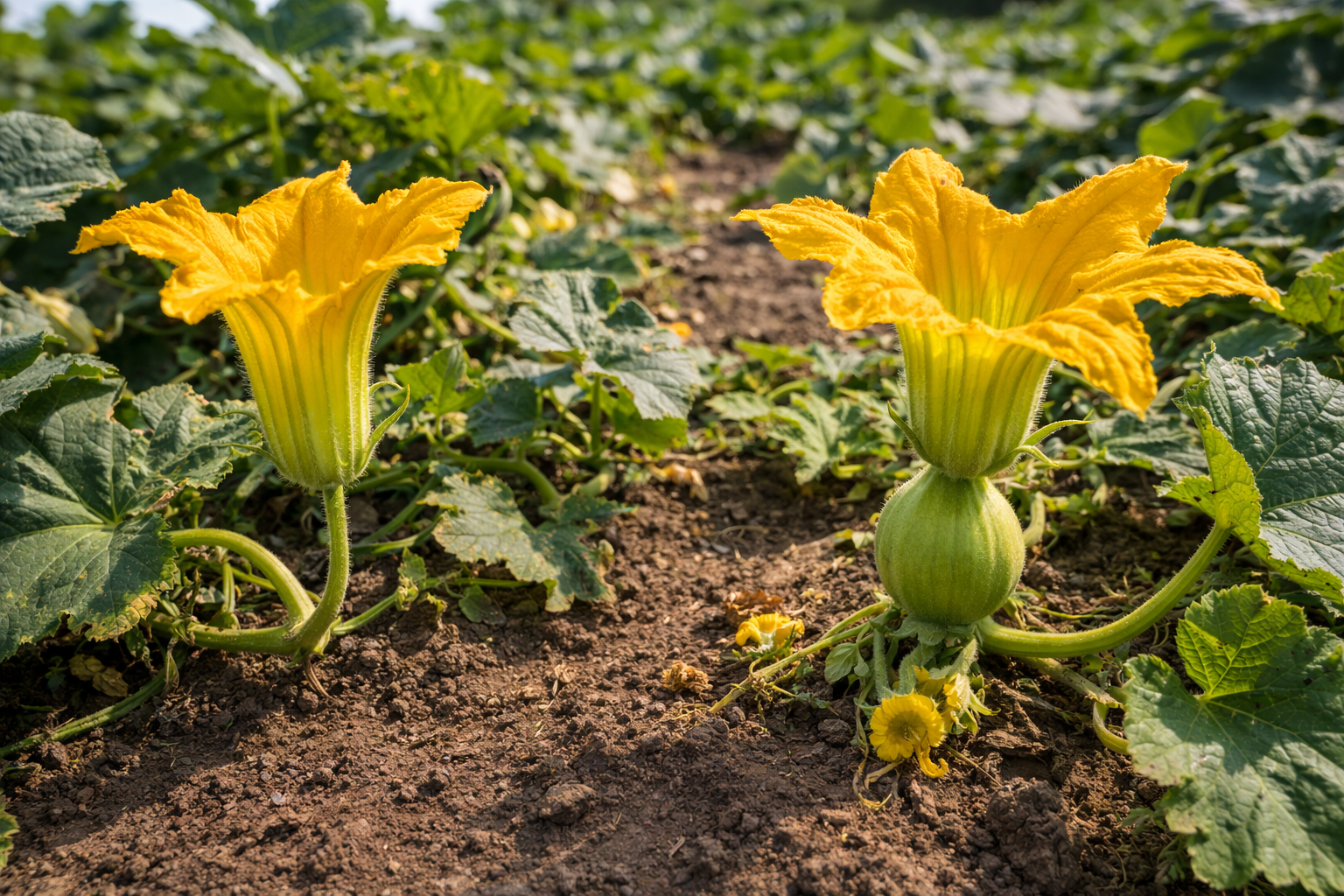
This is the part that makes people mutter at the garden fence.
A pumpkin plant can flower heavily and still produce little because flowers are only stage one. University of Minnesota Extension notes that pumpkins depend on insect pollination, that male flowers bloom about a week before female flowers, and that the flowers open only for a short window in the morning. So if your vine is covered in blooms early on, it may simply be in the male-flower phase. That is normal.
You can spot the difference pretty fast once you know what you’re looking at. Male flowers sit on a straight, thin stem. Female flowers have a small swollen ovary behind the bloom. That little bump is the potential pumpkin. No bump, no fruit.
Poor pollination is the main reason baby pumpkins yellow, shrivel, and drop. Heat stress can do it too. So can erratic watering. Too much nitrogen can push the plant away from balanced fruiting. Sometimes the vine is telling you, in a rather rude way, that it cannot support what it started.
If bee activity seems low, hand pollination can help. In the morning, pick a freshly opened male flower, strip the petals, and dab pollen onto the center of an open female flower. It’s simple, a bit fiddly, and weirdly satisfying.
If the vine has lots of flowers but no pumpkins, check these first
- Are you still only seeing male flowers?
- Do female flowers open when bees are active?
- Has the soil swung from bone dry to soaked?
- Did the plant get a heavy nitrogen push after the vines took off?
- Is hot weather causing blossoms or tiny fruit to abort?
Don’t panic just because the plant looks dramatic in midsummer. Pumpkin vines often do.
How Many Pumpkin Plants You Need for the Harvest You Want
This is the question hiding behind the main keyword for a lot of people.
The easiest planning formula is: desired finished pumpkins divided by realistic yield per plant equals the number of plants to grow. The word that matters most there is “realistic.”
If you want six decent carving pumpkins for the porch, do not plan around the best-case dream that every plant will finish three perfect fruit. Plan around a conservative range. For many home gardens, that means starting more than two carving-pumpkin plants if six finished pumpkins really matters.
If you want a dozen minis, the math changes fast. A couple of strong mini-pumpkin vines can get you there. If you want one giant pumpkin, the plan is simpler and stricter: one plant, one fruit, a lot of space, and a bit of obsession.
I like to use the lower end of the yield range when space is limited or the season is short. That avoids the classic garden math problem where every plant is expected to behave like the happiest plant on the internet.
Quick planning example: Want 6 carving pumpkins? At 1 to 3 finished fruits per plant, starting with 3 to 4 plants is safer than betting everything on 2.
When Small Gardens, Raised Beds, and Giant Pumpkins Change the Math
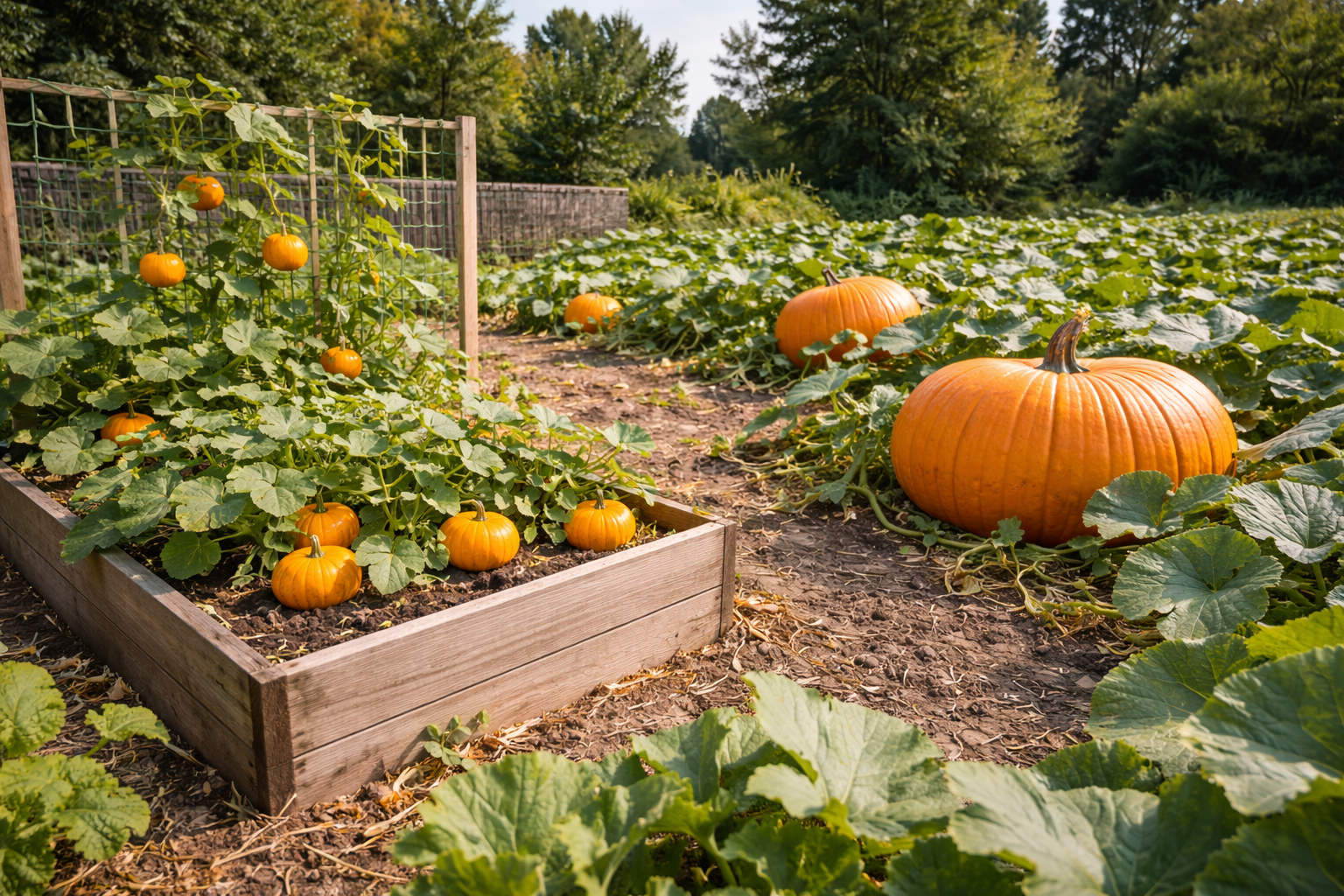
Space can override all the nice averages.
If your garden is small, switch the question from “How many pumpkins per plant?” to “Which pumpkin type fits this space without turning into nonsense?” Bush and semi-bush types are much easier to manage in tight beds. Mini pumpkins are the most forgiving place to experiment with vertical support or guided vines. Large carving pumpkins in a tiny raised bed can work, but they often end up feeling like you tried to park a pickup truck in a bicycle shed.
Raised beds are not the problem by themselves. The issue is that they dry faster and run out of room faster. That pushes watering consistency and variety choice to the front of the line.
Giant pumpkins are the clean exception to nearly every casual rule in this article. University of Minnesota’s giant pumpkin guide recommends a minimum of about 400 square feet per plant. That number tells you everything about the crop’s priorities. A giant pumpkin patch is not a normal pumpkin patch, just scaled up. It is a different hobby wearing the same orange costume.
So if space is tight, pick a compact plant or a smaller-fruited variety. If the goal is giant fruit, commit properly. The messy middle is where gardeners lose both size and count.
FAQ
Do you need two pumpkin plants to get fruit?
No. A single pumpkin plant has both male and female flowers, so one plant can set fruit if pollen is moved from male to female flowers. Bees usually do that job. Low pollinator activity, bad weather during bloom, or a plant that is still in its early male-flower stage can make it look like you need a second plant when the real issue is pollination timing.
Will different pumpkin varieties cross-pollinate and change this year’s fruit count?
Cross-pollination does not change the fruit you harvest this year. It affects the genetics of the seeds inside that fruit. This year’s fruit count still comes back to variety, plant health, spacing, moisture, and pollination success.
How late can a pumpkin set fruit and still mature?
That comes back to the variety’s days to maturity and the first frost date in your area. As a rough guide, many pumpkins need 90 to 120 days from planting to mature, so fruit set that happens very late in the season often stalls before full color and hardness. If your season is short, count backward from frost and lean toward earlier varieties.

Michael Rowan is the founder and lead writer at The Garden Playbook. He has spent 10+ years growing plants across a range of settings — from indoor houseplants and container gardens to raised beds and in-ground plots — adapting methods to different light levels, seasons, and growing conditions.
Michael focuses on practical, experience-based guidance grounded in fundamentals: soil health, watering strategy, plant nutrition, pruning and propagation, and integrated pest management (IPM). His work aims to help readers diagnose common problems (such as yellowing leaves, stunted growth, or pest pressure) and apply straightforward solutions that are realistic for home gardeners.
At The Garden Playbook, Michael develops tutorials and plant guides using a consistent process: documenting real outcomes where possible, explaining the “why” behind each step, and verifying higher-risk topics (such as plant toxicity or pest treatment options) against reputable horticultural references.