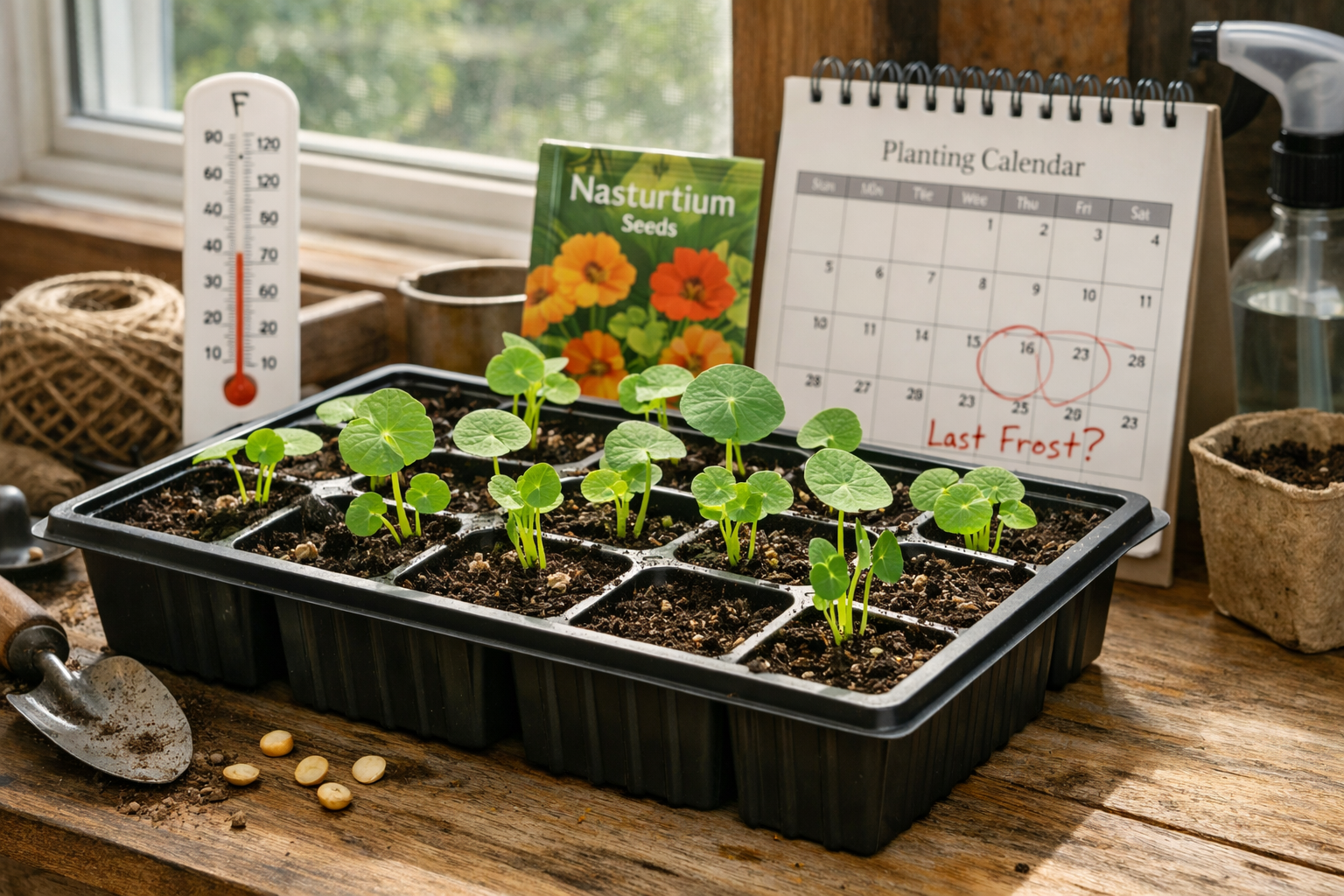
Nasturtiums are one of those flowers that make you feel clever right up until they sulk in a tray. I’ve made that mistake myself. I started them indoors with tomatoes one spring, admired the fast sprouts, and then watched them get lanky and touchy before they ever hit the bed.
So here’s the clean answer to when to start nasturtium seeds indoors: for most gardeners, sow them 2 to 4 weeks before the average last spring frost. Stretch that to 4 to 6 weeks only when spring stays cold, soil warms late, or the season is short enough that every week counts. In a lot of gardens, direct sowing after frost is simpler and works just as well.
That shorter window is the part generic advice often misses.
Nasturtiums grow fast, dislike root disturbance, and do not reward a long indoor runway the way peppers and tomatoes do. The right timing comes down to three things: your real frost date, how fast the soil warms, and whether indoor starting actually buys you anything.
At a glance
| Situation | Best move |
|---|---|
| Average home garden with a normal spring warm-up | Start indoors 2 to 4 weeks before last frost, or direct sow after frost |
| Short season, cold spring soil, high elevation | Start indoors 4 to 6 weeks early, but use individual pots and handle roots gently |
| Patio pots or final containers | Often better to sow straight into the final pot |
| Weak indoor light or a fast-warming spring | Skip indoor starting and direct sow outside |
- Use the frost date as a starting point, not a promise.
- Wait for spring-like soil, not one random warm afternoon.
- Keep the indoor window short so seedlings stay compact.
- Harden off before planting out, or the head start disappears fast.
When to start nasturtium seeds indoors for the cleanest head start
The safest default is simple: count back 14 to 28 days from the date you expect to plant outside. That is the sweet spot for most home gardeners. It gives the seedlings time to sprout and put on a couple sets of leaves, but not enough time to get stretchy, root-bound, or weirdly dramatic on the windowsill.
If spring drags in your garden, then a longer run can make sense. A cool, high-elevation bed that stays chilly into late spring is different from a sunny suburban border that heats up fast. In those slower gardens, 4 to 6 weeks indoors can be worth it.
But that longer window is an exception, not the default.
Nasturtiums are quick. They do not need the same indoor lead time as crops that sit around moping for a month before they get going. If indoor light is only so-so, the shorter window is the safer play. Fast growers under weak light have a habit of turning into floppy green noodles, and nasturtiums are no saints there.
Simple rule: Start nasturtiums indoors only when the extra time will still leave you with compact seedlings on planting day. If the seedlings will be sitting inside, waiting and stretching, that early start is not helping.
So the clean timing rule looks like this:
- 2 to 4 weeks before last frost for most gardens
- 4 to 6 weeks for short seasons, cold springs, or stubbornly slow soil
- 0 weeks if direct sowing will be easy and timely
Direct sow or start indoors? The easier option is often the better one
A lot of gardeners asking about indoor timing are really asking a quieter question: should nasturtiums be started indoors at all?
Often, no.
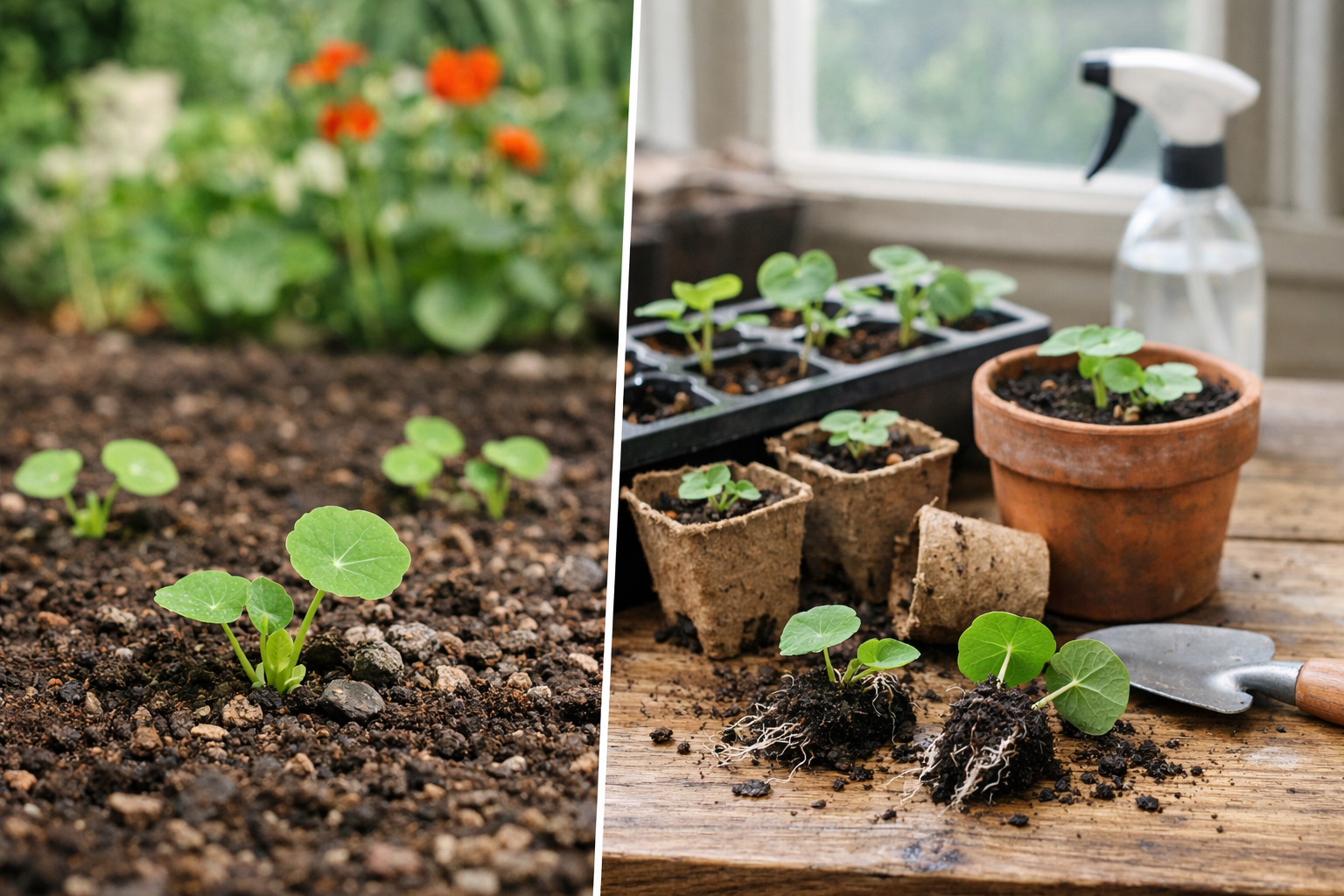
Direct sowing is a strong option because nasturtiums sprout quickly in warm soil and they are not fond of root disturbance. If the season is long enough for them to get going outside without drama, sowing them where they will grow is usually the cleaner move.
Here’s when direct sowing tends to win:
- your spring warms up on schedule
- the bed gets decent sun and drains well
- you do not need the earliest possible bloom
- indoor light is weak or inconsistent
Indoor starting earns its keep when the season is short, the spring soil stays cold, or you want earlier growth in a container display. Even then, the setup matters. Individual cells, small pots, or biodegradable pots are far better than a crowded flat. Nasturtiums do not love having their roots teased apart like a bowl of noodles.
There’s another wrinkle that gets skipped a lot: if the end goal is a patio planter, sowing straight into the final container can beat both methods. You skip transplant shock, you skip potting up, and the plant never has to re-orient after the move.
Remember: The “best” method is the one that gets the plant established with the least fuss. Nasturtiums are not impressed by complicated seed-starting rituals.
Use last frost, soil warmth, and night temperatures to pick the real planting date
The frost date is where planning starts, but it is not the whole answer. The USDA Plant Hardiness Zone Map is based on average annual extreme minimum winter temperature, which is why a zone number cannot tell you when spring frost is done in your yard. Two gardeners in the same zone can still have very different last frost dates.
For timing, the better anchor is your local freeze normal. NOAA’s average last date of spring freeze map uses 1991 to 2020 climate normals and shows the most common date range for the last 32F freeze. That phrasing matters. “Most common” is not the same thing as guaranteed safe.
Then watch the live forecast. The National Weather Service defines a Frost Advisory as 33 to 36 degrees on clear, calm nights, and a Freeze Warning as widespread freezing temperatures being expected. Tender seedlings can get knocked back by either one. A calendar date does not care if a cold pocket settles into the garden at 4 a.m.
Soil warmth matters too. Nasturtiums do better once the bed feels properly spring-like, not cold and gummy. As a working target, look for soil in roughly the 55 to 65F range, with the smoother results usually coming once it is around 60F or above. That is why a late-April planting can fly in one garden and stall badly in another.
Night temperature is the gut-check. If nights are still dipping hard and the soil stays cool after rain, wait a bit. A week of patience there often beats three weeks of sulking seedlings later.
The same trap shows up in cool-season ornamentals too. The line between light frost and the nastier stuff is clearer in this piece on how cold pansies can tolerate, and the logic carries over nicely when spring weather starts bluffing.
Sow nasturtium seeds so they germinate fast and transplant cleanly
Once you’ve picked the right window, the sowing part is refreshingly plain. Nasturtium seeds are chunky enough to handle without tweezers and fussy enough to punish overwatering. That combo keeps people busy.
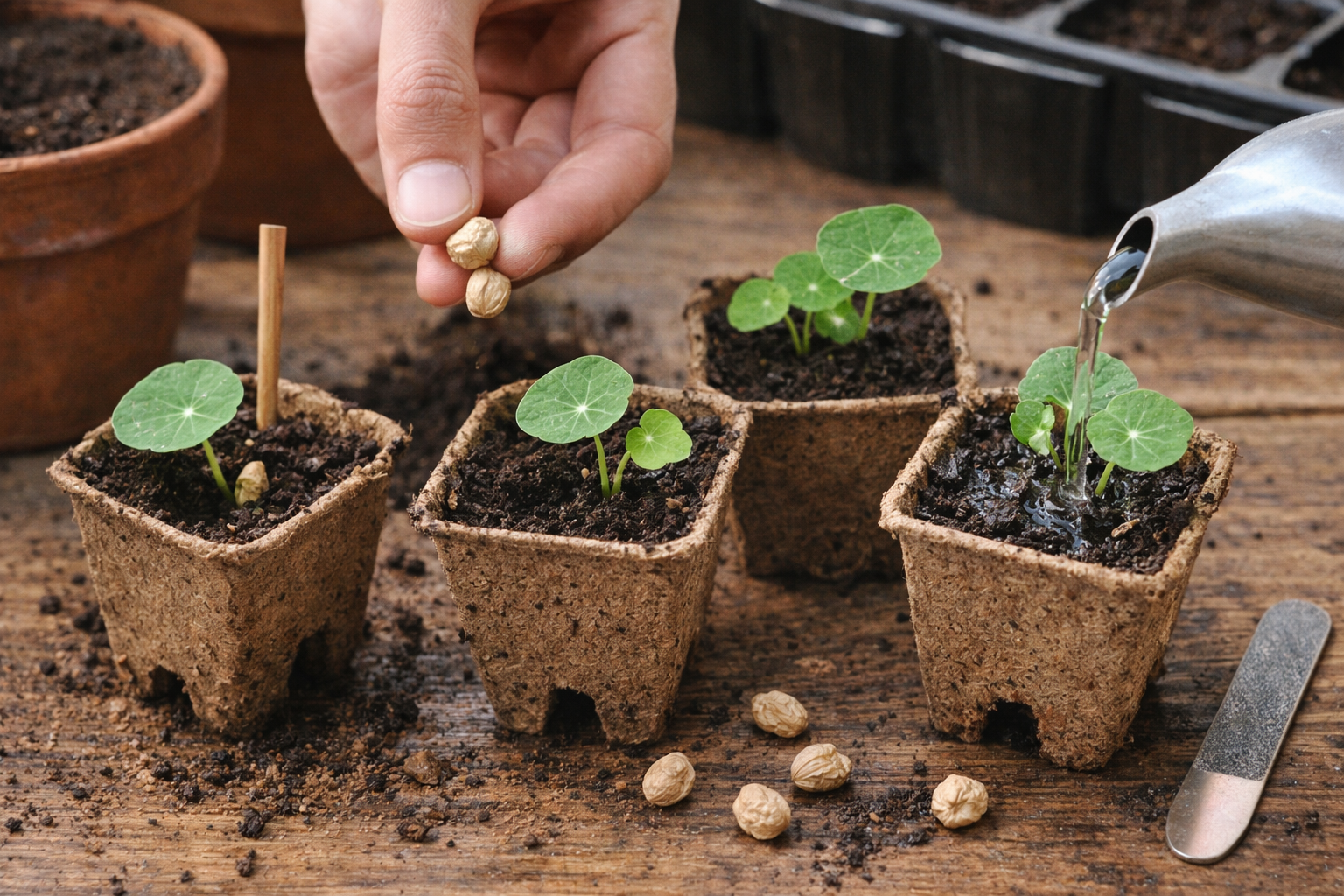
Sow them about 1/2 inch deep in a loose seed-starting mix. Cover them fully. Nasturtiums do not want light to germinate. Keep the mix evenly moist, not swampy, and expect sprouts in around 7 to 14 days.
Warmth helps. NC State Extension notes that most seeds germinate well around 65 to 75F and that scarification helps hard seed coats take in water. That fits nasturtiums nicely. A room-temperature mix works well. A cold sill over a drafty window, less so.
Some gardeners soak nasturtium seeds overnight before sowing. Others nick the coat lightly with a nail file. Both tricks can help water get through the coat faster. I do soak older seed now and then, especially if the batch looks bone-dry, but I do not treat it as mandatory. Fresh seed in warm mix usually sprouts fine without the extra ceremony.
If you’re starting indoors, give each seed a bit of elbow room. Individual cells or small pots are better than dense seed trays. You are not just germinating the seed. You are also trying to avoid a messy root tangle on transplant day.
Note: A sunny windowsill is often weaker than it looks. If seedlings lean hard within a few days, get them under brighter light and closer to it.
Harden off seedlings before the garden chews up your head start
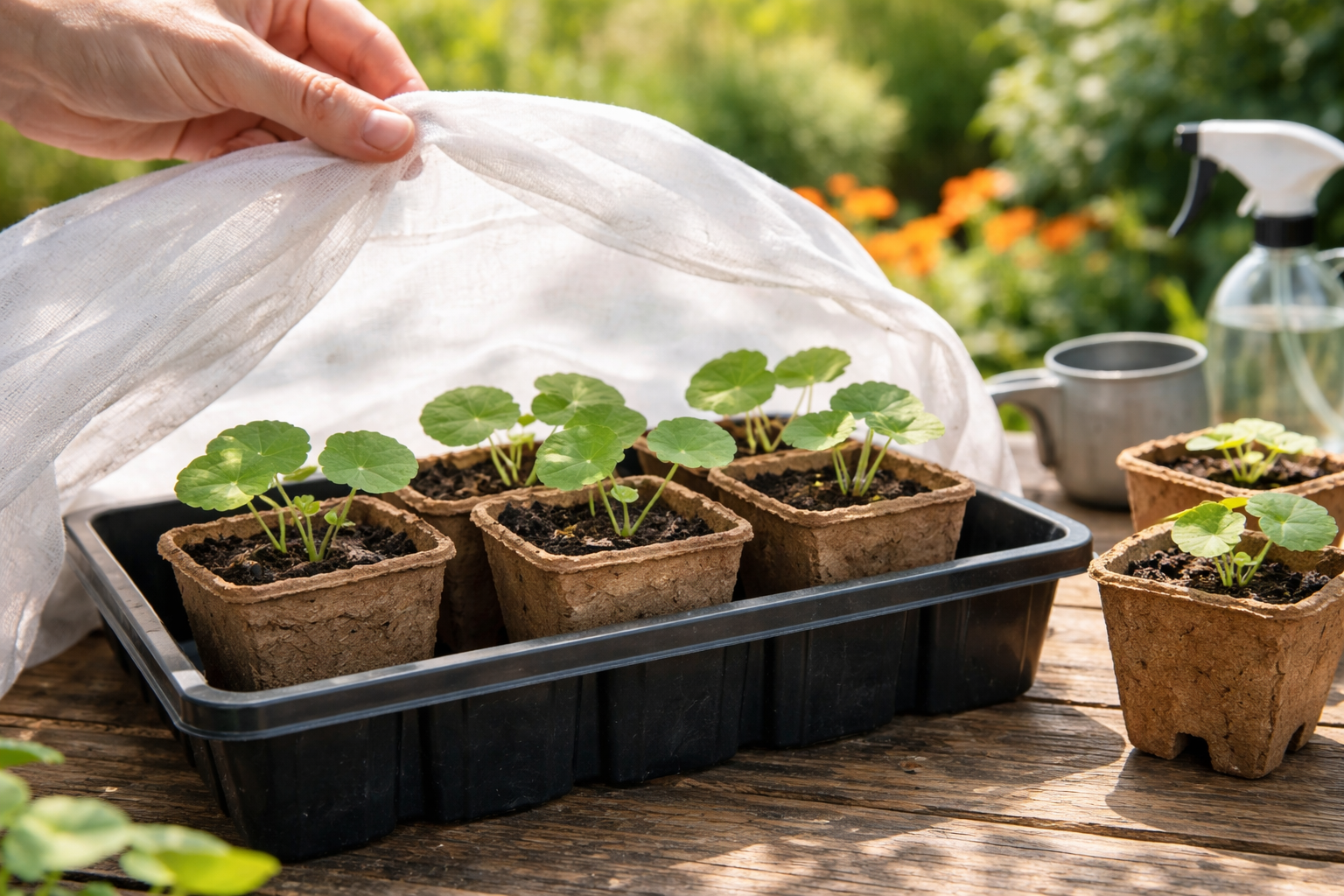
Indoor seedlings live in a pampered little bubble. Stable temperatures, no wind, filtered light, and no real weather. Step them straight from that setup into open air and they can stall, scorch, or fold like damp cardboard.
The Royal Horticultural Society explains that hardening off gradually acclimatises indoor-raised plants to outdoor conditions and notes that the process often takes two to three weeks. That is longer than many gardeners expect. It also points out that hardening off does not make frost-sensitive plants frost-hardy, which is a useful little reality check.
A workable routine looks like this:
- start with a couple of hours outside in bright shade
- bring plants in at night for the first stretch
- increase exposure to light, breeze, and time outdoors bit by bit
- hold off on planting if nights still look sharp or windy
If that sounds slow, well, yes. But the point is to avoid the growth check that wipes out the value of starting indoors in the first place.
Biodegradable pots can help here because the rootball stays more intact at planting time. Even so, tear away any pot rim that sits above the soil line. If that dry edge stays exposed, it can wick moisture away and annoy the root zone. Tiny detail, but it matters.
The mistakes that stall nasturtiums before they ever bloom
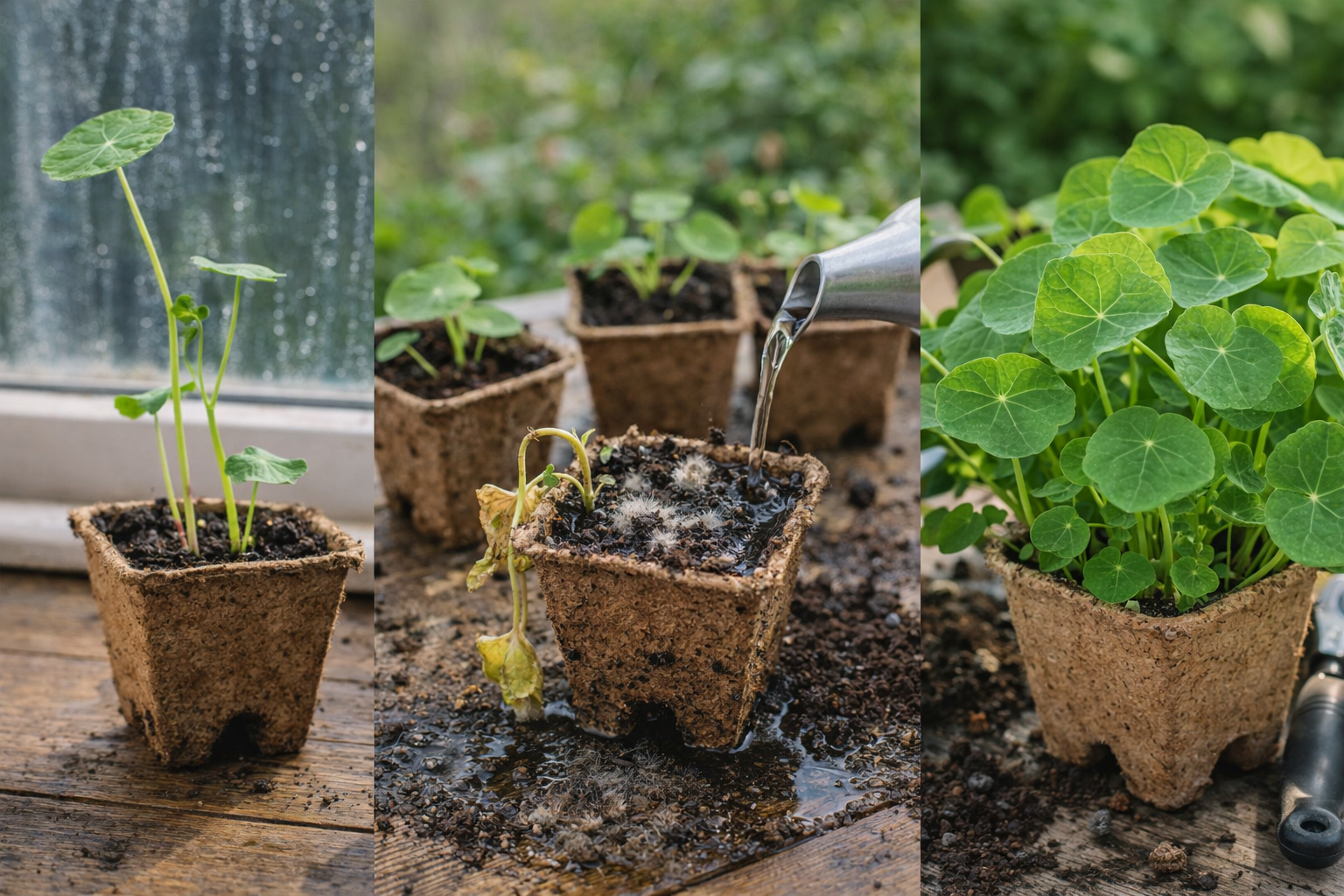
Most nasturtium failures are not mystery failures. They are timing and handling errors with a fake moustache on.
Starting too early is the big one. A seedling that has sat inside too long is much more likely to get leggy, sulk after transplant, or flower later than expected because it spent its first weeks living slightly wrong.
Weak light is next. Nasturtiums stretch fast when the light is poor. Once they do, you can steady them up a bit with better light and gentler handling, but they rarely turn into perfect stout little plugs after that.
Overwatering is the quiet killer. The University of Minnesota Extension notes that damping-off pathogens thrive in cool, wet conditions and get worse with low light, overwatering, and cool soil temperatures. That is the exact swampy combo many indoor trays slide into without anyone meaning to create it.
Cold, wet outdoor soil can cause trouble too. A seed that would pop in warm soil can sit and sulk in chilly ground long enough to rot or emerge weakly. That is one reason direct sowing works beautifully in one week of spring and badly in the week before it.
Too-rich soil is another sneaky one. Nasturtiums are not heavy feeders. Give them lavish nitrogen and they can repay you with lots of leaves and fewer flowers. Pretty foliage is nice, but it is not the whole show.
If seedlings are already leggy: get them into stronger light, stop babying them with extra water, and move toward planting out once weather allows. Repeated potting-up usually makes the situation messier, not better.
Timing shifts for short seasons, mild winters, containers, and late starts
The broad rule works, but a few garden situations change the math.
Short seasons and high elevations. Indoor starting makes more sense here because cold spring soil can chew up valuable time. This is where the 4 to 6 week window becomes useful, as long as seedlings still stay compact by planting day.
Mild-winter and long-season climates. In these gardens, indoor starting is often more trouble than payoff. Direct sowing after the last frost, or after the coolest stretch has passed, is usually the cleaner move.
Containers and window boxes. If the plant will finish in a pot, sowing straight into that final pot is often the best compromise. You skip transplant shock and the roots get one uninterrupted run.
Late starts. Nasturtiums grow quickly enough that being late is not the disaster it is with slower crops. If the weather is warm and the soil is ready, direct sowing late can still give a very decent display. I’ve done this after abandoning a batch of indoor seedlings, and honestly, the outside-sown plants caught up more than once.
Gardens with erratic spring weather. If warm days keep baiting you into planting early and then cold nights keep slapping the garden back into place, hold on a little longer. Nasturtiums are fast enough that waiting for steadier conditions often wins.
If you like a rule you can remember, use this one: when the season is generous, simplify; when the season is stingy, indoor starting earns its keep.
FAQ
Can you start nasturtium seeds indoors without grow lights?
Yes, but only if the light is strong enough to keep seedlings compact. A bright windowsill can work in some homes, though it often falls short. If seedlings lean or stretch within a few days, the light is not doing the job.
Should you soak nasturtium seeds before planting?
Soaking can help speed germination because nasturtium seeds have a firm coat, but it is optional. An overnight soak is enough. If the seed is fresh and the mix is warm, many batches germinate perfectly well without soaking.
Is it too late to sow nasturtiums after the last frost?
Usually, no. Nasturtiums are quick growers. If the soil has warmed and the season still has decent time left, direct sowing after the last frost can work very well. Late sowing is often better than forcing a weak indoor batch to limp along.

Michael Rowan is the founder and lead writer at The Garden Playbook. He has spent 10+ years growing plants across a range of settings — from indoor houseplants and container gardens to raised beds and in-ground plots — adapting methods to different light levels, seasons, and growing conditions.
Michael focuses on practical, experience-based guidance grounded in fundamentals: soil health, watering strategy, plant nutrition, pruning and propagation, and integrated pest management (IPM). His work aims to help readers diagnose common problems (such as yellowing leaves, stunted growth, or pest pressure) and apply straightforward solutions that are realistic for home gardeners.
At The Garden Playbook, Michael develops tutorials and plant guides using a consistent process: documenting real outcomes where possible, explaining the “why” behind each step, and verifying higher-risk topics (such as plant toxicity or pest treatment options) against reputable horticultural references.