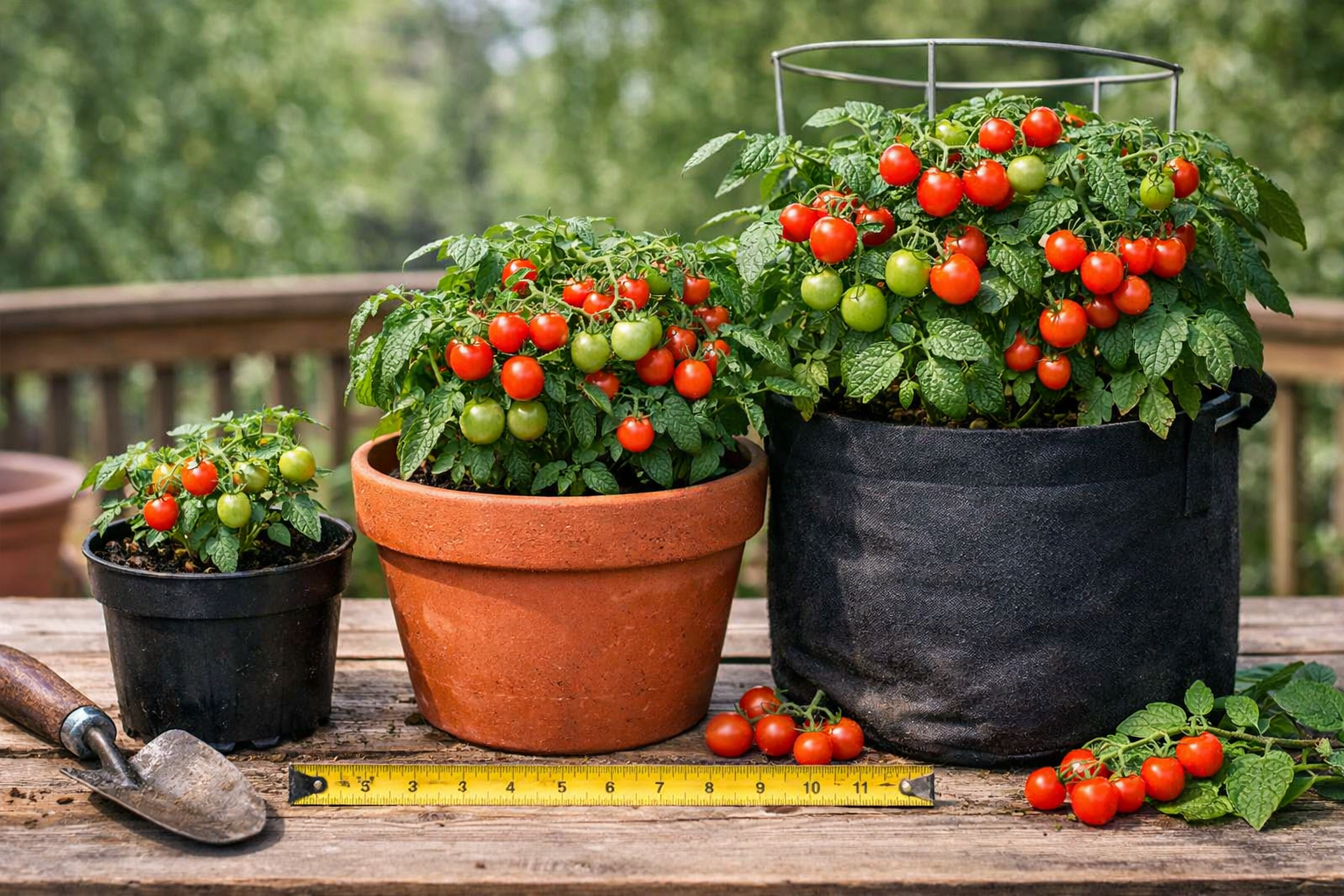
You buy a healthy cherry tomato start, tuck it into a pot that looks plenty big on the patio, water it faithfully for a week, and then summer hits. Suddenly the plant is wilting by midafternoon, the soil is bone-dry by dinner, and you are wondering whether tomatoes are fussy or whether the container was the problem all along.
That is why the usual advice can feel so frustrating. Yes, the common answer to what size pot for cherry tomatoes is often “use a 5-gallon container.” That is not wrong. It is just incomplete. A compact patio cherry, a true micro dwarf, and a vigorous indeterminate cherry tomato do not behave the same way in a pot, and treating them like they do is how people end up with a stressed plant and a much harder season than necessary.
If you want the useful answer, here it is up front: a 5-gallon pot is the practical minimum for many compact cherry tomato plants, but 7 to 10 gallons is usually the smarter choice if you want steadier moisture, less stress, and a more forgiving setup. For larger, fast-growing indeterminate cherry tomatoes, 10 gallons or more is the better call.
In the rest of this guide, you will see how to match the pot to the plant, how to tell when a container is technically big enough but still a poor fit, and what to do if your tomato is already struggling in a too-small pot.
What you’ll learn
- When 5 gallons is enough, and when it is just the bare minimum
- How plant type changes the right container size
- Why pot shape matters almost as much as pot volume
- How heat, wind, and watering habits change your decision
- The warning signs that your current pot is too small
What size pot for cherry tomatoes? Here’s the useful answer
If all you want is the short version, use this rule:
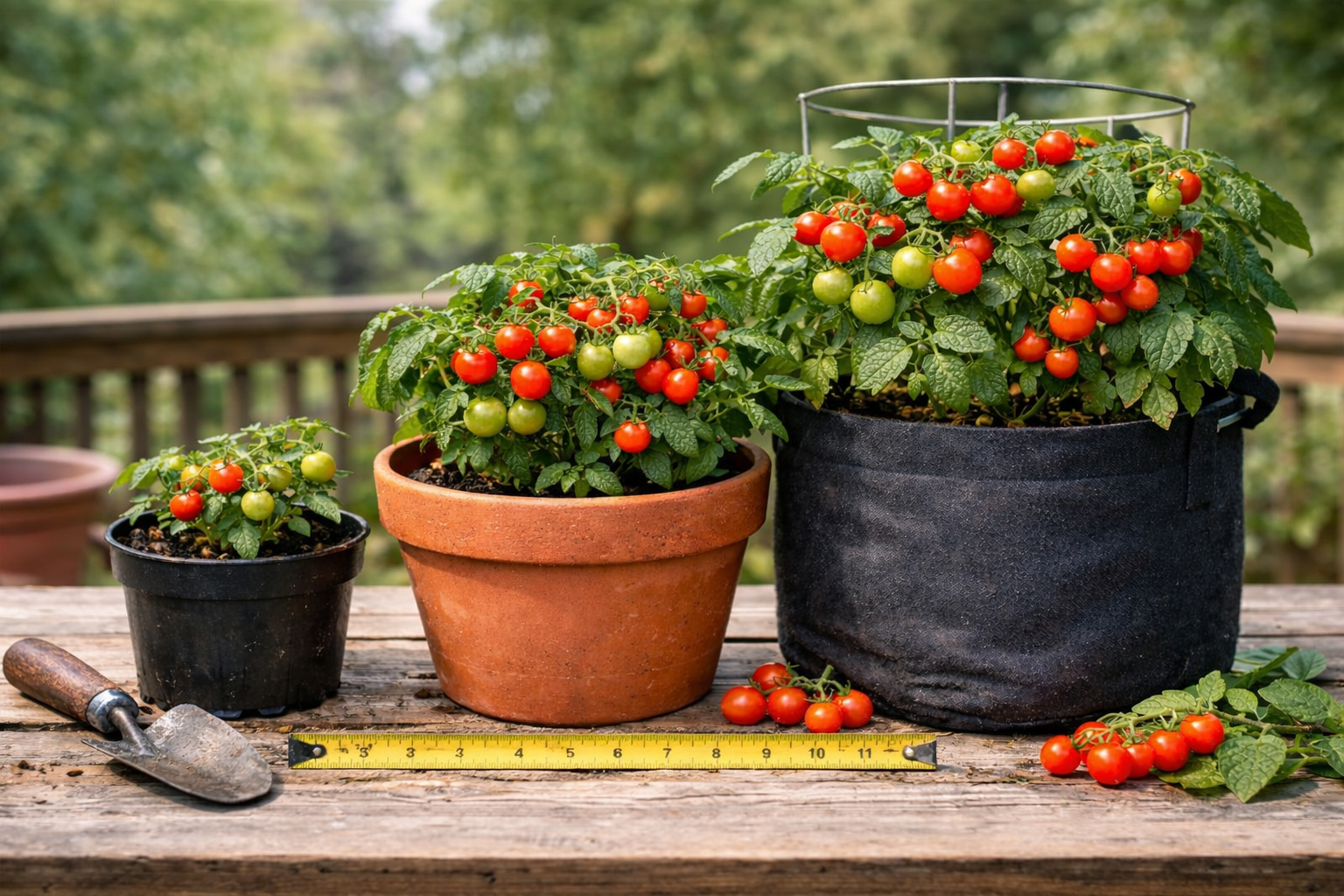
- True micro dwarf cherry tomatoes: sometimes fine in 1 to 3 gallons, but only if the variety is genuinely tiny.
- Compact patio or dwarf cherry tomatoes: about 5 gallons is the practical minimum.
- Most home growers: 7 to 10 gallons is the sweet spot for an easier season.
- Vigorous indeterminate cherry tomatoes: 10 gallons or more is the safer bet.
I have grown cherry tomatoes in containers that were just big enough on paper and in containers that were generous enough to make life easy. The difference is not subtle. In a minimum-size pot, the plant usually survives and may even produce well for a while, but it asks more from you. You end up watering more often, feeding more carefully, and reacting faster when the weather turns hot or windy. In a larger pot, the plant has a buffer. That buffer is what makes container growing feel manageable instead of needy.
So the real decision is not just “What is the smallest pot that works?” It is “How much margin do I want?” A 5-gallon container can work. A 7- to 10-gallon container is usually what makes the whole setup feel steady.
Key takeaway: If you want the shortest correct answer, start at 5 gallons. If you want a less stressful season, move up to 7 to 10 gallons.
The pot-size rule that actually helps: match the container to the kind of cherry tomato
The biggest source of confusion is simple: “cherry tomato” describes the fruit size, not the plant size. A cherry tomato plant can stay neat and compact, or it can grow into a vigorous vine that keeps reaching, flowering, and fruiting long after a small pot has stopped being a fair match.
That is why it helps to think in three groups.
Micro dwarf and tiny patio cherries are the exceptions. These are the small-space specialists. If you are growing one of these, a smaller container may genuinely be appropriate. A 1- to 3-gallon pot can be enough when the variety is bred to stay tiny.
Compact patio and dwarf cherry tomatoes are where the 5-gallon advice starts to make sense. These plants are still manageable in a container, but they are not toy plants. They need enough root room to support steady growth and fruiting. This is the zone where a 5-gallon pot is often workable and a 7-gallon pot starts to feel noticeably easier.
Indeterminate cherry tomatoes are the ones that catch people off guard. Small fruit does not mean a small plant. These are the sprawling, climbing, constantly-producing cherries that can turn a cute container into a daily hydration emergency by midsummer. For these, I would rather see a gardener start too big than too small. If you are growing a vigorous variety, 10 gallons is not overkill. It is common sense.
If you are unsure which type you have, variety choice matters more than most people realize. A guide to the best tomato varieties for containers can help you tell whether your plant is naturally compact or likely to outgrow a smaller setup fast.
Common mistake: Assuming small fruit means a small plant. With cherry tomatoes, that assumption causes more undersized-container problems than almost anything else.
Minimum vs better vs ideal: how to choose without overthinking it
When readers ask about pot size, they are usually asking one of three questions without realizing it:
- What is the smallest pot that can work?
- What is the smartest pot for an average gardener?
- What gives me the best chance of an easy, productive season?
Those are not the same question, so they should not get the same answer.
Minimum: If you have a compact cherry tomato and you are attentive about water and feeding, a 5-gallon pot may work well enough. This is the answer for the gardener who already owns the container and wants to make it work.
Better: If you are choosing from scratch and want the setup most people end up happiest with, 7 to 10 gallons is usually the sweet spot. This size gives you more room for roots, more moisture buffering, and fewer panic moments in heat.
Ideal for vigorous plants or tough conditions: If the plant is indeterminate, your patio gets blasted with sun, your space is windy, or you know you occasionally miss a watering, 10 gallons or more is the smarter move.
This is where the decision gets practical. If your summer is mild and you are home enough to keep an eye on the pot, the minimum may be fine. If your balcony bakes in reflected heat, or you work long days and water when you can, the minimum becomes a gamble. A bigger pot will not solve every problem, but it gives you room for ordinary human imperfection.
I tend to think of it like shoes. A minimum-size pot is like squeezing into footwear that technically fits. You can walk in it. You just would not choose it for a long day.
Use this quick rule
- If your plant is compact and your care is consistent, 5 gallons can work.
- If you want more forgiveness, move to 7 to 10 gallons.
- If your plant is a vigorous vine or your growing conditions are harsh, go 10 gallons or larger.
Width, depth, and shape matter more than people think
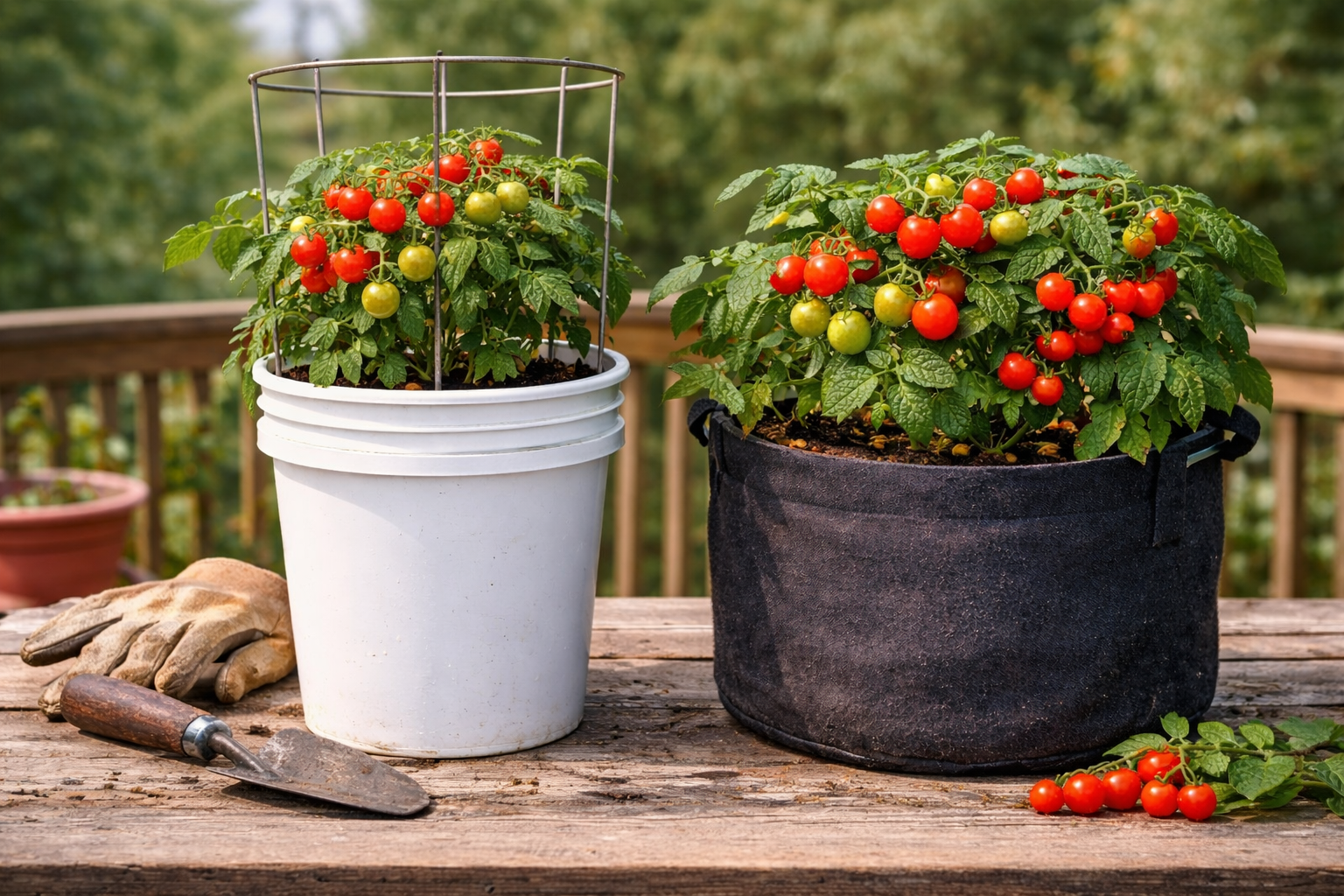
Volume matters, but shape matters too. Two containers can hold roughly the same amount of mix and still behave very differently in the real world.
A pot that is around 12 inches deep is a useful baseline for tomatoes, and wider containers are often easier to manage than tall, narrow ones. The University of Maryland Extension recommends thinking about both depth and overall size when matching vegetables to containers, and that advice lines up with what many gardeners learn the hard way.
A narrow bucket-style container can dry unevenly, tip more easily once the plant gets tall, and feel cramped sooner than you expected. A wider planter with a similar volume often gives you better stability, better support for the root zone, and a more forgiving watering pattern. In practice, that means a broad 7-gallon container may be easier to live with than a tall, skinny pot that looks similar on the label.
This also matters when people try to grow cherry tomatoes in decorative containers. A pot can be beautiful and still be a poor choice if it is too narrow, too shallow, or awkward to stake. The roots are not reading the style notes.
For most cherry tomatoes, aim for a container that is not just deep enough, but also wide enough to stay stable and hold moisture a little longer. On a breezy deck or balcony, that extra width pays for itself quickly.
Common mistake: Buying by gallon label alone. A “5-gallon” pot that is narrow, tippy, and cramped can be much less forgiving than a wider container with a similar volume.
Why bigger pots usually win, even when a smaller one can work
There is a reason so many experienced container gardeners eventually size up. Bigger pots do not just mean bigger plants. They mean more stability.
With more soil volume, the roots have more room to spread, moisture lasts longer, nutrients do not wash through quite as quickly, and the root zone does not swing as wildly between soaked, dry, hot, and stressed. In containers, that buffering is everything. Small pots are more fragile systems. They can work, but they react faster to every mistake and every weather shift.
This is especially obvious in midsummer. The University of Minnesota Extension notes that container plants may need daily watering, or even more often during hot weather, and repeated watering can also wash nutrients out of the potting mix. That is the quiet reason bigger containers so often outperform smaller ones. They give you more time before the plant hits stress.
In my own containers, the jump from a bare-minimum pot to a larger one did not just improve growth. It changed the rhythm of care. The larger containers were less dramatic. They did not go from “fine” to “collapsed” in a single hot afternoon. That matters if you want growing tomatoes to feel satisfying rather than like a summer-long rescue mission.
Of course, bigger is not free. Larger containers are heavier, need more potting mix, and take up more space. But if the choice is between a smaller pot that saves room and a bigger pot that saves the plant from repeated stress, I would rather trim somewhere else.
Here’s what nobody tells you: many “pot size” failures are really watering-buffer failures. The container was not just small. It gave you almost no margin for heat, wind, or a missed watering.
The hidden factors that change the right pot size for you
The right container size is not just about the plant. It is also about your conditions and your habits.
Heat makes a minimum-size pot behave smaller. A 5-gallon container in a mild climate is one thing. A 5-gallon container on a sun-baked patio surrounded by concrete is another. The hotter the site, the more I lean toward the larger end of the range.
Wind dries pots faster and makes tall plants more unstable. On balconies and exposed decks, you are not just choosing for root room. You are choosing for moisture retention and balance.
Container material changes the experience too. Porous materials can dry faster. Thin dark containers can heat up more in strong sun. Fabric pots are useful and popular, but they often dry more quickly than rigid containers, especially in hot, breezy weather.
Your watering habits matter more than people like to admit. If you enjoy checking your plants daily and you are usually home, you can get away with a tighter setup. If you travel, work long hours, or sometimes forget until the leaves tell on you, a larger container is one of the easiest ways to reduce stress.
Support style matters as well. A compact tomato in a small cage is one thing. A vigorous cherry tomato tied to a sturdy stake or trellis needs a stable base. A larger pot helps anchor the whole system.
If your goal is low maintenance, it is also worth considering the setup as a whole, not just the pot size. A self-watering container can make a smaller growing area much more forgiving, and the Royal Horticultural Society also points out that tomatoes are particularly thirsty crops for container growing. That is exactly why the smallest possible pot is rarely the easiest answer.
Signs your cherry tomato pot is too small, and what to do next
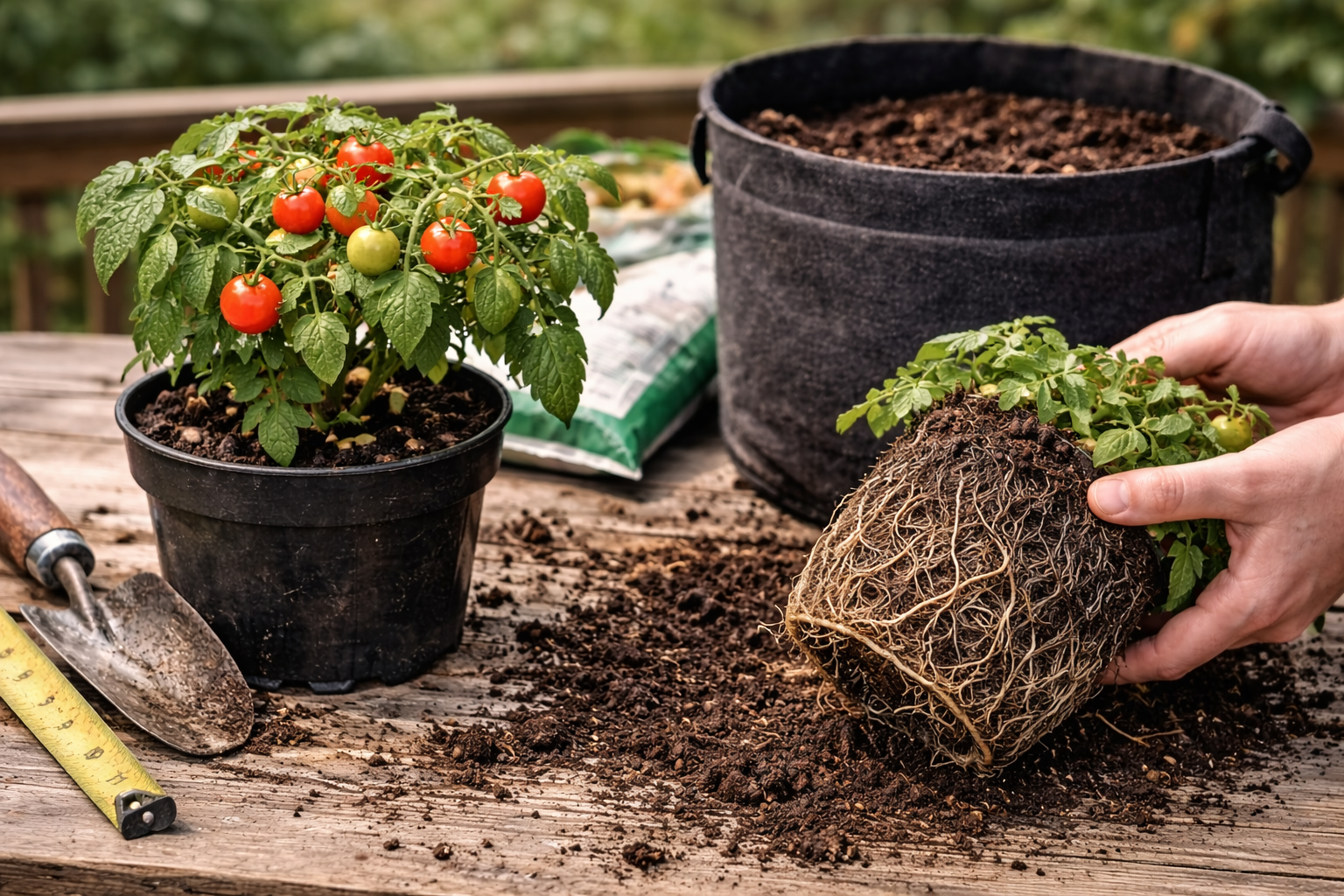
Sometimes you do not realize the pot is the issue until the season is underway. The plant tells you, but not always in obvious ways.
Here are the warning signs I take seriously:
- The plant wilts by midday even though you watered recently
- The potting mix dries out extremely fast
- You feel like you are always trying to catch up with watering
- The plant is top-heavy and unstable
- Growth stalls even though the plant looked fine early on
- Fruit production feels disappointing for the size of the plant
- You notice roots crowding the container or circling heavily
Not every one of these points automatically means the container is too small. Heat, nutrition, and inconsistent watering can overlap. But when several of them show up together, pot size is usually part of the story.
If the plant is still early enough in the season and not yet a tangled monster, repotting into a larger container can help more than people expect. Water it well before moving, disturb the root ball as little as possible, and support it immediately in the new pot.
If repotting is not realistic, you can still reduce the stress. Add mulch over the potting mix to slow evaporation. Tighten up your watering schedule. Feed regularly according to your fertilizer’s directions. Make sure the plant has proper support so the container is not fighting both drought and instability at once.
Late in the season, I am less eager to repot a huge fruiting plant unless the situation is truly bad. At that point, steadier watering and feeding may be the better move. The goal becomes helping it finish well, not forcing a major reset.
Key takeaway: If the plant keeps asking for rescue, the container is not really working. A pot that is “technically enough” but constantly pushes the plant into stress is still too small in practice.
Common container mistakes that quietly shrink your harvest
Most disappointing container tomatoes are not the result of one dramatic mistake. They are the result of a few small choices that compound.
Putting two plants in one standard container is one of the most common. Even with cherry tomatoes, one plant per pot is usually the better rule. If you are deciding how to pair plant count with container size, this guide on how many tomato plants per container clears up the overlap without making the decision feel complicated.
Using garden soil instead of potting mix is another quiet problem. Garden soil compacts, drains poorly in containers, and often creates a root environment that feels heavy rather than airy.
Ignoring drainage is a classic beginner error. A pot without enough drainage holes can look fine at first and then become a stress trap once the roots are established.
Choosing a pot for looks first causes more trouble than people expect. Decorative containers are great when they also meet the plant’s needs. They are a headache when they are too small, too shallow, too dark in full sun, or too unstable to support a loaded tomato plant.
Adding support too late is another issue. Tomatoes do not get easier to cage or stake after they have already sprawled. If the plant needs structure, install it early.
Underestimating feeding needs matters too. Containers are closed systems. Once the plant starts growing hard and fruiting steadily, the potting mix alone will not carry the whole season.
Common mistake: Seeing a plant survive in a small pot and assuming the setup is good. Survival and ease are not the same thing. Neither are survival and strong production.
Best container setups by scenario: balcony, patio, hanging basket, and bucket
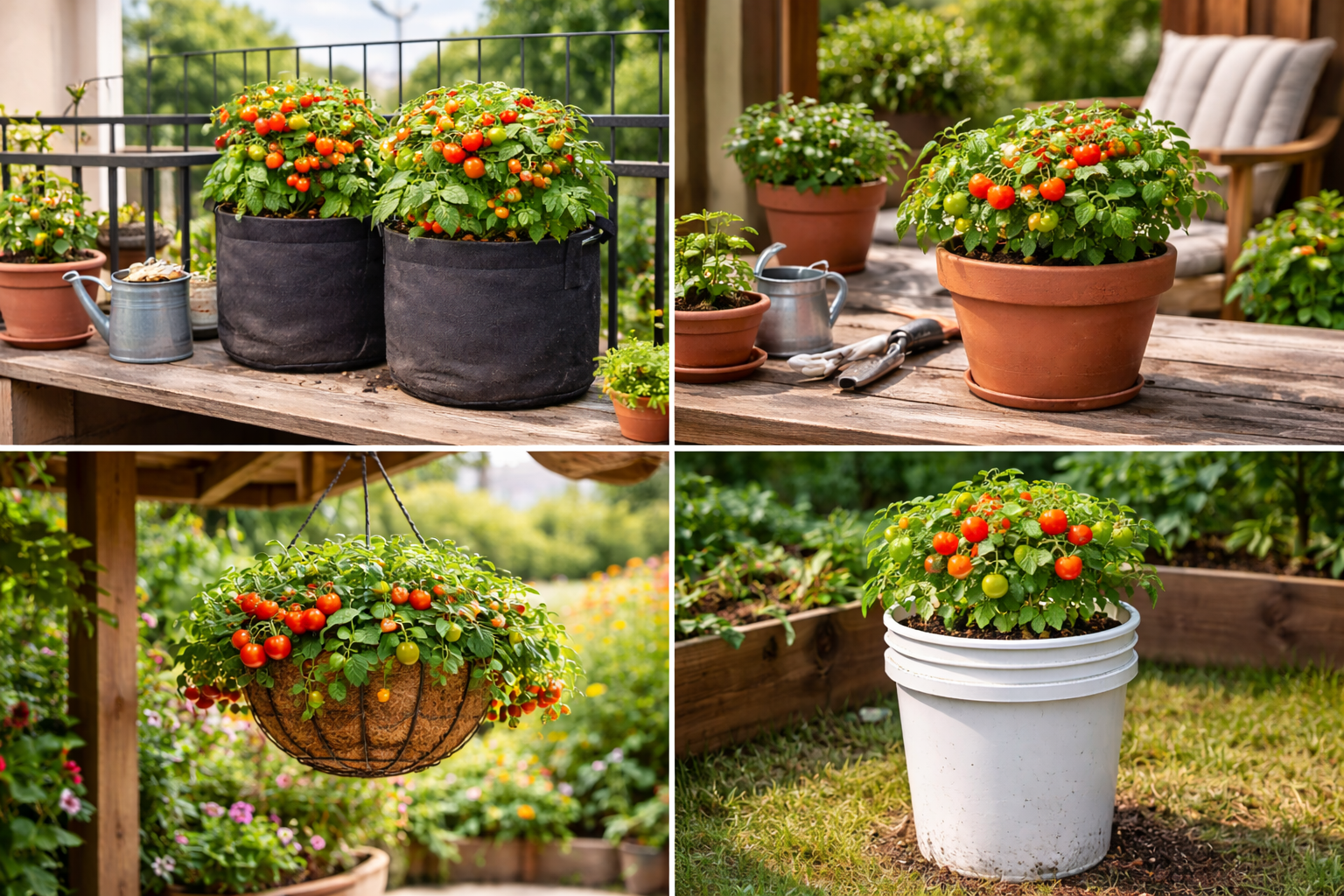
Sometimes the easiest way to choose is by growing situation rather than by theory.
For a hot, windy balcony: lean bigger. This is where 7 to 10 gallons, or even more for a vigorous variety, starts making real sense. Moisture disappears faster, and narrow containers can become frustratingly unstable.
For a small patio with a compact variety: a 5-gallon container can work, especially if you are home enough to monitor water closely. If you have the room, a 7-gallon container is still a nicer place to land.
For a vigorous vining cherry tomato: think 10 gallons or larger, plus a support system you trust. This is not the plant to squeeze into a decorative pot and hope for the best.
For a hanging basket: only use this approach for varieties that are genuinely suited to basket growing. Some trailing or extra-compact cherries can look great there, but a standard cherry tomato is often a poor fit. Hanging baskets dry fast and give you very little margin.
For a bucket setup: a food-grade 5-gallon bucket can be workable, but it is still the minimum zone for many cherry tomatoes. Make sure it has adequate drainage and understand the tradeoff. Buckets are practical, but they are often narrower and less forgiving than wider planters with a similar volume.
If you are still deciding between “Can I make this work?” and “What will make this easy?”, that is really the whole container conversation in one sentence. A lot of setups can work. Fewer of them work comfortably.
The close variant people often ask is “what size container for cherry tomatoes if I want fewer headaches?” The answer stays the same: do not chase the minimum unless you actually need the minimum.

Michael Rowan is the founder and lead writer at The Garden Playbook. He has spent 10+ years growing plants across a range of settings — from indoor houseplants and container gardens to raised beds and in-ground plots — adapting methods to different light levels, seasons, and growing conditions.
Michael focuses on practical, experience-based guidance grounded in fundamentals: soil health, watering strategy, plant nutrition, pruning and propagation, and integrated pest management (IPM). His work aims to help readers diagnose common problems (such as yellowing leaves, stunted growth, or pest pressure) and apply straightforward solutions that are realistic for home gardeners.
At The Garden Playbook, Michael develops tutorials and plant guides using a consistent process: documenting real outcomes where possible, explaining the “why” behind each step, and verifying higher-risk topics (such as plant toxicity or pest treatment options) against reputable horticultural references.