
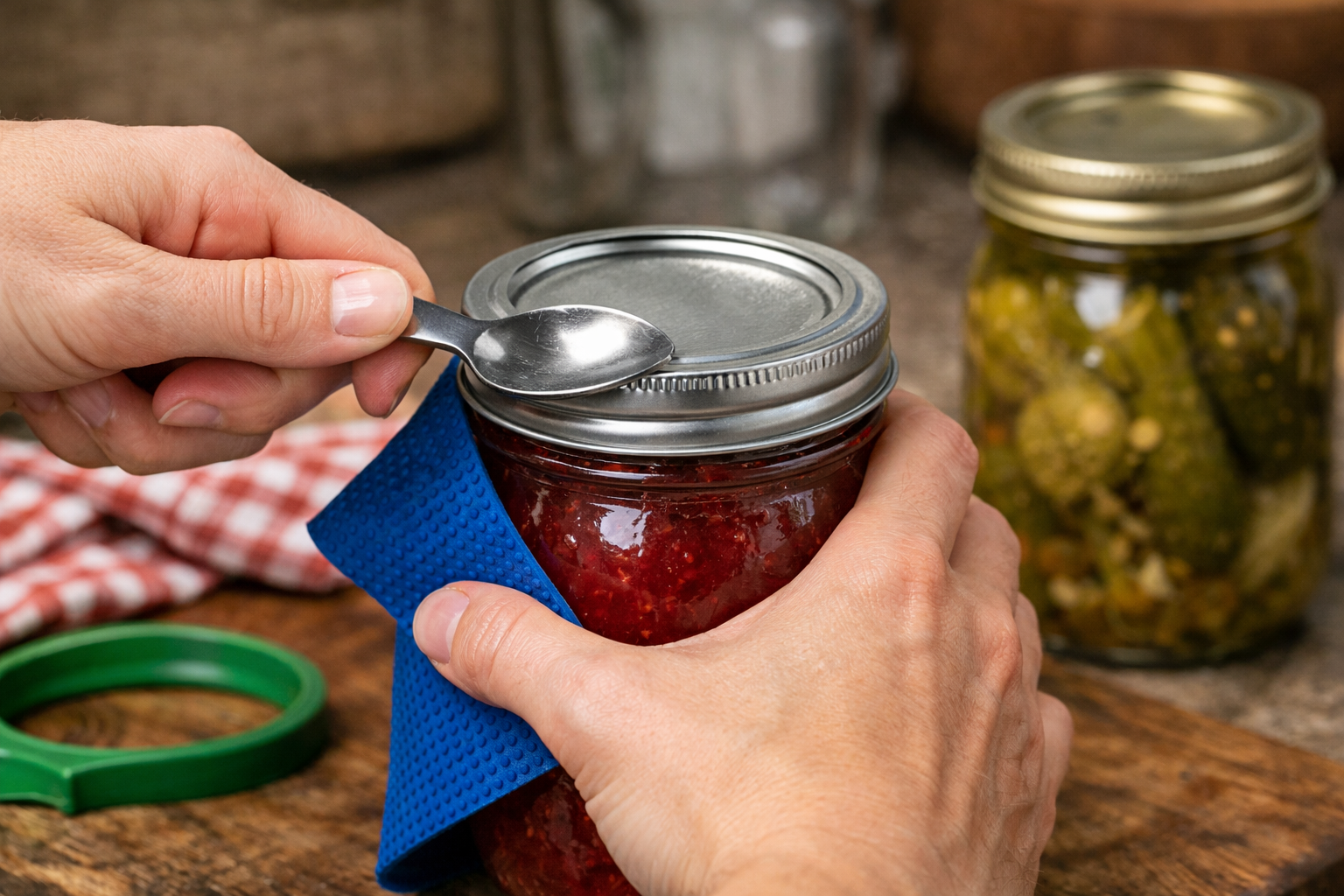
Most stuck Mason jars are not actually “too tight.” They’re either slick, vacuum-locked, or glued in place by dried sugar, brine, or a rusty band. If you’re trying to figure out how to open sealed mason jar lids without cracking glass or gouging the lid with a knife, start simple: dry the lid, add grip, and if it still will not budge, break the vacuum seal with a spoon or bottle opener. Then twist again. If the jar is bulging, leaking, cracked, or spurts when opened, stop there and throw it out.
That’s the useful version of the answer. The generic advice you see everywhere misses the part that matters: the right fix changes with the kind of seal you’re dealing with. I’ve had pickle jars open with one rubber band and a grunt, and I’ve had jam jars act like they were welded shut until the seal gave a neat little pop.
Here’s what you’ll get in the next few minutes:
- The fastest safe order to try, so you do not waste time on the wrong trick
- How to tell whether the problem is grip, vacuum pressure, sticky residue, or a rusted canning ring
- When hot water helps and when it just makes the lid slippery
- How two-piece Mason jar lids behave differently from regular one-piece lids
- The food-safety signs that mean the jar should not be eaten
- A short prevention routine that keeps this from happening again
At a glance: what to do first
| What you notice | What it usually means | Try this first |
|---|---|---|
| The lid slips in your hand | Traction problem | Dry it, then use rubber or silicone for grip |
| The lid feels locked solid | Vacuum seal | Slip a spoon or bottle opener under the edge and release the seal |
| The band will not turn at all | Sticky residue or rust | Warm the band briefly, dry it, then try again |
| The screw band comes off but the flat lid stays on | Two-piece Mason jar seal is still holding | Lift the flat lid edge gently to let air in |
How to Open a Sealed Mason Jar Fast
-
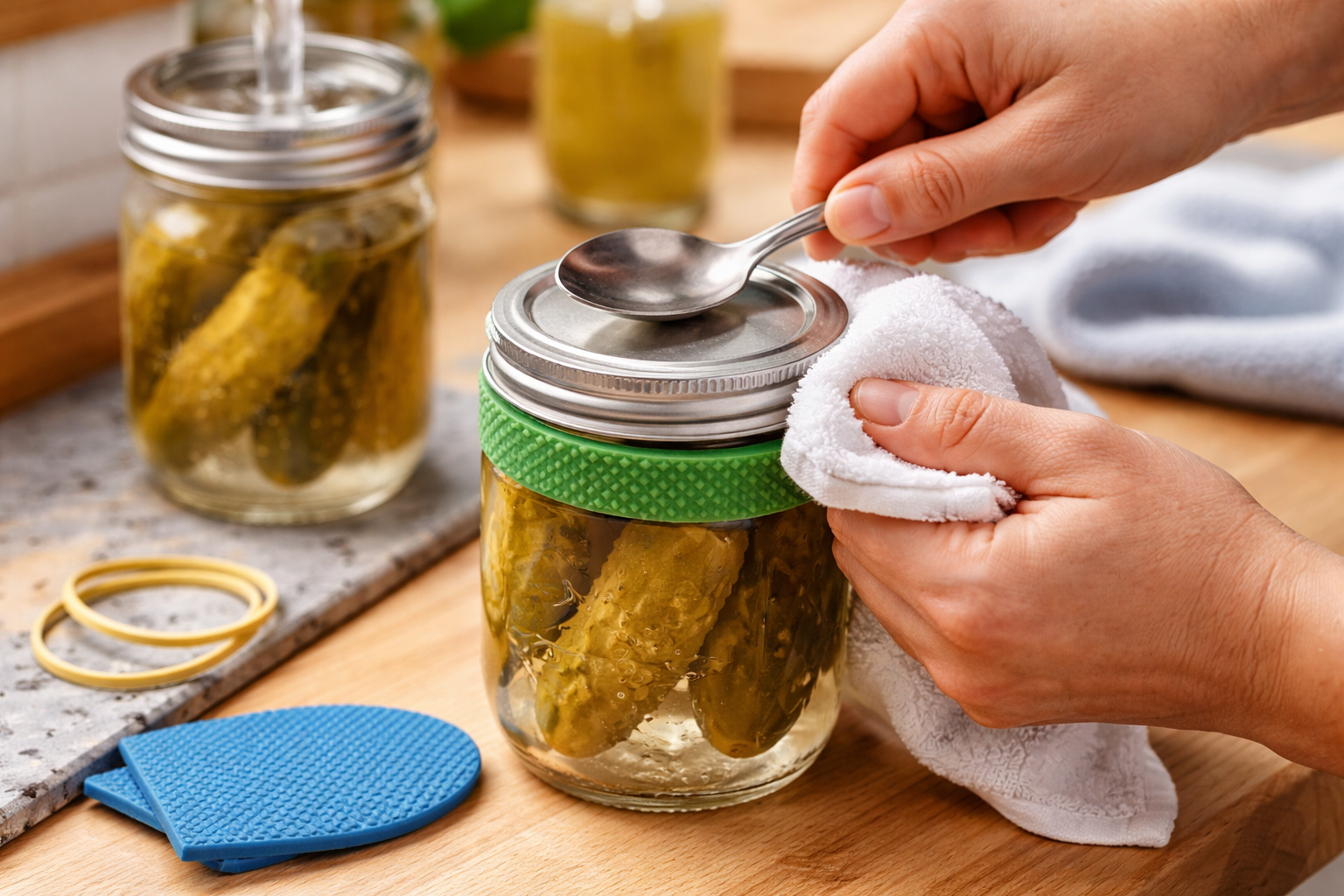
Dry the lid so your grip stops slippingMoisture is the dumb little thing that ruins half these attempts. Wipe the lid, the threads, and your hand. If the jar came out of the fridge and feels sweaty, dry the glass too.
-
Add traction so the lid can actually turnUse a rubber band, silicone pad, or grippy glove. If the seal is only mildly tight, that may be enough.
-
Break the seal so pressure stops pinning the lid downSlide the edge of a spoon or bottle opener under the lid and lift gently until you hear or feel a pop. Then twist again.
-
Warm the lid if residue or metal tension is still hanging onRun hot water over the metal lid for about 15 to 30 seconds, dry it, and retry with grip.
If you only remember one sequence, make it this one: dry, grip, pop, twist. Three moves. No wrestling match.
Important: Skip the chef’s knife. It slips, it chews up the lid, and it turns a stuck jar into a hand injury fast.
A quick rule helps here. If the lid feels slick, treat it like a grip problem. If it feels locked, treat it like a seal problem. If the ring is crusty or orange with rust, treat it like a residue problem first.
Why Mason Jar Lids Get Stuck in the First Place
There are three usual suspects, and they do not behave the same way.
The first is vacuum pressure. The USDA notes that a vacuum seal forms as food cools, which is why a properly sealed jar can feel like it’s being held shut from the inside. That’s not stubborn threading. That’s pressure.
The second is dried residue. Jam, syrup, tomato sauce, pickle brine, honey, all of it can dry on the threads and act like glue. This is the one that fools people. They assume the jar is “sealed tight” when it is really just sticky.
The third is rust or mineral buildup on a canning band. That shows up more on older home-canned jars or jars stored with the screw bands still on. It feels rough, gritty, and uncooperative in a different way.
Quick diagnosis
- Lid slips but moves a hair: not enough traction
- Lid feels rigid and silent: vacuum seal is still intact
- Band turns off but flat lid stays down: the canning lid is still sealed
- Band will not turn and feels crusty: residue or rust is the likely problem
That little dimple in the center of a properly sealed home-canned lid is not cosmetic, either. The National Center for Home Food Preservation explains how jars cool for 12 to 24 hours and then show a concave lid when sealed. Once you know that, the behavior makes more sense. You’re not just unscrewing metal. You’re undoing a sealed system.
Add Grip First When the Lid Is Tight but the Seal Is Not Locked
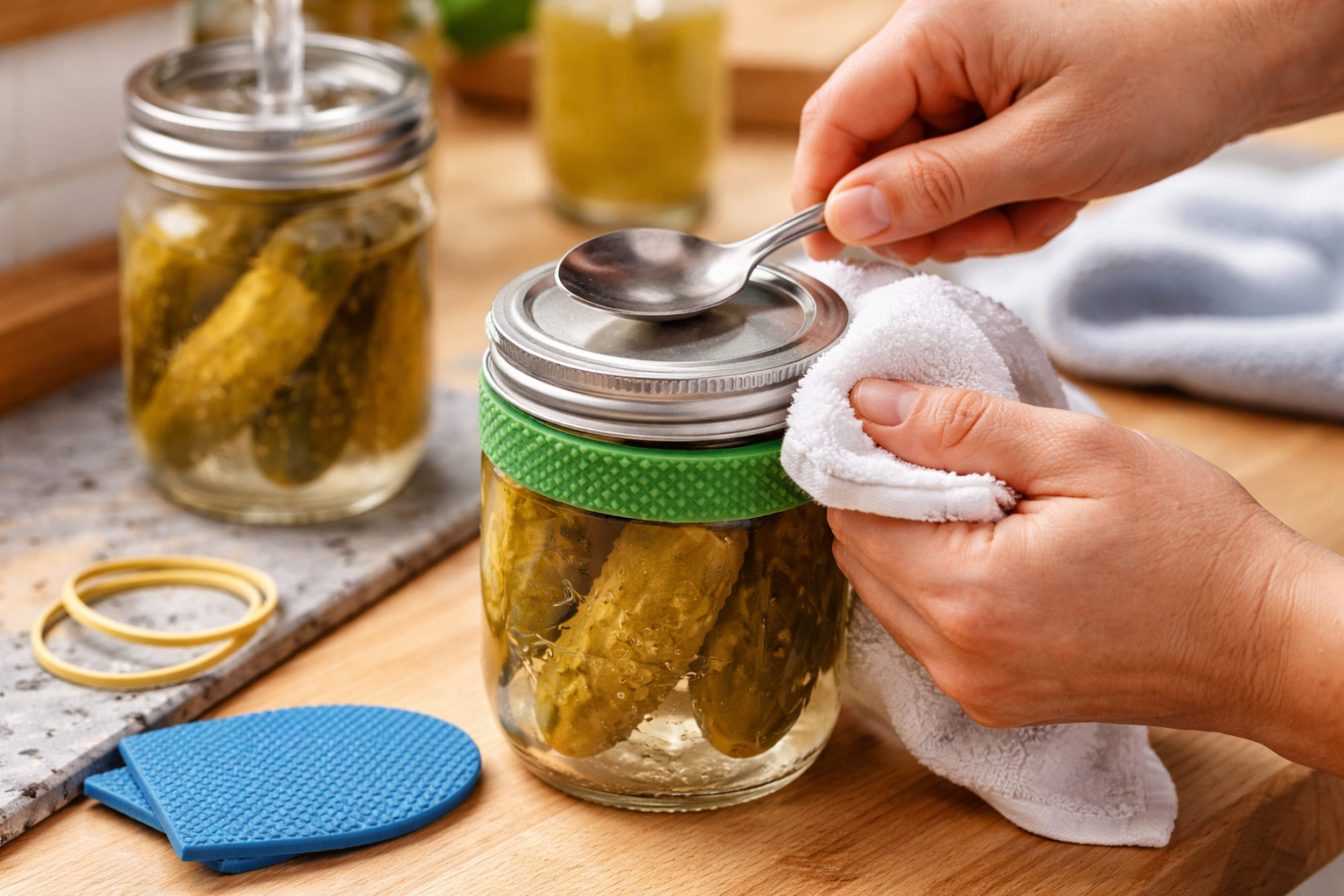
This is the easiest win, and it is where I’d start unless the jar feels completely deadlocked.
A rubber band around the lid works because it gives your hand something to bite into. A silicone trivet or grip pad works even better because it spreads pressure across more of the lid and stops your hand from slipping off one point. A dry dish towel can help, but only if the towel itself is dry. A damp towel on a damp lid is just a slippery mess in disguise.
If your hands are sore, small, or just tired, change the setup before you add more force. Hold the jar close to your body. Keep your wrist straight. Push with the heel of your hand instead of pinching with your fingers. That one tweak matters more than people think.
Note: Grip fixes help when the lid is ready to turn but your hand cannot transfer enough force. They do very little when the vacuum seal is still doing all the holding.
The common mistake here is squeezing the glass harder instead of improving the grip on the lid. You just tire out your hand and make the jar feel more stubborn than it is.
Break the Vacuum Seal Without Bending the Lid
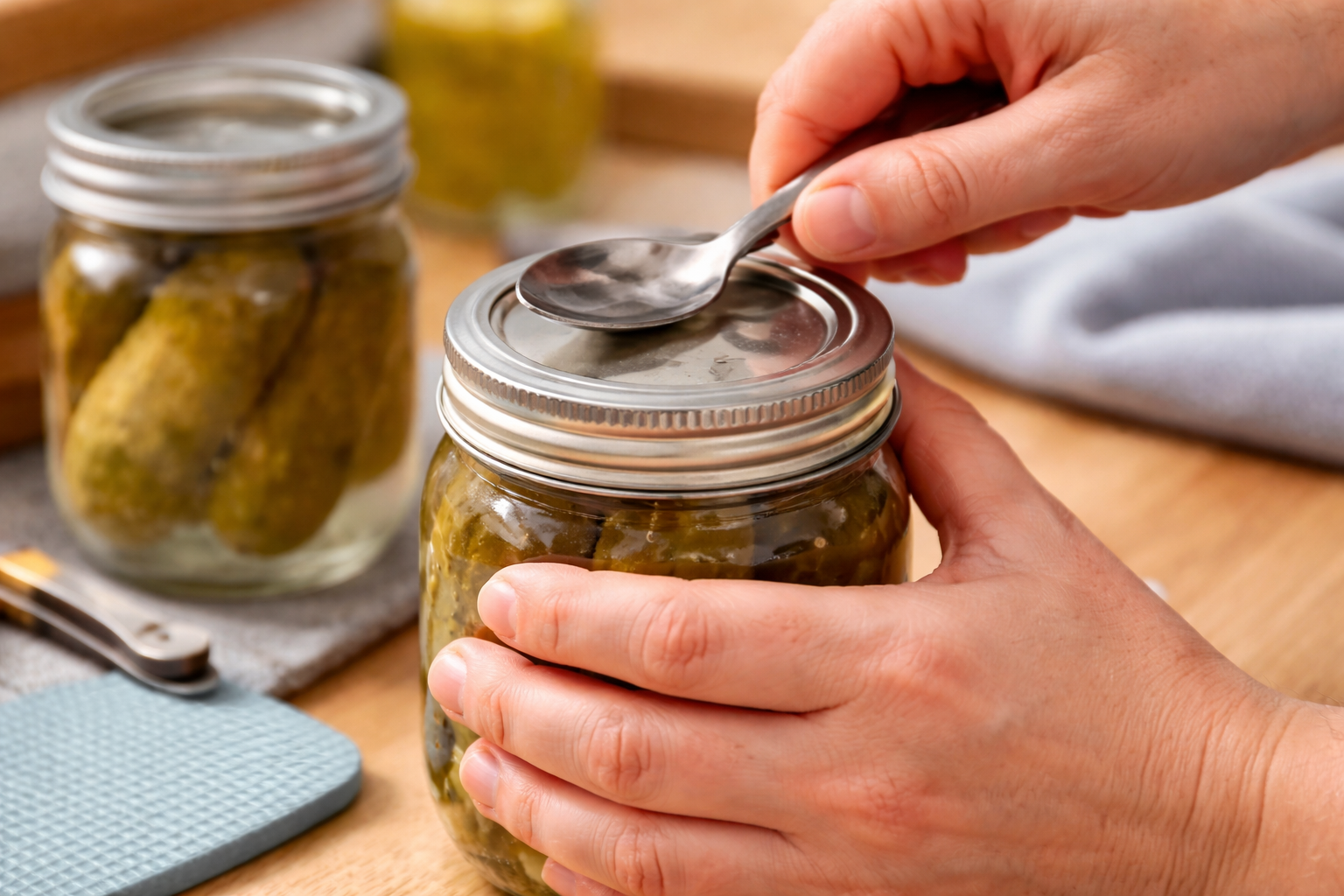
This is the move that opens the jar that “should” have opened three tries ago.
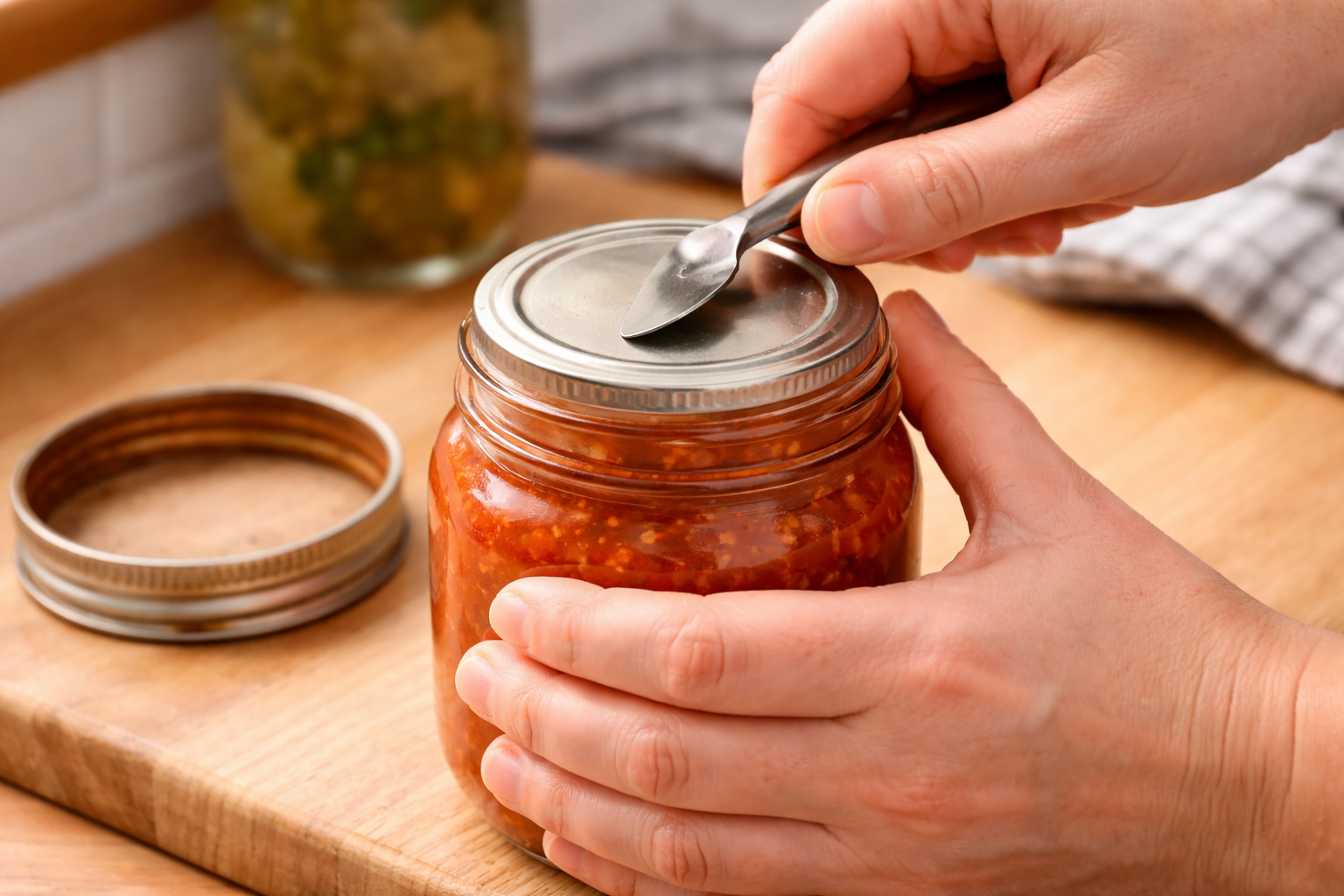
Take a spoon, a bottle opener, or the hook end of a manual can opener. Slip the edge under the lid lip and lift gently. You are not trying to pry the lid halfway off. You are trying to let a whisper of air get in. Once that happens, the seal gives way with a pop, and the jar usually twists open with almost no drama.
That small pop tells you the pressure lock is gone. After that, stop prying and twist. People get into trouble when they keep levering the lid after the seal has already broken. That is how lids get bent and rims get dinged.
I do this with the back edge of a teaspoon a lot, especially on jam jars. One small lift, then done. If the seal is stubborn, try a second spot around the rim instead of forcing the first one higher.
Remember: pry to release air, not to peel the lid off. Tiny movement is enough.
What you should not do is jab a sharp knife tip under the lid. The blade can skid, and even when it does not, it tends to chew the rim and warp the lid more than a blunt tool would.
Use Hot Water and Tapping When Residue or Metal Tension Is the Problem
Heat is not magic, but it has a job. The basic physics of thermal expansion tell us that metal expands when heated, so warming the lid can loosen its grip on the threads. It can also soften sticky residue that is acting like glue.
Run hot water over the metal lid only for about 15 to 30 seconds. Then dry it well and try again with a rubber band, silicone grip, or your seal-release tool. Warming the whole jar is unnecessary most of the time, and with a damaged or suspect jar, that is not a risk worth taking.
Tapping can help, but keep it light. Tap around the lid edge with the handle of a spoon, or give the base of the jar a firm palm tap while supporting the glass. The point is to disturb the seal or residue a bit, not to whack the thing like you’re driving a nail.
Pro tip: Always dry the lid after hot water. Warm and wet is still slippery.
If hot water works once and not the next time, that is normal. This trick helps most when dried-on sugar, salt, or sauce is part of the problem. It is less useful when the seal itself is the whole story.
Open Two-Piece Mason Jar Lids and Rusted Bands the Right Way
This is where Mason jars stop behaving like regular grocery-store jars.
With a two-piece canning lid, the screw band is not the seal. The flat lid is. So if the band spins off easily but the flat lid stays put, nothing is broken. The seal is just still holding. Lift the edge of the flat lid gently with a spoon or bottle opener and it should release.
If the band itself will not turn, that is a different problem. Now you are dealing with residue, rust, or both. Warm the band, dry it, and try a grip aid first. If it is badly rusted onto the jar, work slowly. Forcing a rusted ring is a good way to lose grip and smack the jar on the counter.
Storage habits matter here. The Ball Mason Jars FAQ advises applying bands “fingertip tight” during canning, not cranked down with full force. And the National Center for Home Food Preservation recommends removing the screw bands after the jars have cooled and the seal has been checked. That keeps moisture from getting trapped under the band, and it makes hidden seal failures easier to spot later.
Two-piece lid cheat sheet
- Screw band stuck: treat it like rust or residue
- Band off, flat lid still on: break the vacuum seal on the flat lid
- Band stored on for months: expect more sticking and more rust trouble
Signs a Mason Jar Is Not Safe to Open and Eat
A stuck lid is usually just annoying. Sometimes it is a warning.
The Centers for Disease Control and Prevention warns against eating food from jars that are bulging, leaking, or spurting. Add cracked glass, mold, foam, odd discoloration, or a bad smell to that list. When those signs show up, the problem is no longer mechanical.
Do not taste suspicious food to “check.” That is one of those kitchen habits people pass around like it is sensible, and it really is not. If a home-canned jar gives you spoilage clues, toss it.
Important: Resistance by itself is not the red flag. Resistance plus bulging, leaking, cracking, spurting, or visible spoilage is.
One more nuance here. A jar can be safely sealed and still hard to open. A jar can also be unsafe and open easily. So do not read “tight lid” as a safety test. It isn’t one.
How to Keep Mason Jars From Getting Stuck Again
Prevention is mostly boring little habits, which is annoying because boring little habits work.
Wipe the threads and rim before you close jars with sticky food. Jam, jelly, syrup, and honey are repeat offenders. On storage jars, tighten the lid snugly, not like you’re torquing a wheel nut. On home-canned jars, follow the canning rule and keep bands fingertip tight during processing. After the jars cool and you confirm the seal, take the screw bands off for storage.
If the jar is headed into the fridge after opening, keep the rim clean there too. Dried brine and crystallized sugar do not care whether the jar lives in a pantry or on the top shelf next to the leftovers.
A simple rule that actually sticks
Clean rim, light hand, band off for storage.
If you keep fighting the same jars, give yourself a small assist and keep a silicone grip pad in the drawer. Not because you need a gadget for every kitchen problem, but because it solves this one without fuss.
FAQ
Can you open a sealed Mason jar without any tools?
Yes, sometimes. If the problem is just poor grip, drying the lid and using a rubber band, silicone pad, or dry towel is often enough. If the jar is vacuum-sealed, though, a spoon or bottle opener makes the job much easier.
What if the screw band comes off but the flat lid stays on?
That means the vacuum seal is still holding the flat lid in place. Slip a spoon or bottle opener under the edge of the flat lid and lift gently until the seal pops, then remove the lid.
Can you reuse a flat Mason jar lid after prying it open?
For home canning, no. The flat metal lids are meant for one sealing cycle. The screw bands are reusable if they are clean and not rusty or bent.

Michael Rowan is the founder and lead writer at The Garden Playbook. He has spent 10+ years growing plants across a range of settings — from indoor houseplants and container gardens to raised beds and in-ground plots — adapting methods to different light levels, seasons, and growing conditions.
Michael focuses on practical, experience-based guidance grounded in fundamentals: soil health, watering strategy, plant nutrition, pruning and propagation, and integrated pest management (IPM). His work aims to help readers diagnose common problems (such as yellowing leaves, stunted growth, or pest pressure) and apply straightforward solutions that are realistic for home gardeners.
At The Garden Playbook, Michael develops tutorials and plant guides using a consistent process: documenting real outcomes where possible, explaining the “why” behind each step, and verifying higher-risk topics (such as plant toxicity or pest treatment options) against reputable horticultural references.