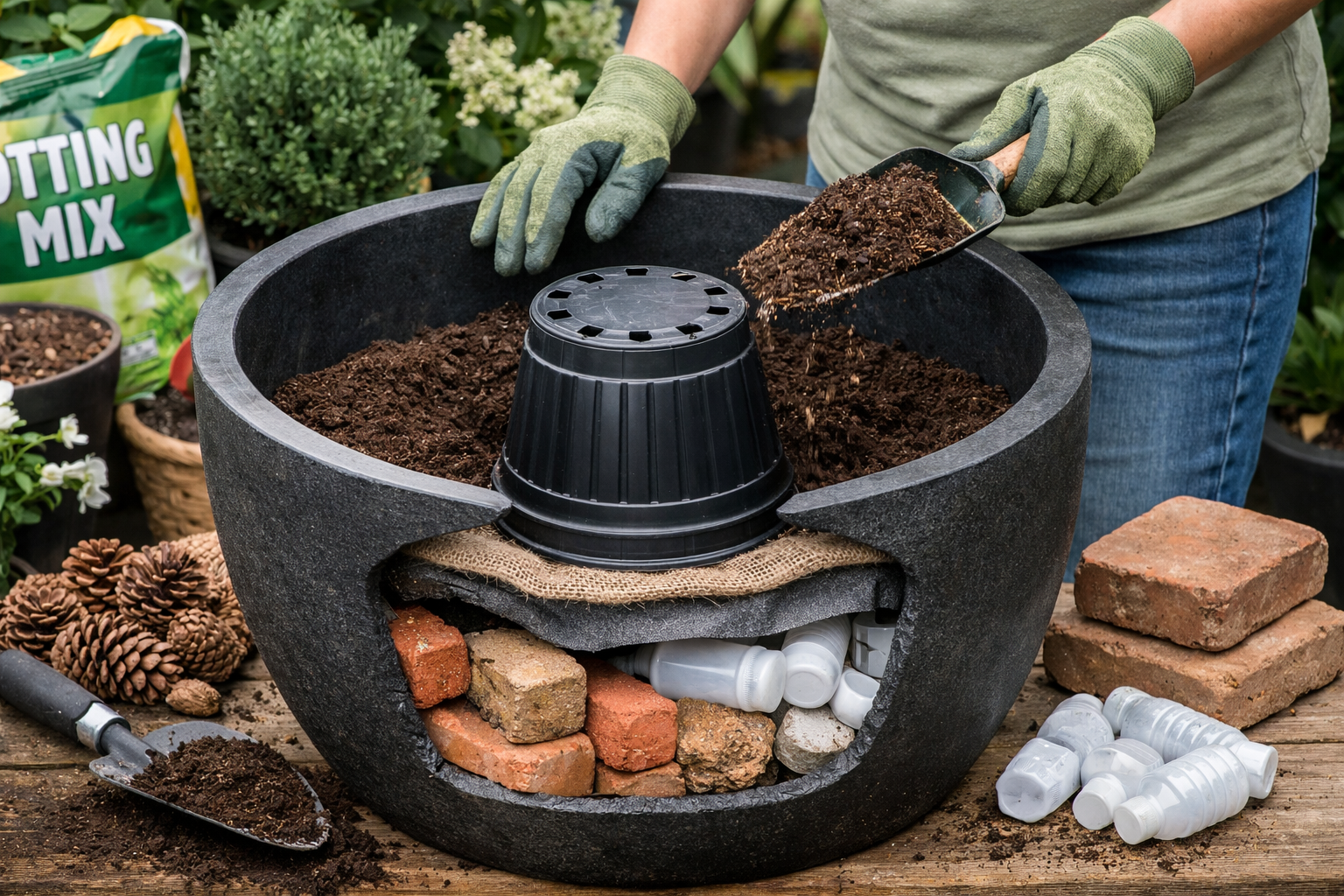
You buy a big planter because it looks great by the front door. Then halfway through the potting mix bag count, the thing feels ridiculous: expensive to fill, annoyingly heavy, and still oddly easy to get wrong.
So, how to fill a large plant container without creating a root problem? Fill the bottom only when the pot is deeper than the plant needs, keep the drainage hole open, and leave enough real potting mix above the filler for the root zone. That is the useful answer. The lazy answer, “just add rocks,” mashes together drainage, stability, and cost-saving like they are the same job. They aren’t.
That tension is the whole topic. A large planter can be easier to water and more stable for big plants, but it can also stay wet too long for smaller ones. And once filler goes in, the real question is no longer “what can I put in the bottom?” It becomes “how much root room did I just give away?”
- How much usable soil depth most plants actually need
- Which filler materials make sense for weight, stability, or short-term displays
- Why gravel is not a magic drainage fix
- How to set up a decorative planter with no drainage hole
- What mistakes quietly wreck large containers
Start here: a fast guideline
| If this is your planter problem | Check this first | What to do next |
|---|---|---|
| The pot is much deeper than the plant needs | Usable root depth | Fill the lower dead space with stable filler, then top with potting mix |
| The planter tips in wind | Base weight | Use ballast low in the pot, but do not steal root depth |
| The outer planter has no holes | Inner pot drainage | Use a nursery pot inside it and empty trapped water |
| The container is hard to move | Wet weight | Use lightweight filler and do not overbuild the base |
Fill Less, Grow Better: Start With the Root-Depth Rule
The first call is not filler. It is root depth.
If the plant only needs a shallow to medium root zone, stuffing the bottom of a tall planter can make perfect sense. If the plant wants real volume, filler becomes a false economy. A front-door annual display and a patio tomato are not asking the same thing from the pot, even if the container looks big enough for both.
For many shallow seasonal flower displays, about 8 to 12 inches of usable potting mix is a practical working band. Small herbs can often live happily in that range too, though not all herbs behave the same. Basil is pretty forgiving in a modest container, while rosemary hates a setup that stays wet forever. That’s why a small herb dropped into a giant decorative pot often looks “fine” for two weeks, then gets weird.
Quick rule: Decide how many inches of potting mix the plant needs above the filler before anything goes in the bottom. Filler belongs in empty basement space, not in the room roots actually need.
The Royal Horticultural Society points out that container size affects watering rhythm and root health, and that drainage holes at the base are non-negotiable. In plain English: bigger is not always safer if the plant is small for the pot. Extra wet soil is still extra wet soil.
I learned this the irritating way with basil in a tall entry planter. It looked elegant. The root zone below stayed cold and damp much longer than the plant wanted, and the top growth never really got moving. A plain 8- to 10-inch pot would have done the job better. For herbs, a more tailored container often beats a dramatic one. That is exactly why a guide like Best Pot for Basil is more useful than generic “bigger is better” pot advice.
Match the Filler to the Job, Not to Whatever Junk Is Nearby
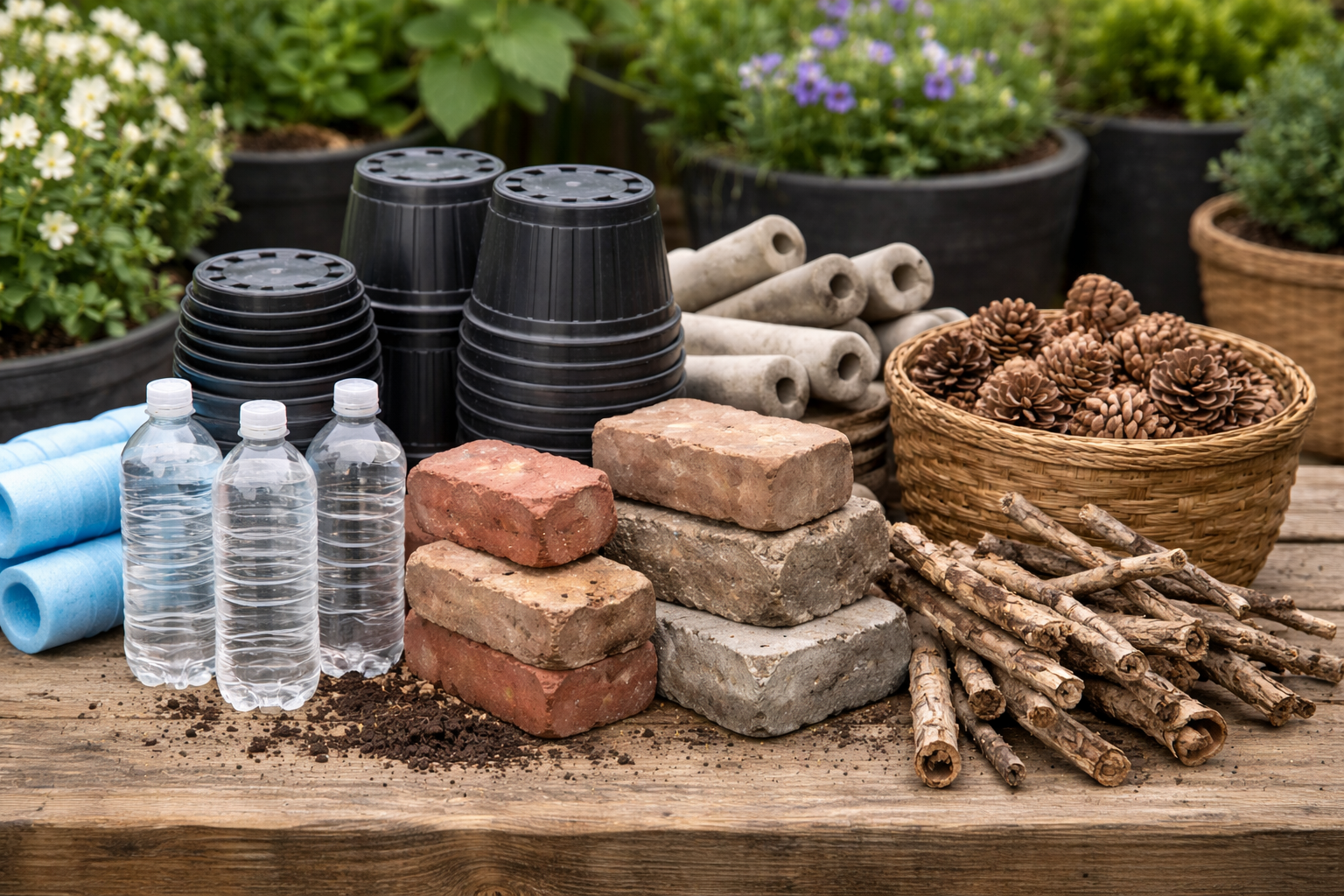
Most filler lists are just attic clean-out projects in article form. That doesn’t help much.
Use lightweight filler when the planter already weighs enough. Use heavy filler when the pot is top-heavy and wind-prone. Use organic filler only when the planting is temporary and a bit of settling won’t bother you later.
Stable, lightweight choices include upside-down nursery pots, empty plastic grow pots, and sealed plastic bottles or jugs. They create void space without turning the bottom of the planter into a compacted mess. They are also cleaner to deal with when replanting season comes around.
Heavier options like bricks or pavers have one good use: ballast. If the container is tall, narrow, and parked in a windy spot, a little low weight can stop that awful rocking motion. But the goal there is stability, not drainage.
Organic filler, such as pine cones or chunky sticks, is fine for short-lived seasonal displays. I use it under fall porch planters where I know the whole thing is coming apart in a few months anyway. For a long-term shrub or a mixed container that will stay planted for a year or more, that same filler can sink, break down, and leave the soil line annoyingly lower than where it started.
What to skip: anything that compacts into sludge, blocks the hole, or decays fast in a planter meant to last. The cleanup later is always worse than it sounds.
Stop Using Rocks as a Magic Fix for Drainage
This is the part most gardeners hear twice and get told backwards once.
The University of Illinois Extension says a gravel layer in the bottom of an individual pot does not make excess water drain away right off. Water gathers in the soil above that coarse layer until the air spaces are filled. The University of California Master Gardeners explain the same thing from the soil side: water does not move readily from fine-textured potting mix into coarse material below it until saturation is high enough.
So the old gravel trick is not a general drainage cure.
That said, the story is a bit messier than old gardening myths and neat debunks make it seem. A 2025 paper in PMC found that drainage layers often reduced overall water retention in containers, with the result changing by potting medium and drainage material. Useful paper. Useful reminder too. The effect is media-specific, not magical.
For a home gardener, the practical takeaway is still simple: do not reach for rocks first when the real problem is soggy potting mix, blocked drainage holes, or a plant sitting in far more soil than it can use. Use rocks or bricks because you need ballast, not because you expect them to rescue a bad setup.
Build the Layer Stack That Actually Makes Sense
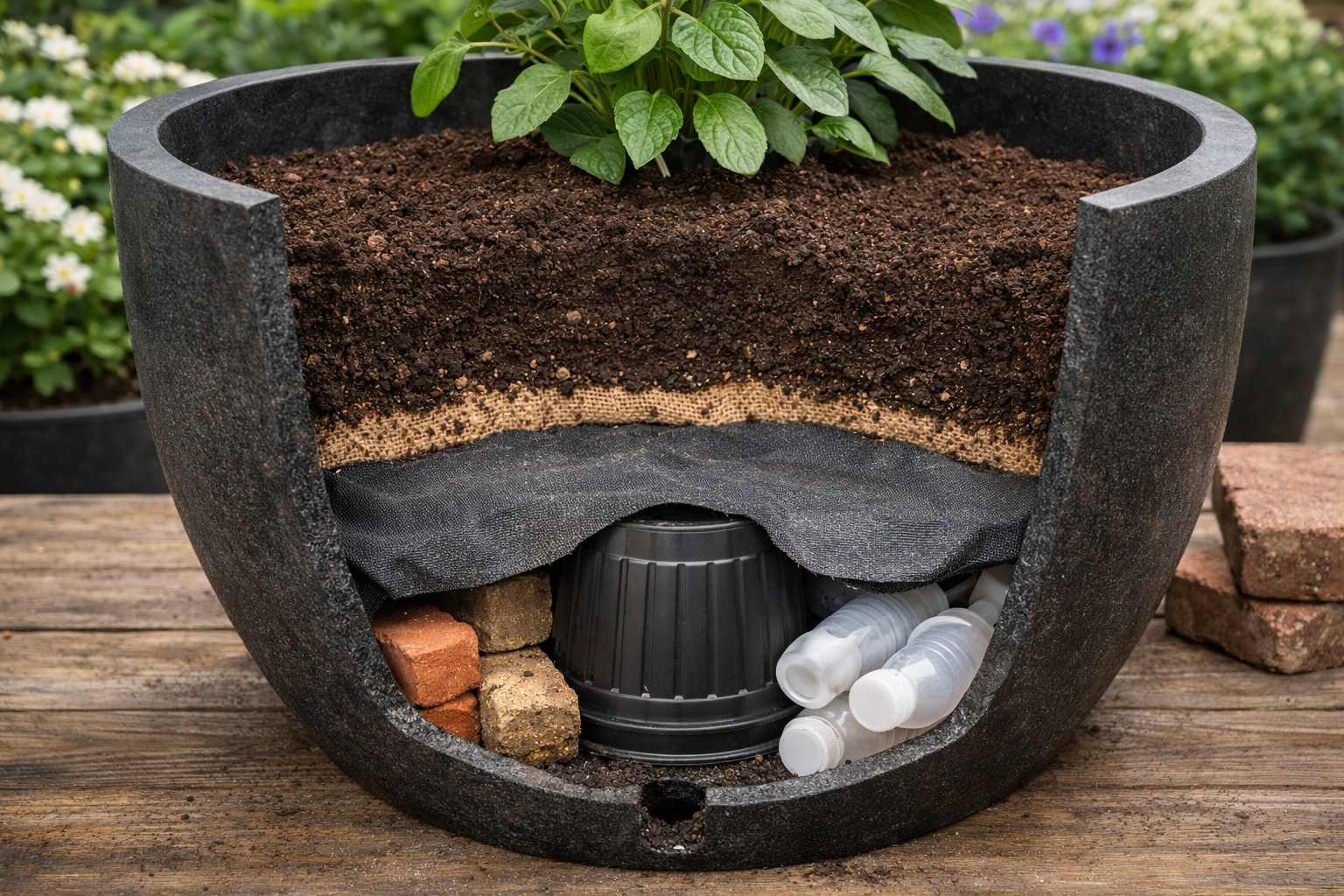
A large planter doesn’t need a complicated internal architecture. It needs a clean stack.
Step 1. Check the hole so water can leave.
If the planter has no drainage hole, stop there and switch to a pot-in-pot setup. If it has a hole, keep it open. Do not jam a flat shard or a dense slab over it.
Step 2. Add filler so you cut dead space, not root space.
Set the filler in the bottom to the height that still leaves enough potting mix above for the plant. For many annual planters, that means keeping roughly 8 to 12 inches of usable mix. For bigger specimens, keep much more.
Step 3. Separate layers so the mix stays put.
Landscape fabric, mesh, or burlap works well here. The point is containment, not creating a waterproof barrier. If the filler is a stack of inverted nursery pots and the top is already fairly even, you may not need much more than a light sheet of fabric.
Step 4. Add potting mix to the finished depth.
Use container mix, not garden soil. Then leave about 2 inches below the rim. That watering lip sounds minor, but it makes a big difference when you are trying to soak a hot container without overflowing it down your shoes.
Step 5. Water once and watch what happens.
A good setup shows its cards right away. Water should move through, not pool endlessly, and the soil surface should settle only a little.
Small check that saves headaches:
- Water comes out of the hole within a reasonable time
- The planter does not wobble after watering
- The soil line stays close to where it started
Use These If/Then Rules to Choose the Right Setup Fast
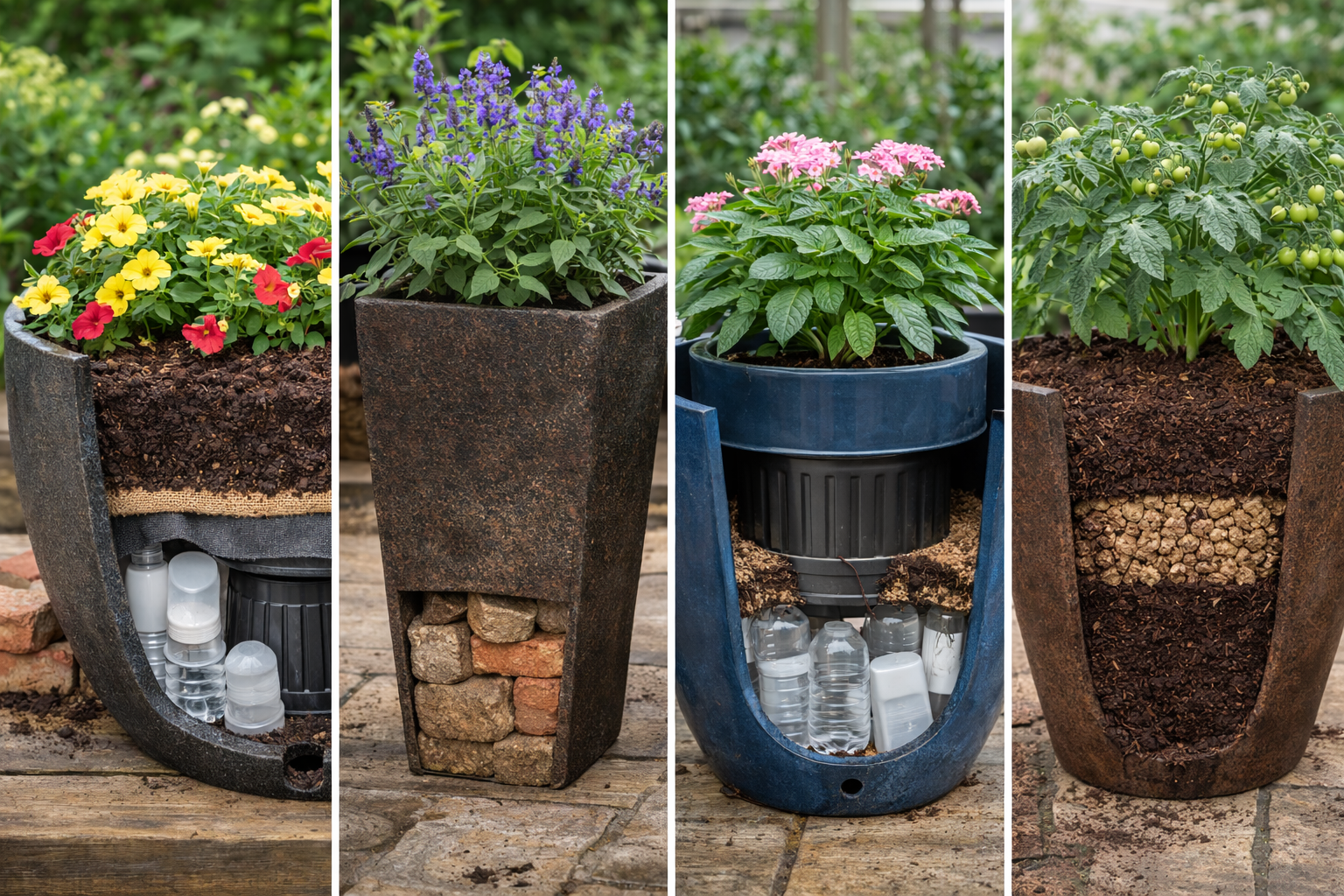
Here is the short decision grid most people were actually looking for.
| Goal | Best move | Skip this |
|---|---|---|
| Save potting mix in an oversized flower planter | Use lightweight filler and keep 8 to 12 inches of usable mix for shallow-rooted displays | Filling half the pot without checking plant depth |
| Keep a tall planter from tipping | Add low ballast with bricks or pavers, then keep full root depth above | Assuming rocks “fix drainage” |
| Use a decorative pot with no holes | Keep the plant in a draining nursery pot inside the outer pot | Planting straight into a sealed pot |
| Grow a larger edible or shrub | Prioritize root volume over filler | Turning a big planter into a shallow one |
If the planter sits on a balcony, keep weight low with empty nursery pots or sealed plastic bottles. If the planter is a tall entryway piece with a narrow footprint, add a bit of ballast. If the planting is temporary, organic filler is fair game. If the planting is permanent, stable filler or plain potting mix is usually the cleaner call.
For larger edibles, generous root volume changes everything. A cucumber or tomato grown in a container does not care that the planter looks stylish. It cares about soil volume, heat buffering, and steady watering. A guide like What Size Container to Grow Cucumbers? becomes much more relevant once the planter is no longer just decor.
Handle the Tricky Cases Before They Handle You
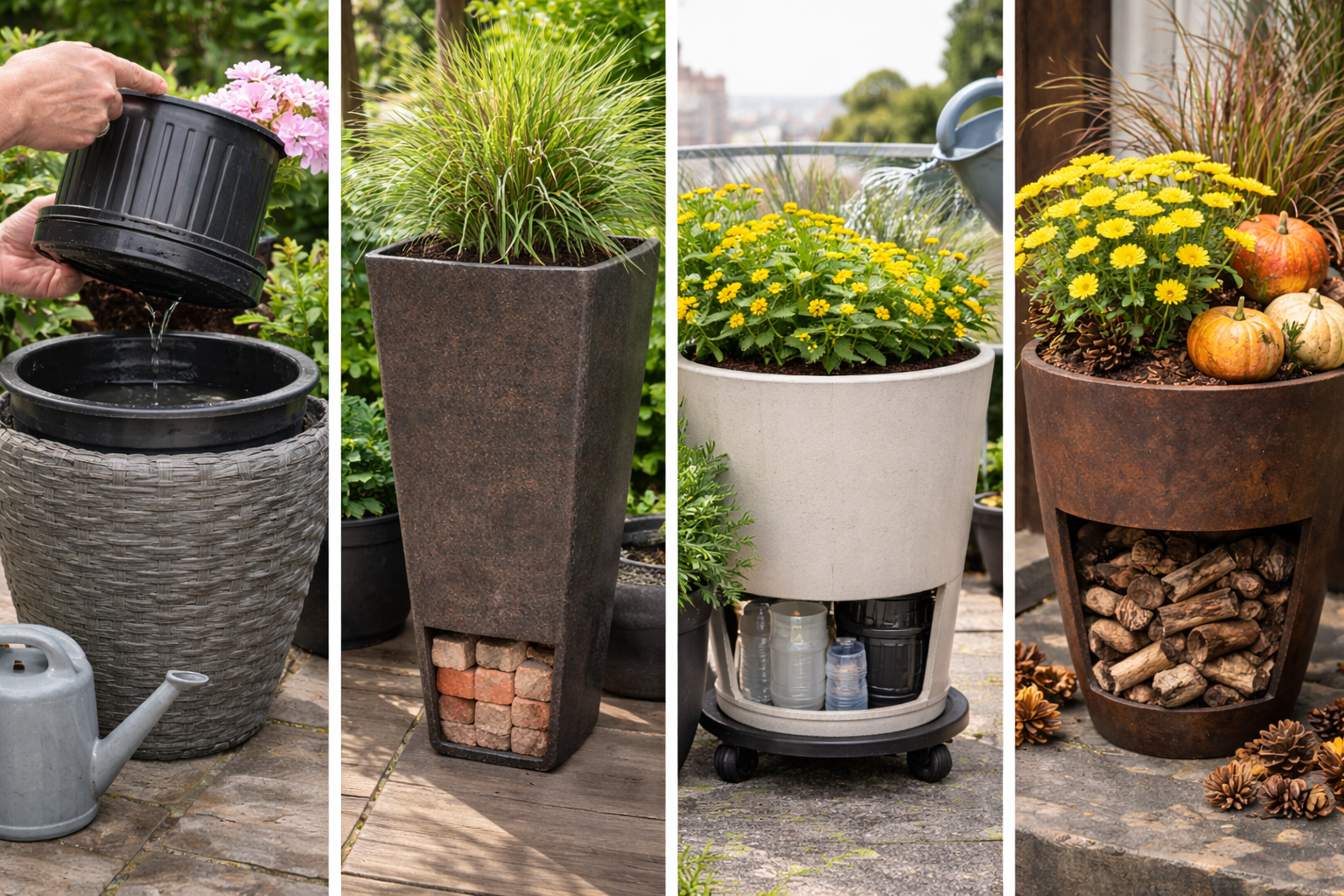
The awkward cases are where people usually lose a season.
Decorative planter with no drainage hole.
Treat it as a cachepot. Keep the plant in a nursery pot with drainage, set that inside the outer container, and lift it now and then to dump trapped water. Straight planting into a sealed container is a slow-motion root problem.
Very tall, narrow planter.
This is where ballast earns its keep. A few bricks low in the base can settle the pot down. Just do not let the ballast steal the depth a shrub or upright grass still needs.
Balcony or rooftop planter.
Wet weight matters. Potting mix gets much heavier after a full watering, and a giant ceramic pot can get absurd fast. Lightweight filler helps here, and restraint helps more. Bigger is not always better if the site itself has weight limits.
Seasonal porch display.
This is the place for pine cones, sticks, or other chunky organic filler. The planting is temporary, the setup is forgiving, and nobody is asking that base layer to look tidy in 14 months.
Long-term edible container.
Here I would be stingy with filler. Root crops, tomatoes, cucumbers, peppers, and woody herbs pay you back for real soil volume. Once the filler starts eating too far into that, the pot looks big and behaves small. And if the top mix matters more than the bottom void, this is where Best Soil for Growing Tomatoes in Pots is the more useful next read.
Safety note: Drilling drainage holes in glazed ceramic or brittle material can crack the pot. If there is any doubt, use an inner nursery pot instead of forcing the issue.
Avoid the 7 Mistakes That Make Large Containers Harder Than They Need to Be
1. Filling first, thinking later.
If you do not set a target soil depth before adding filler, you are guessing. Guessing is how a large planter turns into a shallow planter by accident.
2. Using rocks for the wrong reason.
They are decent ballast. They are not a catch-all drainage fix.
3. Blocking the drainage hole.
A hole that cannot drain is decorative, not functional.
4. Using decomposing filler in a long-term planting.
What looks chunky and helpful in spring can sink by midsummer and leave the root zone lower than planned.
5. Using garden soil.
Outdoor ground soil in a pot usually becomes dense and awkward. Container mix is made for the tighter air and water pattern inside pots.
6. Forgetting wet weight.
A large container that seems movable while dry can become a two-person problem after watering.
7. Treating every plant like an annual display.
A basil planter, a rosemary pot, and a shrub in a front-door urn do not want the same internal setup. Rosemary, in particular, hates sitting in a root zone that stays wet too long. That is why something like How to Care for Rosemary in a Pot Without Killing It ends up being a drainage article in disguise.
Know When Not to Fill the Bottom at All
Sometimes the smartest filler choice is none.
If the plant wants the depth, give it the depth. If the container is only a bit oversized, leave it alone. If the planting is long-term and root-heavy, real potting mix often beats a clever base layer. And if the pot already has a built-in insert or self-watering system, extra filler can just get in the way.
This is where people overthink the thrift side of the project. Saving one bag of mix is satisfying. Replanting a stressed shrub because the pot behaves smaller than it looks? Not satisfying. Not even slightly.
There is also a visual trick here. A large planter stuffed with filler can look grand and still act cramped. It is a bit like buying a king-size bed frame and sleeping on a narrow cot inside it. The outer dimensions flatter you. The actual living space does not.
So yes, filler is useful. It just is not a rule. It is a tool for oversized containers, awkward decorative pots, and specific stability problems. Once the plant truly wants that volume, stop being cute and let the roots have the room.
FAQ
Can I use packing peanuts or foam in the bottom of a planter?
They can reduce weight, but only use clean, stable material and keep it below the real root zone. Loose filler that shifts, breaks down, or traps a lot of water is usually more trouble than it is worth.
How often should organic filler like pine cones be replaced?
For short seasonal displays, one cycle is fine. For long-term containers, check for settling when replanting or refreshing the mix. If the soil line has dropped a lot, the filler has broken down enough to matter.
Is it okay to put a large nursery pot upside down inside a planter?
Yes. It is one of the cleaner ways to take up dead space in a large planter, especially for shallow seasonal displays. Just keep enough potting mix above it for the plant’s roots and do not block the drainage hole.

Michael Rowan is the founder and lead writer at The Garden Playbook. He has spent 10+ years growing plants across a range of settings — from indoor houseplants and container gardens to raised beds and in-ground plots — adapting methods to different light levels, seasons, and growing conditions.
Michael focuses on practical, experience-based guidance grounded in fundamentals: soil health, watering strategy, plant nutrition, pruning and propagation, and integrated pest management (IPM). His work aims to help readers diagnose common problems (such as yellowing leaves, stunted growth, or pest pressure) and apply straightforward solutions that are realistic for home gardeners.
At The Garden Playbook, Michael develops tutorials and plant guides using a consistent process: documenting real outcomes where possible, explaining the “why” behind each step, and verifying higher-risk topics (such as plant toxicity or pest treatment options) against reputable horticultural references.