
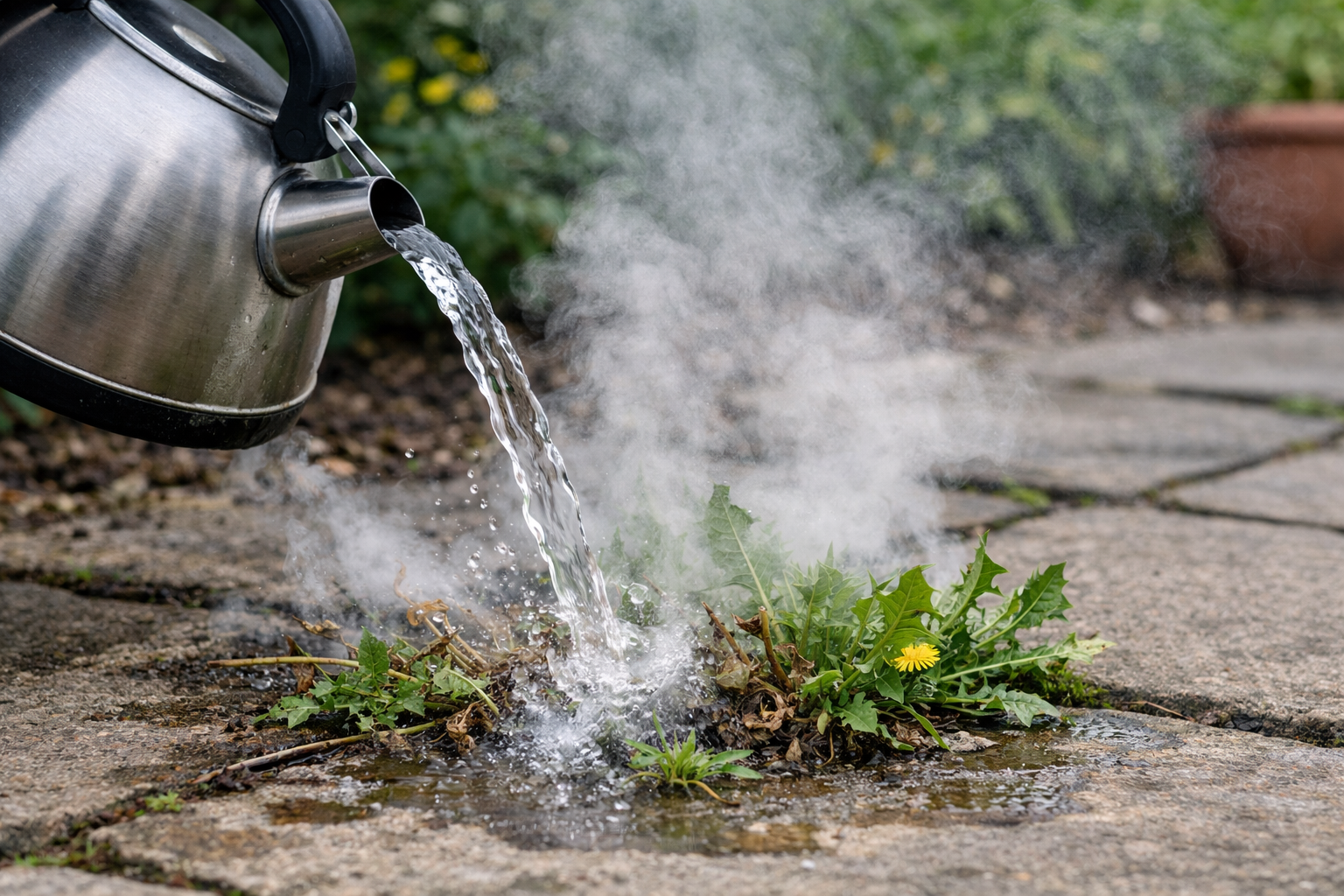
Patio-crack weeds have a knack for showing up right after you’ve swept, watered, and told yourself the yard looks sorted. The first time I tried this trick, I walked outside with a pasta pot in one hand and too much confidence in the other. The leaves collapsed fast. I felt clever for about a day.
Then half of them came back.
So, does boiling water kill weeds? Yes, it can. It works best on young weeds, shallow-rooted seedlings, and weeds growing in cracks where you can hit the whole plant without splashing anything worth keeping. It is far less useful on established perennial weeds, taproots, lawn weeds, or anything tucked into a bed full of plant roots.
That is the part most quick answers skip. A tiny weed between pavers and a dandelion in a flower border are not the same job. One is a quick scald. The other is a root problem dressed up as a leaf problem.
- Which weeds boiling water can kill well
- Why some weeds wilt fast and still come back
- Where this method shines and where it backfires
- How to pour it safely without hitting nearby plants
- What to do next when the weed resprouts
- When pulling, mulch, vinegar, or flame makes more sense
At a glance: use, skip, or switch
| Situation | Best call | Why |
|---|---|---|
| Tiny seedling in a patio crack | Use boiling water | Easy target, little room for roots to hide, no nearby ornamentals |
| Mature dandelion in a border | Switch methods | Taproot survives more often than the leaves suggest |
| Weeds mixed into a lawn | Skip it | Boiling water is non-selective and grass burns too |
| A few weeds in gravel away from plants | Use with care | Can work on small patches, but repeated seedling flushes still need follow-up |
| Large weedy patch in open soil | Switch methods | Too slow, too awkward, and nearby roots are easy to hit by accident |
Fast rule: if the weed is young, isolated, and sitting in hardscape, boiling water is a fair bet. If it is rooted deep or growing among plants you like, pick another tool.
Does Boiling Water Kill Weeds? Yes, but It Usually Works Best as a Spot Treatment
A short, honest answer is more useful here than a dramatic one. Boiling water can kill weeds, but it is not a broad weed-control plan. It is a spot treatment. When you pour it onto the plant, the heat damages the leaf and stem tissue it touches. Iowa State Extension describes it as a contact herbicide, which tells you almost everything you need to know. Contact treatments are strongest where they land. They are weaker on roots they never reach.
That is why this trick feels great on weeds in driveway cracks. You can hit the crown, the foliage, and a good bit of the root zone in one pour. The same trick feels flimsy on a deep-rooted weed in garden soil. The leaves collapse, but the root often shrugs and starts over.
Quick rule: Use boiling water for a few small weeds in the open. Do not treat it like a cure-all for beds, lawns, or established perennial weeds.
If you’re choosing between “try it” and “don’t bother,” the real question is not whether boiling water can kill weeds. It can. The better question is whether it can kill your weed in that location with one or two careful treatments. That is where the answer starts to split.
Why Boiling Water Works, and Why the Effect Often Stops at the Surface
Heat wrecks plant tissue fast. UC WeedCUT explains that hot water and steam injure plants through membrane rupture and protein denaturation. That’s the science-y way of saying the cells lose their structure and stop doing their job. You see the result as limp leaves, darkened stems, and a plant that suddenly looks tired in a dramatic way.
But the heat has a short temper. Once boiling water hits cooler air, cooler soil, and a thicker root system, its punch fades. That is the whole game.
A useful picture is this: boiling water is good at scorching the roof. It is not always good at knocking out the foundation. Seedlings have almost no foundation, so they go down hard. Older weeds have stored energy below ground, and that stored energy is what lets them come back after a top kill.
This is why a weed can look dead by dinner and still return next week. The top growth was cooked. The deeper root tissue stayed alive enough to push new leaves.
Remember: fast wilt is not proof of a root kill. It only proves the heat hit the exposed plant tissue.
That detail also explains why location matters so much. In a narrow crack, there is less cool soil around the weed and less room for roots to spread. In a planted bed, the heat disperses into living soil, and you are one splash away from scalding roots you paid good money for. Same water. Different odds.
The Weeds Boiling Water Can Kill Well, and the Ones Likely to Come Back
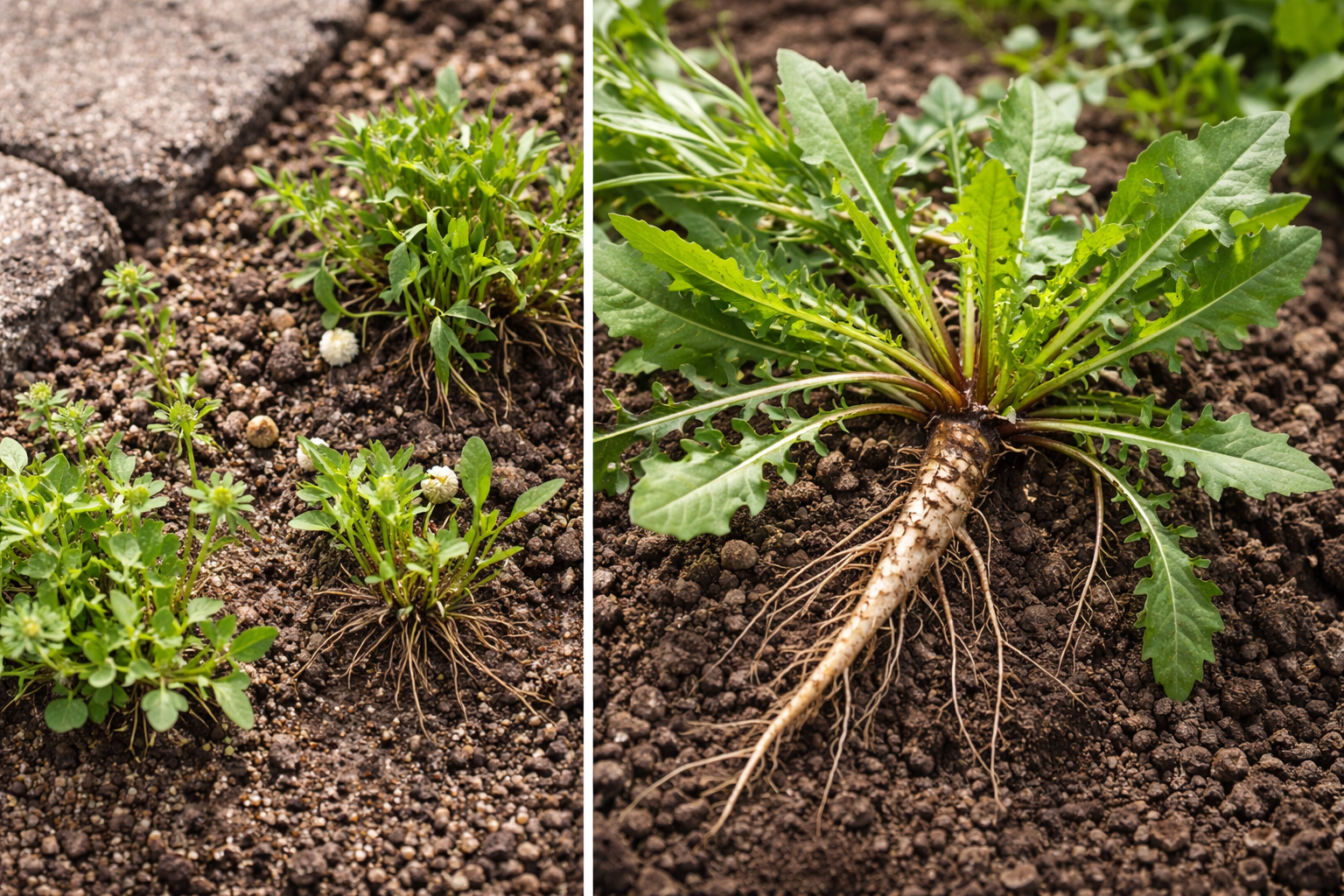
If you sort weeds by age and root depth, the method gets much easier to judge. Maryland Extension notes that hot water works best on young, tender, small annual weeds. That means fresh seedlings, little broadleaf weeds, and shallow-rooted growth you caught early. Think chickweed, tiny spurge, or a small volunteer that popped up between pavers after a week of rain.
Good candidates usually share three traits:
- They are young
- They have shallow roots
- They are growing where you can hit the whole plant cleanly
Poor candidates share a different set of traits. They are older. They have a taproot, rhizomes, or a deeper root mass. They store energy below ground. Dandelions are the classic example. The leaves look manageable, but the plant’s real engine sits lower down. Perennial grasses can be just as annoying for a different reason. Their growing points are better protected, so a quick top scald does not settle the matter.
Here is the practical split:
Best fit
New annual weeds, tiny seedlings, isolated weeds in cracks, and fresh flushes in gravel.
Maybe, with a repeat
Small weeds that are no longer tiny but still shallow-rooted.
Bad fit
Dandelions, bindweed-type weeds, mature perennial grasses, woody weeds, and weeds tucked into beds with desirable plants.
If you are not sure what weed you have, do not get stuck trying to play botanist. Ask two blunt questions instead: “Is this weed young?” and “Does it look like the roots run deep?” Those answers will take you further than a perfect name tag.
When a weed resprouts after one treatment, that is not a mystery. It is a clue. A second treatment about 7 to 10 days later is reasonable for small regrowth. After that, repeated resprouting usually means you are dealing with a perennial or a root system that boiling water is only annoying, not killing.
Where Boiling Water Makes Sense, and Where It Usually Backfires
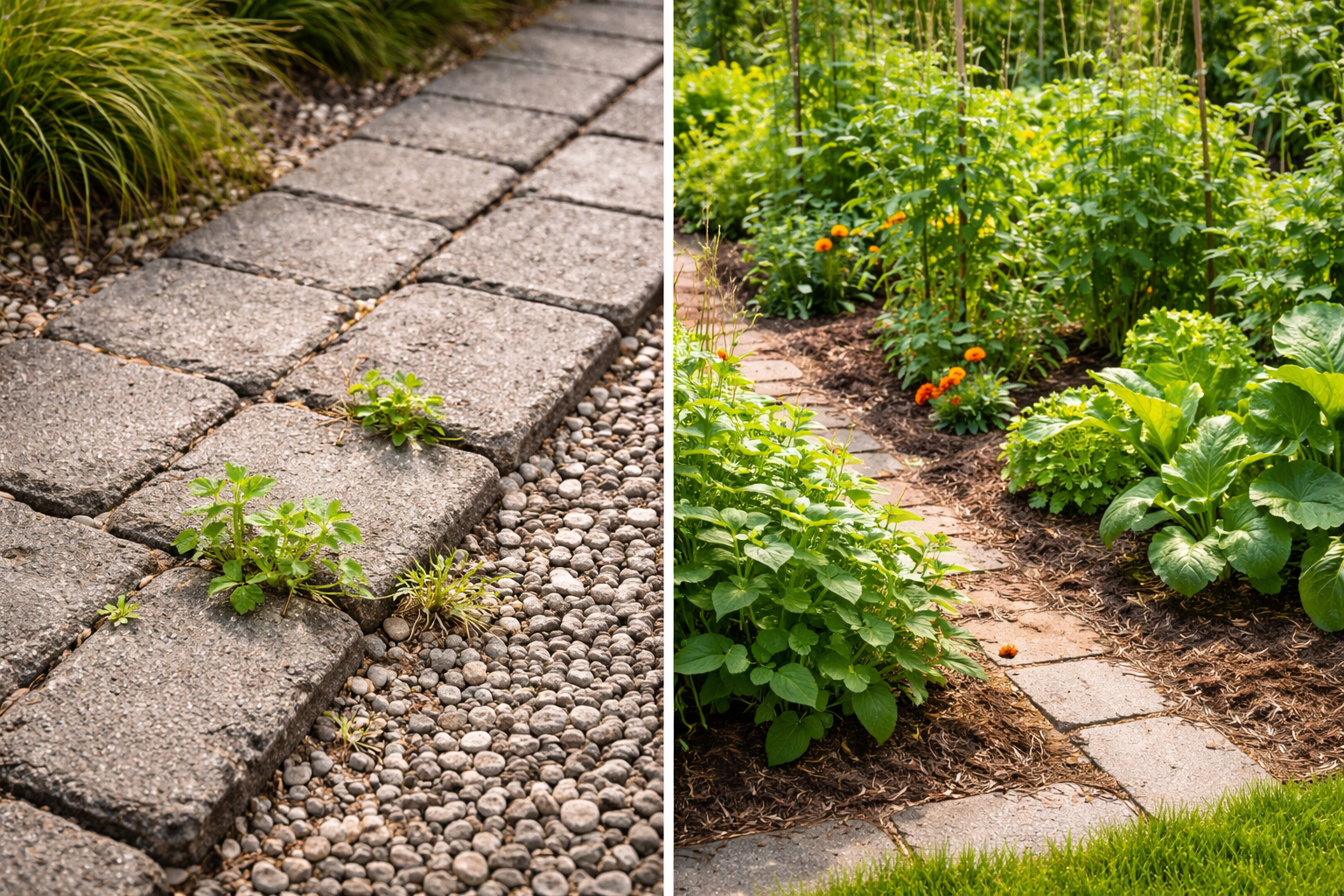
The best use case is simple: hardscape. Sidewalk cracks, paver joints, driveway seams, the edge of a patio, maybe a few isolated weeds in gravel. These places let you aim well and miss the plants you want to keep. They also give the weed less soft, cool soil to hide in.
That is the first smart filter. Not “what weed is it?” but “where is it growing?” In practice, place often matters more than species.
Good places to use it
- Between pavers
- In driveway and sidewalk cracks
- Around path edges with no nearby ornamentals
- Small gravel patches away from plant roots
Places where it can go sideways fast
- Lawns
- Flower beds
- Vegetable rows
- Raised beds
- Any crowded planting where roots overlap below the surface
That last point gets missed a lot. In a planted bed, the root zone is not neatly divided into “weed area” and “nice plant area.” Roots mingle. Boiling water does not care which root belongs to whom. That is why this method can feel oddly harsh in living soil. You’re not just attacking the weed. You are heating a small patch of the place everything is trying to grow.
Note: In hardscape cracks, any soil-life concern is tiny compared with the risk in a planted bed. In beds and borders, the bigger problem is collateral damage to nearby roots.
There is also the plain, unglamorous issue of effort. Carrying a kettle to wipe out three weeds is satisfying. Carrying it across the yard again and again for a broad patch gets old fast. If the job looks bigger than a quick walk and a careful pour, the method is already losing its edge.
How to Apply Boiling Water Safely and Give It the Best Chance to Work
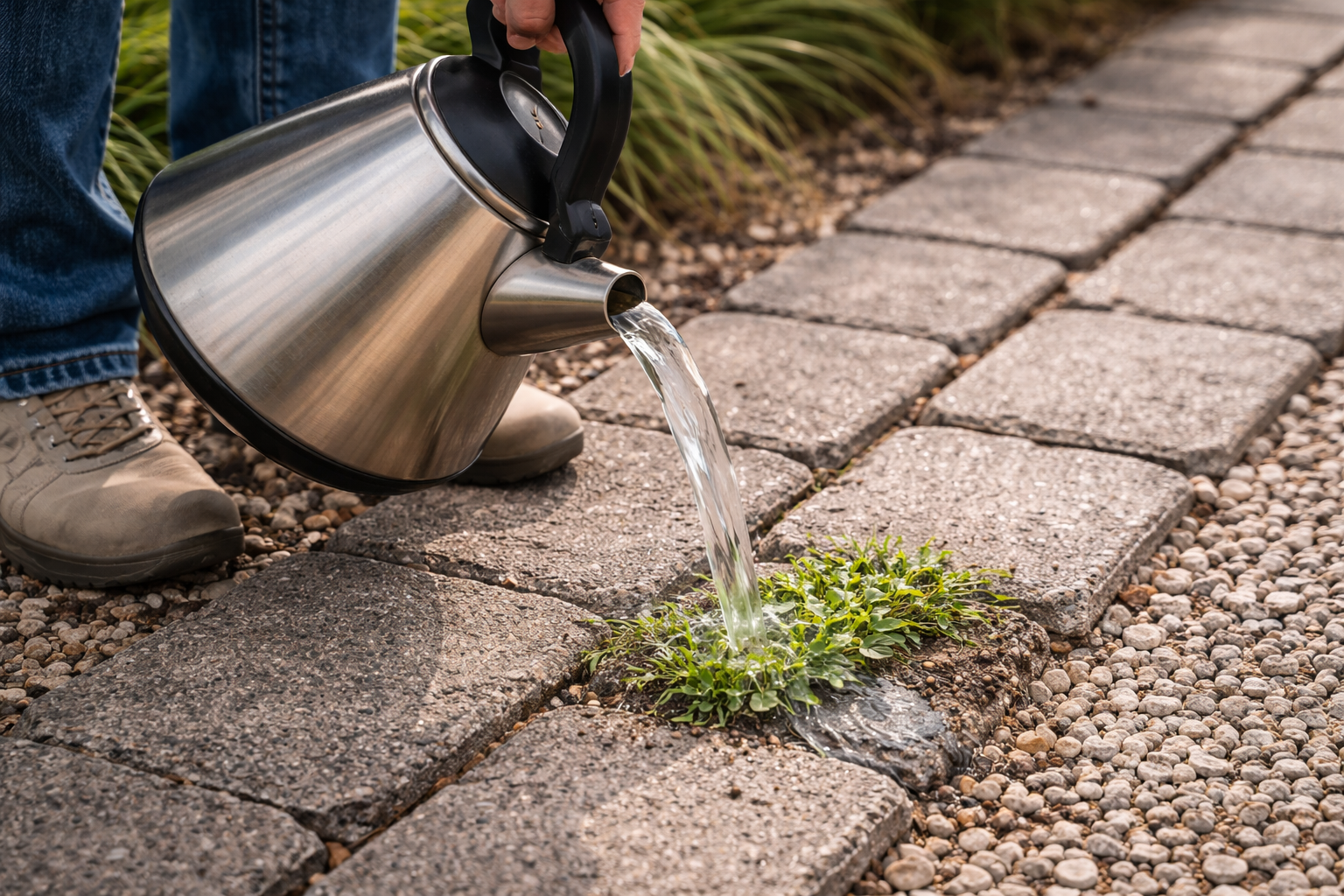
This part is short because it should be. The method is simple. What matters is precision.
Boil in a kettle for better aim
A kettle with a narrow spout beats a wide pot every time. You get a cleaner pour, less slosh, and far less chance of clipping the leaves of a nearby plant. A pasta pot works in a pinch. It also makes you feel like you’re carrying a trap.
Pour low and slow to cut splash
Stand close enough that you do not have to lob the water from above. A low pour lands where you want it. A high pour bounces. That is how “just one weed in the crack” turns into a scorched edge on the plant beside it.
Hit the crown, not just the tips
Leaves alone are not the target. Aim for the base of the weed where the stems meet the soil or crack. That is the part most likely to affect the growing point. If you only wet the top leaves, you are treating the easiest part of the plant to replace.
Watch the plant, then wait a beat
You will often see wilting pretty quick. Full browning can take a day or two. Do not keep pouring fresh rounds onto the same spot that same afternoon out of impatience. Give the plant time to show you what survived.
Repeat once when the regrowth is small
If fresh growth appears, one follow-up in about 7 to 10 days is a fair test. That timing is sensible because you are treating new, tender tissue again. If the same weed keeps returning after that, switch tactics.
Pro tip: Plain leftover boiling water from cooking can do the job. Skip it if the water is salty, oily, or full of starch and food bits. Plain water is the cleaner choice.
And the safety bit matters. Wear shoes. Keep kids and pets out of the path. Use a kettle you can handle one-handed without a wobble. There is nothing “natural” about a boiling-water splash on bare skin.
What to Do When the Weed Comes Back
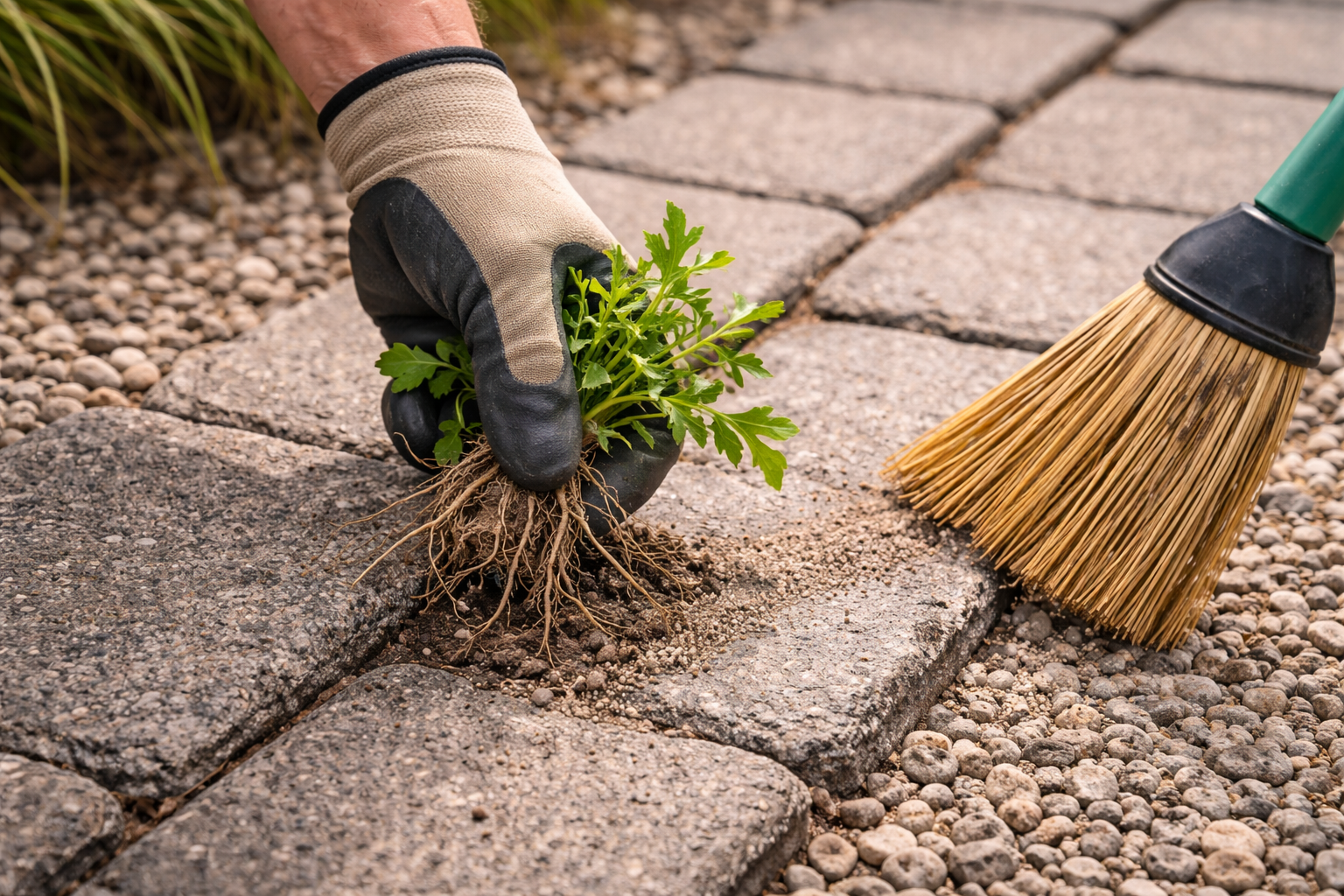
A returning weed is telling you something. Usually it is saying one of three things: the root survived, the weed was too established from the start, or the site keeps sprouting new seedlings from old seed sitting in the crack or soil.
That matters because each cause asks for a different next move.
Repeat once and reassess
If the regrowth is light and fresh, do one more treatment. This works best when the first pour clearly knocked the plant back and the second round is hitting soft new tissue. Small annual weeds often fold after that second pass.
Pull after softening the crown
Some weeds loosen up after a scald, and that is your moment. If the plant has softened and the soil or crack gives you enough grip, pull it while the crown is weakened. This is a handy move on weeds between pavers where you can grab the plant before it resets.
Close the opening that keeps feeding the problem
Dead weeds are only half the job in hardscape. If the crack still holds dust, organic bits, and enough moisture for seed to settle, more seedlings will show up. Sweep the joint clean. Top up polymeric sand or repair the gap if that fits the surface. That step does more long-term work than one extra kettle ever will.
In beds and borders, the follow-up is different. Illinois Extension notes that keeping up a mulch layer suppresses weed seeds and makes fresh weeds easier to pull while they are still small. That is the move that saves time later. Boiling water may clear a weed. Mulch changes the odds of it coming back.
One clean cutoff: if the same taprooted or perennial weed comes back after two careful treatments, stop spending kettle water on it. Dig it out or switch tools.
This is where many people waste effort. They repeat the same light treatment on the same stubborn weed and call that persistence. It is not persistence. It is just a poor match between method and weed.
Boiling Water vs Pulling, Vinegar, Flame Weeding, and Mulch
Boiling water is not wrong. It is just narrow. That is why it helps to compare it with the other common options people reach for when they want natural weed control or at least something less fussy than a full herbicide plan.
| Method | Best for | Weak spot |
|---|---|---|
| Boiling water | Small weeds in cracks, pavers, and isolated hardscape spots | Weak on deep roots and awkward for large areas |
| Hand pulling | Single weeds where you can remove the root | Frustrating in compacted cracks or fibrous root mats |
| Vinegar | Small top growth in dry weather | Also mostly a top kill and can drift or splash |
| Flame weeding | Young weeds in hardscape or open non-flammable areas | Fire risk changes the whole equation |
| Mulch | Beds and borders where prevention beats repeated treatment | Does not remove established weeds by itself |
Hand pulling wins when you can get the whole root. That makes it better than boiling water for dandelions, dock, and other weeds that laugh off a top kill. Boiling water wins when the weed is wedged in a crack and a full root pull is fiddly or impossible.
Vinegar and boiling water share the same basic weakness. They are both much better at burning exposed growth than wiping out established perennials. Colorado State Extension notes that contact herbicides work best on annual weeds, and that logic tracks here too. If the weed’s growing power sits above ground or close to the surface, a contact treatment can do real work. If the weed stores energy below ground, the method gets shakier.
Flame weeding can be effective on tiny weeds in hardscape, but the fire risk changes the conversation. Dry mulch, old leaves, deck boards, fencing, and stray fluff near the treatment area make it a different category of tool. Boiling water has its own burn risk, but it does not turn a windy afternoon into a bad story.
Mulch is the least dramatic option and often the one that saves the most time. It does not give you the instant satisfaction of a wilted weed, but it reduces how many weeds germinate in the first place. For beds and borders, that is often the smarter play. Fewer weeds beats killing the same weeds over and over.
If you want one plain recommendation, here it is: use boiling water for a few young weeds in hardscape. Pull deep-rooted weeds. Mulch beds. Save vinegar and flame for the narrow cases where they actually fit.

Michael Rowan is the founder and lead writer at The Garden Playbook. He has spent 10+ years growing plants across a range of settings — from indoor houseplants and container gardens to raised beds and in-ground plots — adapting methods to different light levels, seasons, and growing conditions.
Michael focuses on practical, experience-based guidance grounded in fundamentals: soil health, watering strategy, plant nutrition, pruning and propagation, and integrated pest management (IPM). His work aims to help readers diagnose common problems (such as yellowing leaves, stunted growth, or pest pressure) and apply straightforward solutions that are realistic for home gardeners.
At The Garden Playbook, Michael develops tutorials and plant guides using a consistent process: documenting real outcomes where possible, explaining the “why” behind each step, and verifying higher-risk topics (such as plant toxicity or pest treatment options) against reputable horticultural references.