
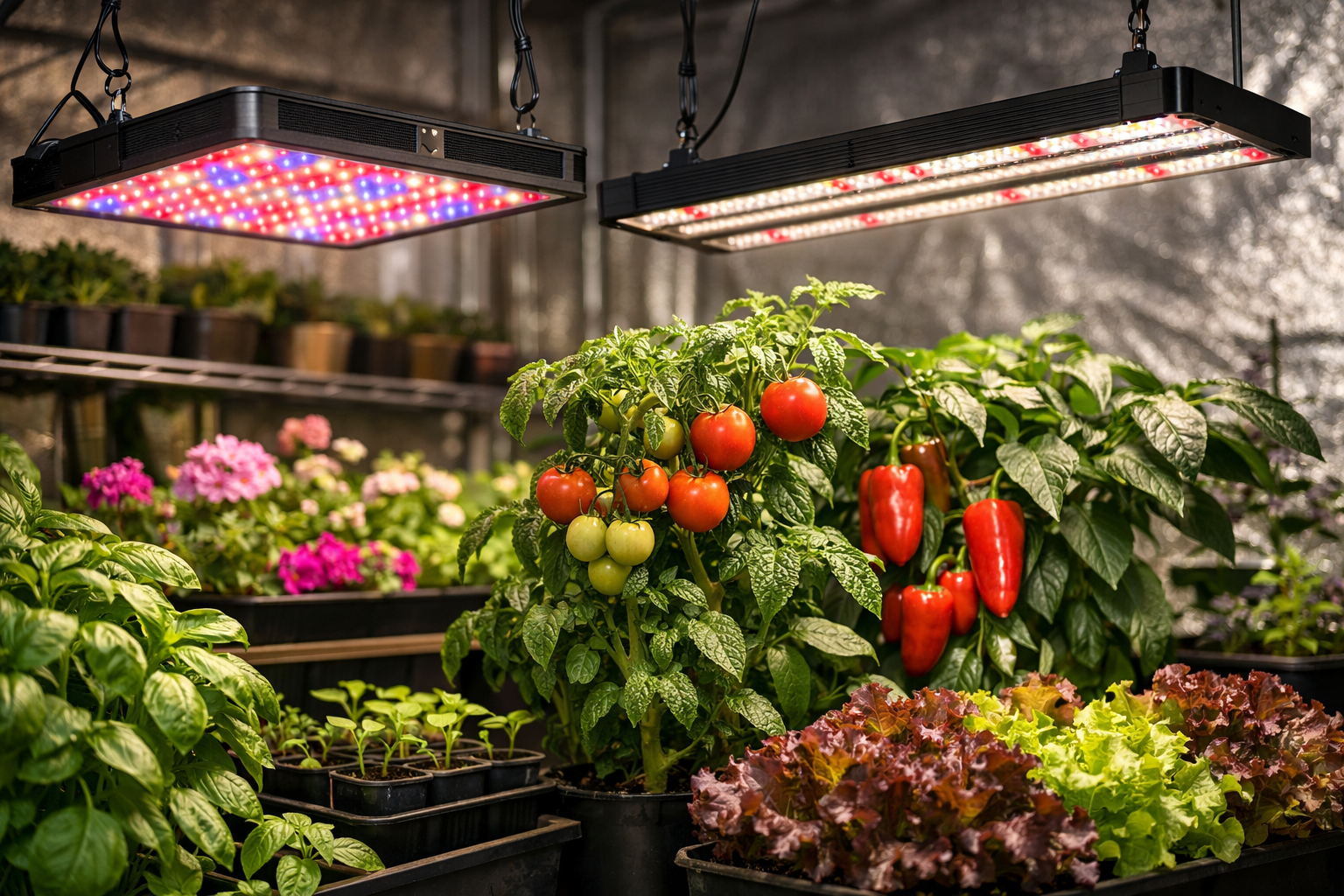
You can waste a weird amount of time buying the wrong grow light.
I’ve done it with basil on a kitchen shelf. The first light looked bright, looked “full spectrum,” and looked perfect in the product photos. The plant disagreed. It stayed alive, sure, but it grew like it was rationing hope. That is the trap with the phrase best led grow lights for indoor gardening. The broad answer is easy. The useful answer starts one step later.
For most home growers, the best pick is a full-spectrum white LED grow light matched to the plant’s light demand and the size of the lit area. A bulb can work for one pothos. A clip-on can help a peace lily through winter. But herbs, lettuce, and seedlings usually need a bar light or a stronger fixture with better coverage. Fruiting crops ask for more again. The central tension is simple: most bad grow-light buys come from mixing up “bright enough to look good” with “strong enough to grow well.”
This guide gives you a fit test, a shortlist, and the setup rules that stop indoor plants from turning leggy, pale, or weirdly stalled.
Best Suggestions Table (All products have been personally reviewed & tested by us! Click the buttons below to jump to the reviews.)
| Product | Best for | Action |
|---|---|---|
| SANSI LED Grow Light Bulb | One plant or a small cluster near a lamp | Check PriceReview |
| Leoter 4-Head Grow Light | Flexible placement on a desk, side table, or mixed plant shelf | Check PriceReview |
| SunBlaster LED Strip Light | Seed trays, herbs, and shelf runs that need even coverage | Check PriceReview |
| Soltech Grove LED Grow Light | Visible living spaces where looks matter too | Check PriceReview |
| Spider Farmer SF-1000 | Demanding edible crops and higher-output indoor growing | Check PriceReview |
Tip: Clicking the “Review” button will move you to the review so you can decide fast.
Start Here
| If this sounds like you | Start with this light style | Skip this common mistake |
|---|---|---|
| One pothos, ZZ plant, or snake plant in a dim corner | Bulb or compact clip-on | Buying a big panel “just in case” |
| Basil, parsley, lettuce, or one seed tray | Bar light or stronger tabletop fixture | Using a decorative bulb and calling it done |
| Shelf of seedlings or a mini indoor garden | Strip light or rack setup with adjustable height | Ignoring coverage and hanging height |
| Tomatoes, peppers, or other fruiting plants | Higher-output panel or dedicated production light | Trusting “full spectrum” on a weak light |
The best LED grow light depends on what you’re trying to grow, not what the box shouts
The shortest honest answer is this: buy a white full-spectrum LED that matches the crop and the footprint. Not the label drama. Not the “equivalent wattage.” Not the rainbow graphic on the box.
University of Minnesota Extension breaks indoor light needs into low, medium, and high light ranges, and the gap between those buckets is bigger than most product pages make it sound. Their guidance puts low-light plants around 50 to 150 micromoles per square meter per second, medium light around 150 to 250, and high light around 250 to 450. Then they say the quiet part out loud: low light is not enough for seed starting indoors, and some crops like tomatoes and peppers get leggy without extra light even in bright spots. After you see that, a lot of “best overall” lists start to feel flimsy.
That is why one light can be great for a pothos and lousy for basil. A pothos can tolerate lower light and stay decent-looking. Basil, lettuce, and seedlings usually want a stronger daily light dose if you want tight growth instead of pale, stretched stems.
If the goal is only to keep a houseplant from sulking through winter, a bulb in a lamp or a compact clip-on can be fine. If the goal is active growth, regular herb harvests, or sturdy seedlings, step up to a bar light or a stronger fixture with even spread. If the goal is fruit, get serious early. Fruiting plants are where weak consumer lights get found out fast.
What you’ll get from this guide: how to match a light to a plant goal, which specs matter, when a cheap shop light is enough, how long to run the fixture, and which products fit each setup without guessing.
Natural light still matters, by the way. A south-facing room and a gloomy hallway are not the same job for the same light. If window direction is still fuzzy, this breakdown of the best facing window for plants is a good companion read because it makes the “supplemental or sole-source” question much easier to answer.
Use the 3-part fit test so you stop choosing lights that are too weak or too big
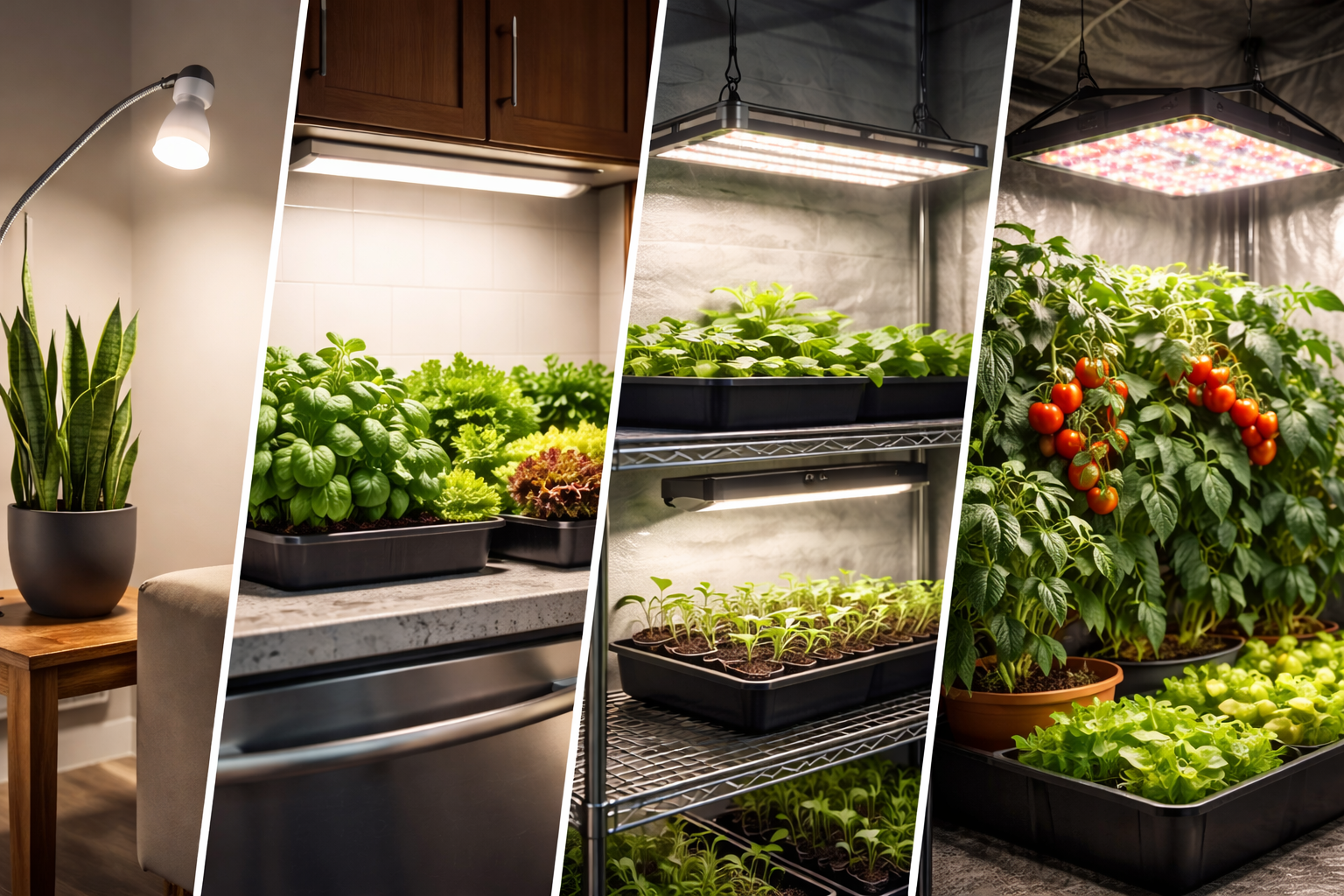
Here’s the fast filter I keep coming back to. Before looking at a single product, answer three things: What are you growing? How much area are you lighting? Is the light helping daylight, or replacing it?
That sounds basic. It saves a lot of dumb purchases.
A light for one snake plant in a dark office is a support light. A light for a shelf of basil is a working light. A light for tomatoes indoors is a production light. Those are not the same category, and treating them as if they are is how people end up staring at a “full-spectrum” gooseneck while their seedlings lean like drunks at closing time.
| Plant goal | Area size | Best starting point |
|---|---|---|
| Keep one foliage plant healthy | One pot | Bulb or compact clip-on |
| Grow herbs or lettuce well | Countertop or 1 to 2 containers | Bar light or strong tabletop fixture |
| Start one tray of seedlings | 1020 tray footprint | Strip light with adjustable height |
| Run a shelf or rack | Multiple trays or planters | Multi-bar or rack lighting |
| Grow fruiting crops indoors | Small tent or dedicated area | Higher-output panel |
If you’re still unsure, use this rule. If you want harvests, buy for the crop you want at its best, not the crop at its most forgiving. A weak light can keep mint green. That same light can leave basil thin and can make lettuce slow and floppy.
Iowa State Extension gives a handy daily light integral range too: roughly 12 to 16 mol/m2/day for high-light foliage, seedlings on the low side, and leafy edibles such as lettuce and basil. Fruiting crops sit higher. That is a clean reminder that “plants” is not one light target. It’s a family of targets.
Quick rule: one plant equals aimable light, one tray equals spread light, one shelf equals even light, fruiting crops equals more output than most casual setups provide.
Ignore the flashy wattage claims and check these specs instead
If a grow light listing screams wattage and stays vague on canopy output, coverage, or hanging height, I start squinting at it.
Iowa State says watts are not a reliable indicator of light intensity because watts measure energy use, not the amount of plant-usable light coming off the fixture. They also spell out why lumens are limited. Lumens describe light seen by people, while plants care about photosynthetically active radiation. Then they put the better metric on the table: photosynthetic photon flux density, or PPFD, which is the amount of plant-usable light actually reaching the leaves.
That changes what you should scan for on a product page.
- PPFD at a stated distance: useful
- Coverage area at a stated hanging height: useful
- PPF: useful if you also know the lit area
- Watts: only tells you power draw
- Lumens: better than nothing, still not the best plant metric
Iowa State also notes that moving a fixture closer raises intensity over a smaller area. That’s the bit people forget. Closer is stronger, but it also shrinks the sweet spot. A light that looks good dead center can leave the tray corners underfed.
Daily Light Integral helps here because it turns a fuzzy spec sheet into a useable rule. Virginia Tech explains that DLI is the amount of photosynthetic light a plant gets over 24 hours. Their formula for electric lights is PPFD multiplied by 3,600 and by the number of operating hours, then divided by 1,000,000. Their worked example uses a PPFD of 200 with a 16-hour day and lands at 11.5 mol/m2/day, which they say is enough for a wide range of crops from seedlings to bedding plants but not most fruiting crops.
That gives you a sharp if/then rule:
- If a light can only give modest PPFD, you can stretch its usefulness by running it longer.
- If the crop is fruiting, runtime alone won’t rescue a weak fixture forever.
- If the product page hides distance and coverage, don’t hand it the benefit of the doubt.
Note: “Full spectrum” is nice. It is not proof of strong output. Quantity and duration do more of the heavy lifting in home setups.
Match the light style to the job so the setup works in daily life
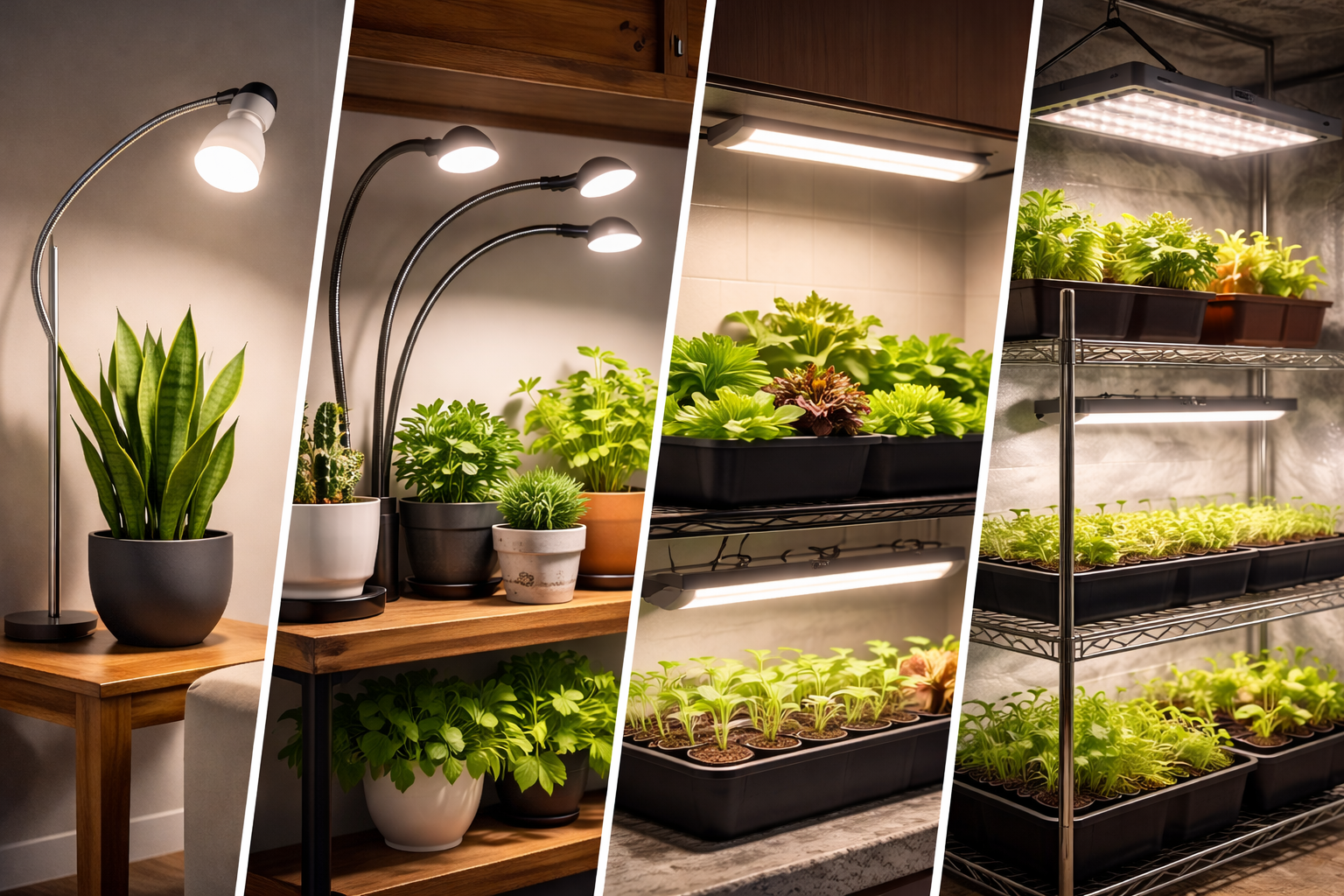
Form factor matters more than people expect because it changes coverage, convenience, and where the light can live without becoming a nuisance.
Bulbs in lamps are the easiest entry point. Screw one into a gooseneck lamp, point it at a single plant, and you have a simple support setup. This works best for one pot, not a mini jungle. The spread is usually narrow, and the moment you try to light three plants with one bulb, somebody ends up at the edge of the beam doing badly.
Clip-on or gooseneck lights are flexible. That flexibility is useful if the shelf is awkward or the light has to sneak around other decor. The weak spot is uniformity. Four heads do not always mean four strong heads, and the edges of each beam fade faster than people think.
Bar lights and strip lights are the quiet workhorses. They are better for seedlings, herbs, and shelf runs because they spread light more evenly across rectangles, which is exactly what trays and planters tend to be. If you’ve ever watched the middle of a tray race ahead while the corners lag, you already know why bars are popular.
Shelf stands and rack kits cost more up front, but they solve three annoying problems at once: height adjustment, better spread, and cleaner plant organization. For seed starting, that is not nothing.
Pendant or design-forward fixtures help in visible rooms where a black panel would look absurd. The tradeoff is easy to guess. Looks often get better as output per dollar gets a bit less forgiving.
There’s one more angle here. The Royal Horticultural Society notes that artificial lighting helps in dark corners, for early seedlings, and for decorative plant displays, while making the practical point that normal domestic bulbs are unsuitable for growing plants because the intensity is too low. That’s useful because a lot of people are not choosing between two grow lights. They’re choosing between a true grow light and a nice lamp with a regular bulb. That second option usually loses before it starts.
Pick the right light for seedlings, herbs, houseplants, and fruiting crops
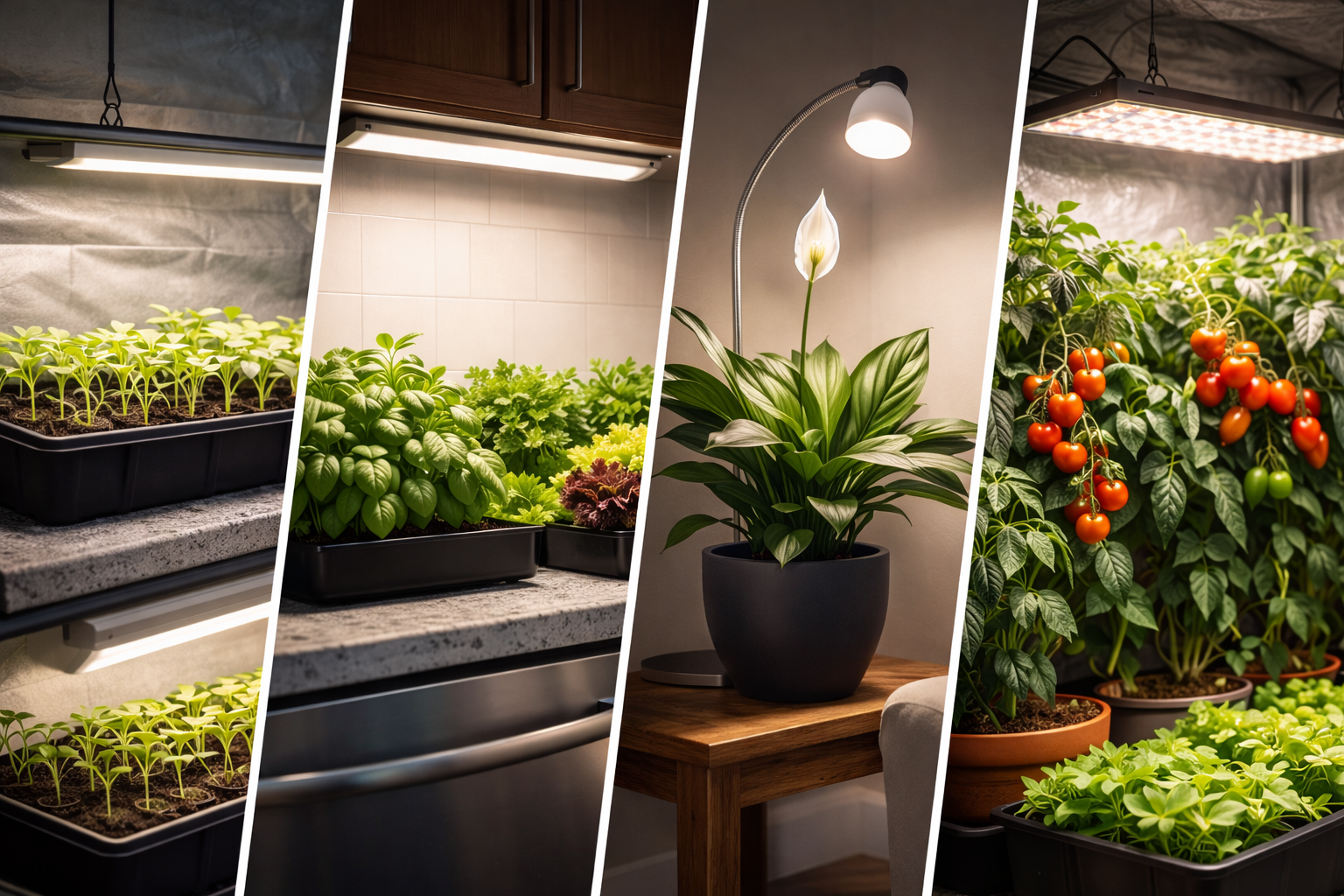
Different crops fail in different ways under weak lighting, and the fix isn’t always “buy a stronger light.” Sometimes the fix is “buy the right kind of stronger light.”
For seedlings: even coverage matters almost as much as output. Seedlings are close together and they all need similar treatment, so bar lights and strip setups make more sense than a bulb. The usual failure here is height. The fixture starts close, the plants pop, then growth speeds up and the light never gets raised. Or the reverse: the light hangs too high from day one and the stems stretch. Either way, the signal is obvious. You get lanky seedlings that look eager and weak at the same time.
For herbs and leafy greens: think “working light,” not “decorative help.” Iowa State’s daily light guidance places herbs and vegetables grown for leaves in the high-light band, right around the same range where many seedlings live. That is why basil gets disappointing under the same clip light that keeps a philodendron alive. If the goal is a few leaves now and then, a modest fixture can get you by. If the goal is steady cuts from basil or indoor lettuce that doesn’t crawl, go wider and stronger.
That also makes indoor cilantro care easier to get right. Cilantro is one of those herbs people call “fussy” when the real issue is often weak light paired with warm conditions.
For houseplants: this is where people often overspend. Many foliage plants only need a supplemental boost. University of Minnesota says low-light plants fit north windows or darker corners and tend to grow more slowly in dimmer spaces. That slower pace is not a problem if the plant still looks good and the goal is maintenance, not rapid growth. So yes, a bulb or compact clip-on can make sense here.
For fruiting plants: be honest with yourself. Tomatoes, peppers, and fruiting edibles need much more energy. Virginia Tech says fruiting crops often need nearly double or even triple the DLI of some leafy greens. That’s the line casual fixtures trip over. You can grow the plant under a modest light. Getting real production is a different ask.
If leafy greens are the main target, container choice matters too because weak drainage and shallow soil make indoor lettuce problems look like lighting problems. This guide to lettuce containers indoors pairs well with a grow-light setup because the two choices affect each other more than people think.
Set the light at the right height and schedule so plants grow compact, not lanky
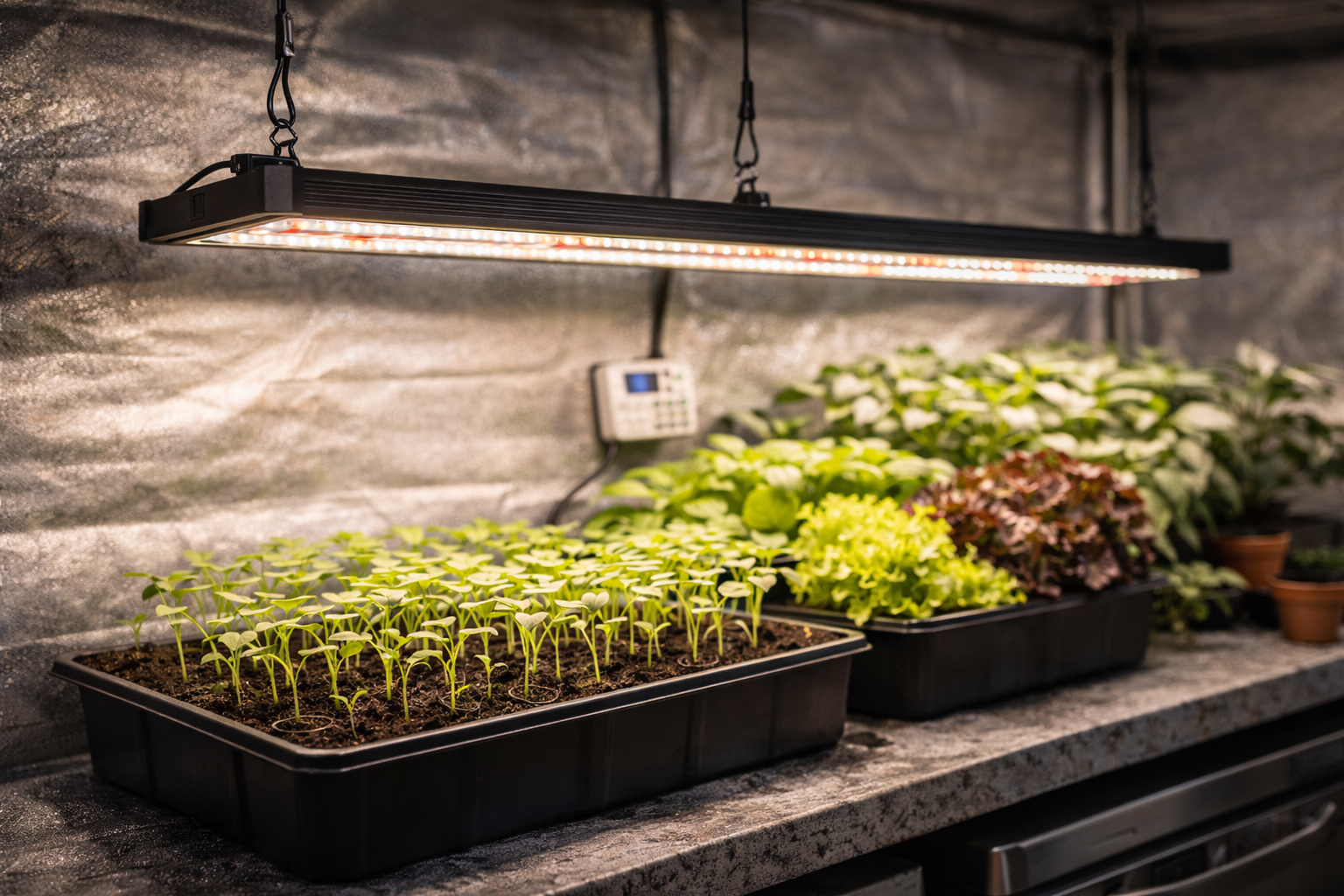
A decent light hung badly is still a bad setup.
UNH Extension says the failure point with lamps is often about light quantity, meaning intensity and duration, more than quality. In the same Q&A, they say LED shop lights can work fine for starting seedlings if you keep them low enough, bright enough, and on long enough each day. That’s useful because it turns setup into a behavior problem, not some mystical “grow light vs not grow light” battle.
Set the fixture low enough to stop stretching
Start with the manufacturer’s stated hanging range if the light provides one. Then watch the plant. If seedlings are stretching, the fixture is usually too weak, too high, or on for too short a day. A lot of home LEDs land somewhere around 12 to 18 inches above the canopy as a starting range, but that is not universal and it gets sloppy fast if you treat it as law.
Raise the fixture as plants gain height
Leaf tips can bleach or scorch if the light is too intense at close range. University of Minnesota points to scorched and bleached leaves as a symptom of too much light. That’s your cue to raise the fixture a bit or reduce intensity if the fixture is dimmable. Good setups are not “set once and forget.”
Run the light long enough to make the daily total count
Iowa State says most home gardeners should aim for about 12 to 14 hours of light a day, with a practical range of 10 to 16 hours. Their page also notes that seedlings usually sit on the higher side of the range. So if the fixture is modest, a timer becomes part of the light itself. Forgetting to switch it on is the same as buying a weaker unit.
Read plant signals before they turn into setbacks
Leggy growth means the plant is asking for more light. Bleaching means back off a touch. Slow growth with healthy color often means the plant is surviving, not thriving. That’s not always a problem. It just means you should call the setup what it is.
Pro tip: if you only change one thing, fix height first. A lot of “bad light” complaints are actually “bad distance” problems.
Use this no-regret shortlist to choose the right type of LED grow light
These are the product picks I would sort people into first, and the reason is simple: each one solves a different job. That’s how they were judged here too. The criteria were the same for every light: how well the beam shape fit the intended use, how easy the setup was to place at the right height, how believable the coverage was for the crop, whether timer or dimming features were actually helpful, and what kind of buyer would regret the purchase.
I also looked at them the way a normal home grower would. Could the light fit a shelf, counter, or visible room without turning the place into a mini warehouse? Could it keep coverage even enough that one side of the planter wouldn’t surge while the other sulked? And did the light make sense for the crop category it claimed to serve? That’s the kind of testing people usually skip in favor of spec-sheet gawking.
SANSI LED Grow Light Bulb
The SANSI bulb is the clean answer for one plant, a small grouping, or a lamp-based setup where you need aimable supplemental light without adding a new fixture. What it does well is convenience. If you already own a decent lamp with the right socket, setup is almost annoyingly easy. Screw it in, angle it toward the plant, and get the distance under control. For a pothos, ZZ plant, small monstera, or even one basil plant that sits close to the bulb, that simplicity is a real advantage.
The catch is the same one nearly every bulb carries: narrow coverage. This is not the light I’d trust for a tray of seedlings or a mini herb station unless the plants are packed very tightly under the beam and you stay on top of height. Bulbs are support lights first. Working lights second. If you treat one bulb like a shelf system, the center plant usually wins and the edge plants get the leftovers.
Who it’s for: someone with one or two plants in a dim room, or someone who wants a low-fuss entry point. Who should skip it: anyone trying to grow lettuce, herbs, or seedlings over a broad footprint. In that setting, a bar light does the job with less drama and better spread.
Leoter 4-Head Grow Light
The appeal here is obvious. Four adjustable heads, clip-on mounting, timer functions, and enough flexibility to snake light around a mixed shelf. For awkward setups, that flexibility is genuinely helpful. I can see why these are popular with people trying to light a sideboard, office shelf, or a small indoor plant corner where a rigid fixture would be annoying.
Still, flexible does not automatically mean strong. Multi-head gooseneck lights often look more powerful than they are because the beam can be pointed in several directions. Once you split light across several plants, output per plant drops fast. That’s fine for low- to medium-light houseplants that just need help. It is much less convincing for basil, parsley, or seedlings where even growth matters more. The usual disappointment is not quality. It’s expectation.
I like this type for support duty: a peace lily near a dark window, a mixed group of foliage plants, maybe one herb you want to babysit. I don’t like it as the backbone of a seed-starting setup. The timer is useful, the clamp is handy, and the heads are easy to aim. Just don’t mistake aimability for tray-level coverage.
SunBlaster LED Strip Light
This is the type of light that makes seed starting feel much less fiddly. Strip lights spread output over a rectangle, which is exactly what seed trays, herb planters, and shelf runs need. That shape match matters. You get more even growth, fewer weak corners, and a setup that is easier to keep close to the canopy without blasting one plant and starving the next.
For indoor gardeners who want a practical rig for herbs, leafy greens, or seedlings, this is one of the safer bets. It doesn’t pretend to be all things. It just does the useful job well. Mount it under a shelf, suspend it above a tray, pair it with a timer, and you have a real working station. That matters more than fancy spectrum talk for a lot of home use.
The tradeoff is aesthetics. Strip lights are not the prettiest thing in a living room, and they ask for a bit more setup than screwing in one bulb. But functionally, this is where a lot of indoor gardeners should start. If the crop is basil, lettuce, cilantro, or a tray of tomatoes that will later move outside, I trust this style faster than I trust most clip-on gadgets.
Soltech Grove LED Grow Light
The Soltech Grove exists for people who want a grow light to do two jobs at once: help the plant and not look like grow-room hardware hanging over the coffee table. In visible rooms, that is a fair ask. Plenty of plant owners are not building a seed rack in the basement. They’re trying to keep a fiddle leaf fig or a philodendron happy in a room where design still counts.
This sort of fixture is strongest when the crop is ornamental and the viewing distance matters. Pendant-style lights can make indoor plant displays feel intentional rather than improvised. The weak point is value per ounce of output. You are paying for form, finish, and how the light lives in a room, not just raw production. That’s not a flaw. It’s just the trade.
I would pick a light like this for a statement plant, a visible corner, or a decorative cluster where a black panel would be ridiculous. I would not choose it first for herbs, seed trays, or any setup where spread and production beat looks. If the room matters as much as the plant, though, this type earns its keep.
Spider Farmer SF-1000
This is the pick for readers who are past decorative support lighting and into actual crop production. The reason to step up to a higher-output panel is not because bigger is always better. It’s because some plants ask for more daily light than bulbs and clip-ons can deliver without turning the schedule into a marathon or the coverage into a narrow hot spot.
Virginia Tech’s DLI guidance is useful here. Fruiting crops often need nearly double or triple the daily light of some leafy greens. That simple fact explains why casual fixtures stall out once tomatoes or peppers enter the chat. A light in this class makes more sense when the goal is heavy vegetative growth, stronger edible output, or a setup where the fixture is the main light source, not a sidekick.
The cost of choosing a panel like this too early is overbuying. The cost of choosing it too late is replacing a weak light after weeks of mediocre growth. If you’re growing one pothos, skip it. If you’re growing a rack of leafy greens or trying to push demanding crops indoors, this is the kind of light that stops pretending and starts working.
Still in doubt? Buy the light that fits the footprint first. A strip light beats a bulb for a tray. A bulb beats a panel for one plant in a lamp. A panel beats both once production is the goal.
Avoid the mistakes that make growers blame the light when the setup is the problem
The most common mistake is choosing by wattage or by the words “full spectrum” and stopping there. A weak full-spectrum light is still weak. Iowa State says watts do not map cleanly to useful plant intensity, and that PPFD at the leaf surface is the better guide. That one correction would save a lot of returns.
The next mistake is hanging the light too high. You see it all the time with seedlings. The grower bought a decent light, then parked it so far above the tray that half the usable intensity never reaches the leaves. UNH’s advice on shop lights is refreshingly plain: keep them low enough, bright enough, and on long enough. That’s the setup in one sentence.
Another easy miss is overestimating coverage. A beam that looks bright to your eye can still leave the outer plants underlit. This is why bar lights punch above their weight for trays and shelf runs. They fit the geometry. You don’t need a physics lecture for that. You just need to stop treating rectangles like circles.
Then there’s the houseplant trap. A low-light plant can tolerate modest lighting, so the grower assumes the same fixture will work for basil or seedlings. University of Minnesota separates those use cases clearly. Low light works for certain foliage plants. It does not work for seed starting. That line matters.
And one more thing: use the daylight you already have. The Royal Horticultural Society points out that artificial light helps most when natural light is limited, but they also say to make the most of available daylight first. That sounds obvious until you see someone tuck a plant in a dim corner and ask a small clip light to fix the whole room.
Safety note: don’t stare into bright LEDs, keep cords tidy around watering areas, and use timers and fixtures the way the maker intended. No drama. Just basic indoor-electricity common sense.
If the appeal of a separate light, timer, planter, and nutrient routine is fading by the minute, an all-in-one system can be the saner path. This guide to indoor gardening systems is useful for readers who want the light and growing setup bundled into one tidy unit.
FAQ
Can regular LED bulbs grow indoor plants, or do I need a true grow light?
A regular household LED bulb is usually too weak for active plant growth. The Royal Horticultural Society says domestic light bulbs are unsuitable for growing plants because intensity is too low. A real grow light is the safer pick. The one exception is a bright LED shop light or work-style fixture used close enough and long enough, which UNH says can work for seedlings if light quantity is adequate.
Do LED grow lights replace sunlight completely, or just supplement it?
Both are possible. A support light can supplement a bright room. A stronger fixture can act as the main light source in a shelf setup, rack, or tent. The question is not “replace or supplement” in the abstract. It’s whether the fixture can deliver enough daily light for the crop. One houseplant asks for much less than basil or tomatoes.
Why are my seedlings still leggy even though I bought a grow light?
Usually because the fixture is too high, too weak for the area, or not running long enough. Legginess is one of the clearest signs that the plant wants more usable light. Lower the fixture within the maker’s range, tighten up the schedule with a timer, and make sure the whole tray is inside the good part of the beam, not just the middle.

Michael Rowan is the founder and lead writer at The Garden Playbook. He has spent 10+ years growing plants across a range of settings — from indoor houseplants and container gardens to raised beds and in-ground plots — adapting methods to different light levels, seasons, and growing conditions.
Michael focuses on practical, experience-based guidance grounded in fundamentals: soil health, watering strategy, plant nutrition, pruning and propagation, and integrated pest management (IPM). His work aims to help readers diagnose common problems (such as yellowing leaves, stunted growth, or pest pressure) and apply straightforward solutions that are realistic for home gardeners.
At The Garden Playbook, Michael develops tutorials and plant guides using a consistent process: documenting real outcomes where possible, explaining the “why” behind each step, and verifying higher-risk topics (such as plant toxicity or pest treatment options) against reputable horticultural references.