
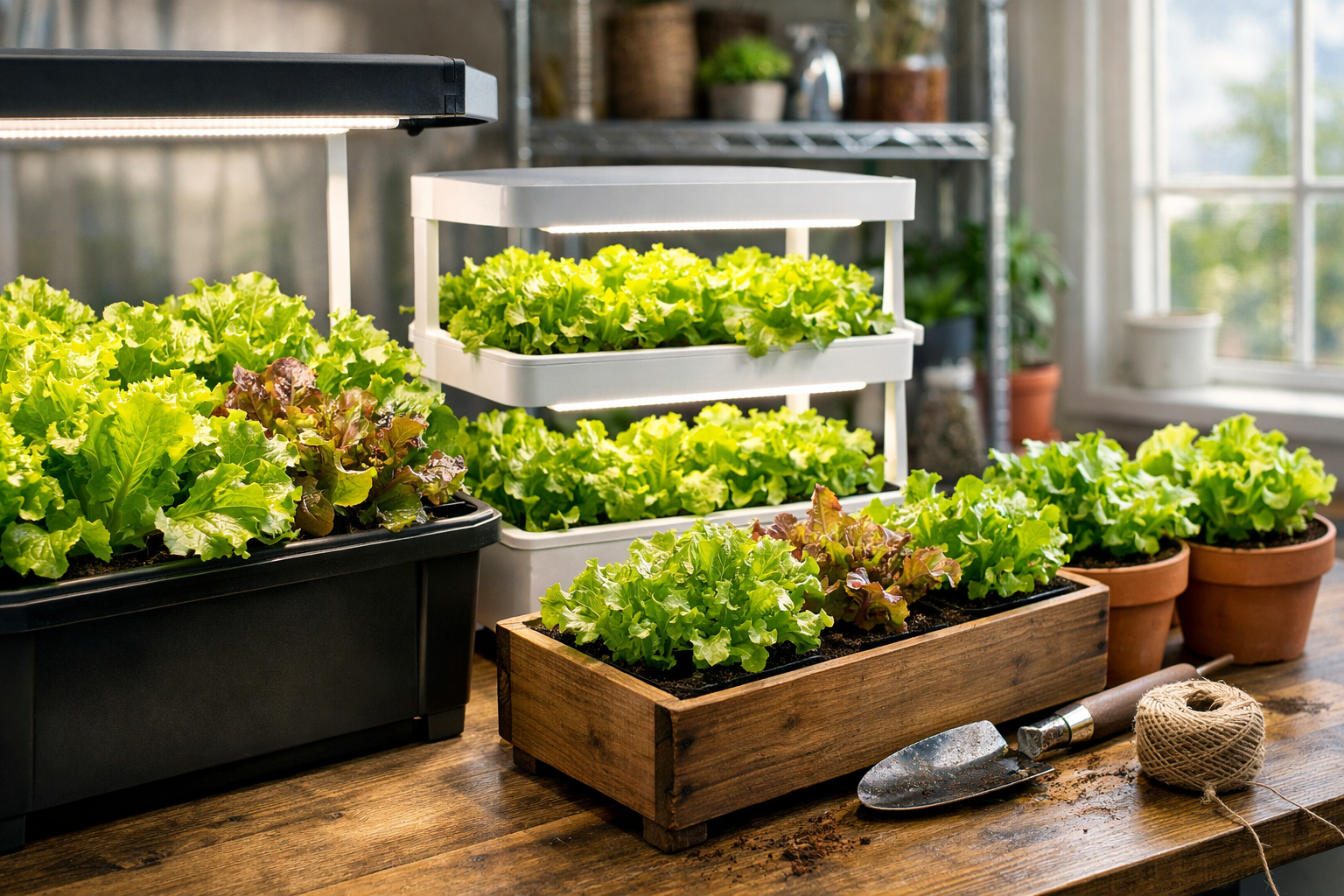
You don’t usually notice the container first. You notice the lettuce.
It looks fine for a week, then one morning the leaves are limp, the mix is still wet, and the whole thing feels annoyingly harder than “lettuce in a pot” was supposed to be. That’s why the best container for growing lettuce indoors is usually a wide planter or tray with real drainage and about 6 inches of depth, not a tall decorative pot and not a sealed bowl that happens to hold soil.
The stock answer stops too early. A shallow tray, a window box, and a round self-watering planter can all work. But they are not solving the same job. One is best for fast baby leaves. One is better for a tidy windowsill harvest. One buys you a bigger watering buffer when life gets busy.
This guide will help you:
- pick the right indoor lettuce container for baby leaves, bigger plants, or a low-fuss setup
- sort out tray vs pot vs self-watering planter without guessing
- use depth, width, and material as decision rules, not trivia
- avoid the container mistakes that keep roots wet or leave plants cramped
- choose a product faster if you’d rather buy than improvise
Best Suggestions Table (All products have been personally reviewed & tested by us! Click the buttons below to jump to the reviews.)
| Product | Best for | Action |
|---|---|---|
| Bloem Dayton Window Box Planter 24″ | Most indoor growers who want easy cut-and-come-again harvests | Check PriceReview |
| LECHUZA CLASSICO Color 21 | Low-maintenance growers who want a cleaner self-watering setup | Check PriceReview |
| Gardener’s Supply GrowEase Seed Starter Kit | Dense sowing and staggered indoor lettuce starts under lights | Check PriceReview |
Tip: Clicking the “Review” button will move you to the review so you can decide fast.
Still in doubt? Here’s a fast guideline to save you some time.
- If you want baby leaves every week, buy a wide window box or shallow trough with drainage.
- If you want a few larger plants and hate frequent watering, use a 6- to 8-inch-deep self-watering planter in good light.
- If your only bright spot is under a grow light, trays and flats use that footprint better than deep round pots.
- If the container has no drainage hole, skip it for lettuce.
The best container for growing lettuce indoors is usually wide, shallow, and well-drained
For most people, the best indoor lettuce container is a rectangular planter or tray that is at least 6 inches deep, has real drainage holes, and gives you more surface area than height. That last part matters more than many articles let on.
University of California Agriculture and Natural Resources says lettuce does well in containers about 6 to 9 inches deep, and the Royal Horticultural Society says almost any container can work for baby salad leaves if it is more than 15 cm, or 6 inches, deep and drains well. That tells you two useful things right away. Lettuce doesn’t need a tall root run, and the real fight indoors is moisture control, not depth for its own sake.
That’s the broad answer.
The useful answer is narrower. If you’re growing loose-leaf lettuce for cut-and-come-again harvests, width wins. If you’re growing fewer, larger plants, a bit more soil volume buys you time between waterings. Indoors, that buffer is nice because the swing between “bone dry by the heater” and “still soggy on a dim sill” can get silly fast.
Good default: a plastic or resin window box, roughly 6 to 8 inches deep, with a saucer and enough width to sow several rows. That setup suits the way most people actually harvest indoor lettuce: a handful at a time.
If the home is very dim, container choice gets even touchier. A large pot full of wet mix in weak light is not “safer.” It often just stays wet longer. If the light is strong, the same pot can feel forgiving. That is why the container answer always has to be tied to the room, not just to the plant.
Readers who are already leaning toward a built-in light and reservoir setup should probably look at a compact indoor gardening system instead of trying to force a soil planter to act like one.
Match the container to how you want to harvest lettuce
The fastest way to pick the wrong container is to skip this question: are you trying to harvest baby leaves often, or are you trying to grow fewer, larger plants?
Those are two different layouts.
If you want baby lettuce, think “patch” not “specimen.” A tray or window box lets you sow a short dense block, snip outer leaves, and come back again. It uses shelf space well and gives you the kind of steady trickle most indoor growers actually want. Sandwich leaves. A side salad. Something fresh to cut while dinner is happening.
If you want mini romaine or larger leaf types, switch to more room per plant. The University of Maryland Extension lists leaf, cos, and butterhead spacing at 4 to 10 inches in-row, with the exact spacing changing with harvest stage. Indoors, you can treat that as a warning flag more than a strict map: crowding full-size plants in a shallow tray works for a little while, then they start fighting for light and airflow.
Here’s the practical split:
- Baby leaf lettuce indoors: choose a shallow, wide container and sow in bands.
- Cut-and-come-again loose leaf: choose a window box or trough with a bit more depth and room for roots to re-sprout.
- Larger romaine or butterhead: choose fewer plants in more volume, often one per pot or generous spacing in a wider planter.
What to check first
If you want “salad whenever I feel like it,” buy width. If you want “a few bigger plants I don’t have to fuss over,” buy volume.
This is also where the usual “lettuce has shallow roots” advice goes off the rails. True, but incomplete. Shallow roots do not mean every shallow container is equally good indoors. A flat that dries in a day under a grow light behaves very differently from a self-watering round pot on a cool sill.
Choose the right container type without overthinking it
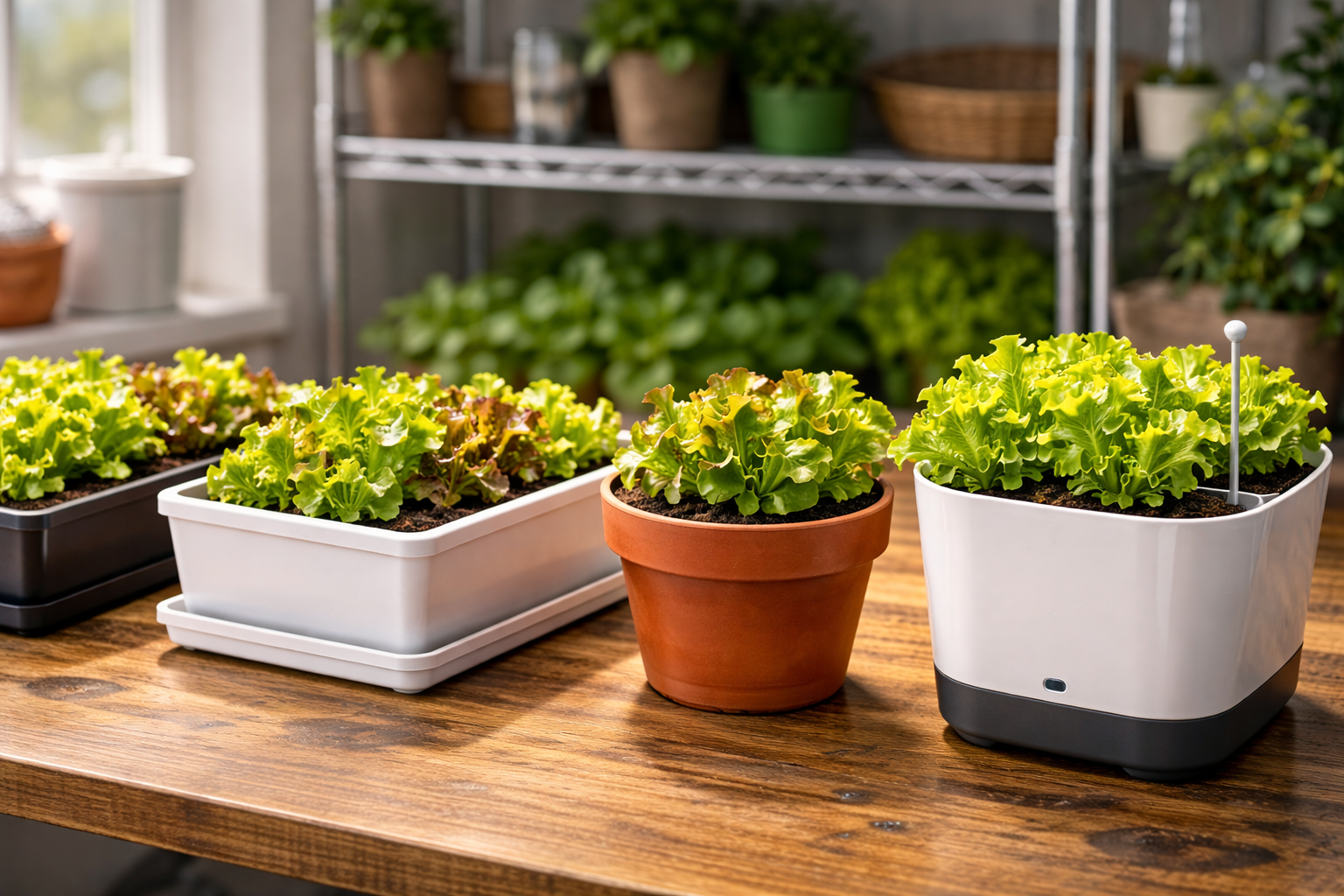
There are really four container styles worth comparing for indoor lettuce: a shallow grow tray, a rectangular window box, a standard round pot, and a self-watering planter. Anything else is usually a variation on those.
| Container type | Best use | Main upside | Main catch |
|---|---|---|---|
| Shallow tray | Baby leaves under lights | Great use of footprint | Dries fast |
| Window box | Most indoor cut-and-come-again setups | Best balance of width and volume | Needs a saucer and cleanup plan |
| Round pot | A few separate plants | Simple, easy to find | Less harvest per windowsill inch |
| Self-watering planter | Busy growers in good light | Steadier moisture | Can stay too wet in dim rooms |
I judge container picks against the same checks every time: drainage, usable width, real growing depth, watering forgiveness, cleanup indoors, and whether the shape matches the way lettuce is harvested. A container can look perfect in a product photo and still be a bad lettuce choice if it is tall, narrow, or awkward to water inside.
Bloem Dayton Window Box Planter 24″
This is the one that fits how most people grow lettuce indoors. A 24-inch window box gives you the shape lettuce wants: long, usable surface area and enough depth to grow a cut-and-come-again patch without turning the whole thing into a tiny swamp. Amazon listings for the Bloem Dayton line show a removable saucer option on some versions, pre-drilled drainage, and a footprint that makes sense on a sill or narrow shelf. That matters. Indoor lettuce is usually limited by footprint and light, not by some deep-root issue.
What I like most in this format is how forgiving it feels. You can sow a short row every week or two, or give a few loose-leaf plants more elbow room. It also makes thinning less painful because you can picture the harvest zone better than in a cluster of small round pots. In actual use, rectangular boxes are just easier to manage. You can rotate them under a light, water evenly, and cut leaves without wrestling foliage from all sides.
The catch is simple: not every window box sold for decor is good for edible growing. Some have shallow depth, weak drainage, or a sealed base. If buying this style, check that the model really drains and gives you around 6 inches of usable depth. When it does, this is the most sensible all-around pick for indoor loose-leaf lettuce.
LECHUZA CLASSICO Color 21
The LECHUZA CLASSICO Color 21 is a better pick for people who miss waterings than for people trying to maximize harvest per inch. LECHUZA’s product pages show a built-in reservoir, a water-level indicator, and a compact round shape. That reservoir is the whole story here. Indoors, the nicest self-watering pots don’t just hold water. They smooth out the rhythm so the mix doesn’t swing from dry to drenched every few days.
For lettuce, that can be very handy if the room is bright and cool enough. A small loose-leaf planting in a pot like this often grows more evenly than the same planting in plain terracotta, which can dry out in a hurry near a sunny window or radiator. The indicator is useful too. You don’t have to poke the mix as often or guess from the top layer.
But I would not call this the best default for everybody. The round footprint is less efficient than a trough, and self-watering planters can stay too wet in weak winter light. This is a “buy because it fits your habits” container, not a universal answer. If you want one or two neat plants on a bright sill and you know you forget to water, it makes sense. If you want repeated salad harvests from a small indoor space, width still beats it.
Gardener’s Supply GrowEase Seed Starter Kit
This one is best used a little differently, and that’s why I like it. Gardener’s Supply says the 24-cell GrowEase kit uses a capillary mat and reservoir, with each cell about 2 inches square and 2.25 inches high. In plain English, it’s built to raise clean, even starts. For lettuce growers indoors, that opens up a smart routine: start more seedlings than you need, transplant the strongest into a wider harvest container, and keep the cycle going.
If you’ve ever tried to keep one big tray productive for too long, you know the slump. The first cuts are great, then the patch gets uneven, the crowded plants lag, and the whole thing starts looking tired. A seed starter like this helps you stagger fresh lettuce instead. One tray is germinating, one planter is producing, and you aren’t asking a single container to do every job.
I would not use this as the only lettuce container unless you’re treating it as a baby-leaf system under lights and cutting very young. The cells are too segmented for a true broad harvest patch. Still, for organized growers, it’s a strong add-on pick because it removes a lot of watering guesswork at the seedling stage and keeps the rotation tidy.
Get the size right: depth matters, but width usually matters more
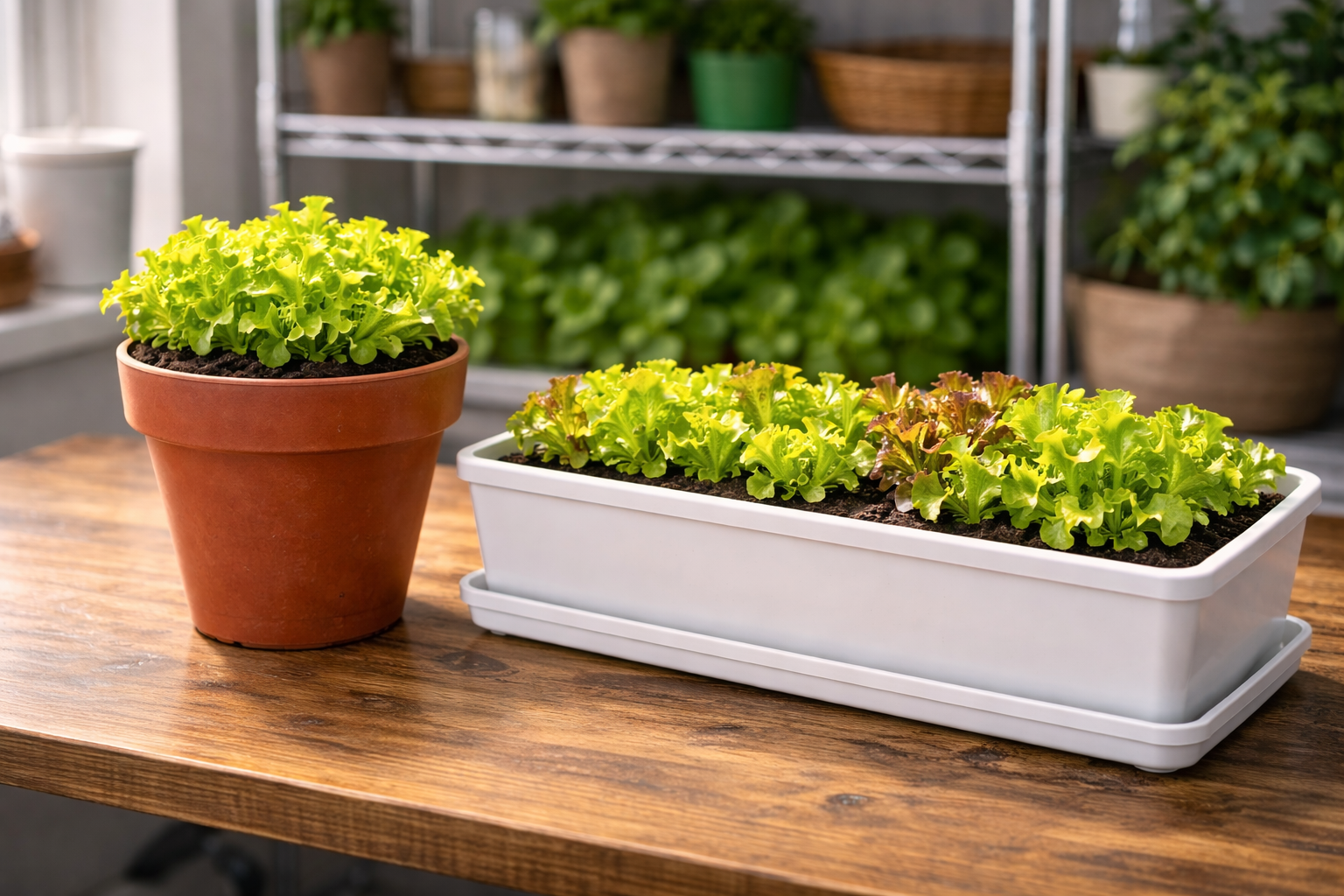
This is the part people overcomplicate. Lettuce is shallow-rooted. Fine. But indoors, tiny containers fail faster from moisture swings than from lack of root depth.
RHS guidance says a 25 cm, or 10-inch, pot can produce several supermarket bags of salad leaves, and UC ANR puts the practical depth range for lettuce containers at 6 to 9 inches. Read together, that gives you a better rule than “shallow roots”: once you hit about 6 inches of depth, extra width often adds more harvest than extra depth.
So if you’re choosing between a tall narrow pot and a broad box with the same soil volume, the box usually wins for indoor lettuce. More sowing area. Better use of the light footprint. Easier cutting. Less awkward crowding.
Use these if/then rules:
- If you want baby leaves and you check moisture often, a shallower tray can work well.
- If you miss waterings or want bigger plants, move into the 6- to 8-inch-deep zone.
- If space is tight, pick width first once depth is adequate.
- If the room is dim, don’t jump to an oversized planter just because it feels safer.
Quick rule: depth keeps the plant alive, width makes the harvest worth doing.
That sounds a bit blunt. It’s still true.
Pick the material that matches your watering habits, not your decor
Material changes the watering rhythm more than anything else. Indoors, that’s not a small detail. It’s the difference between “nice little salad project” and “why is this thing always either dry or boggy?”
Plastic and resin are the easiest starting point. They don’t leak moisture through the sides, they are light, and they hold a steadier moisture level than terracotta. For lettuce, that is usually helpful. The leaves stay tender when watering is steady, not erratic.
Terracotta has its place. UC ANR notes that clay and terracotta dry faster than plastic. That can be useful if you overwater and have strong light. In a dim room or cool season window, though, terracotta often turns into extra work without much payoff. I’ve had it save herbs from my own heavy hand, then annoy me with lettuce because the top half of the mix dried faster than the root zone settled in.
Glazed ceramic acts more like plastic, though it can be heavy and messy to move once planted. Fabric pots are fine outdoors, but for indoor lettuce they often dry faster than people expect and drip in ways that get old quick. Metal containers are mostly style pieces for this job. They warm fast and they are rarely the easiest edible setup indoors.
If you’re choosing by habit, not by looks:
- Forgetful waterer: plastic, resin, or self-watering.
- Heavy-handed waterer in strong light: terracotta can help.
- Neat freak with a painted sill: skip porous pots and skip risky saucer setups.
Readers sorting out window quality first can use this guide on the best facing window for plants. Light changes how forgiving any pot material feels.
Use drainage and saucers the right way so roots do not drown indoors
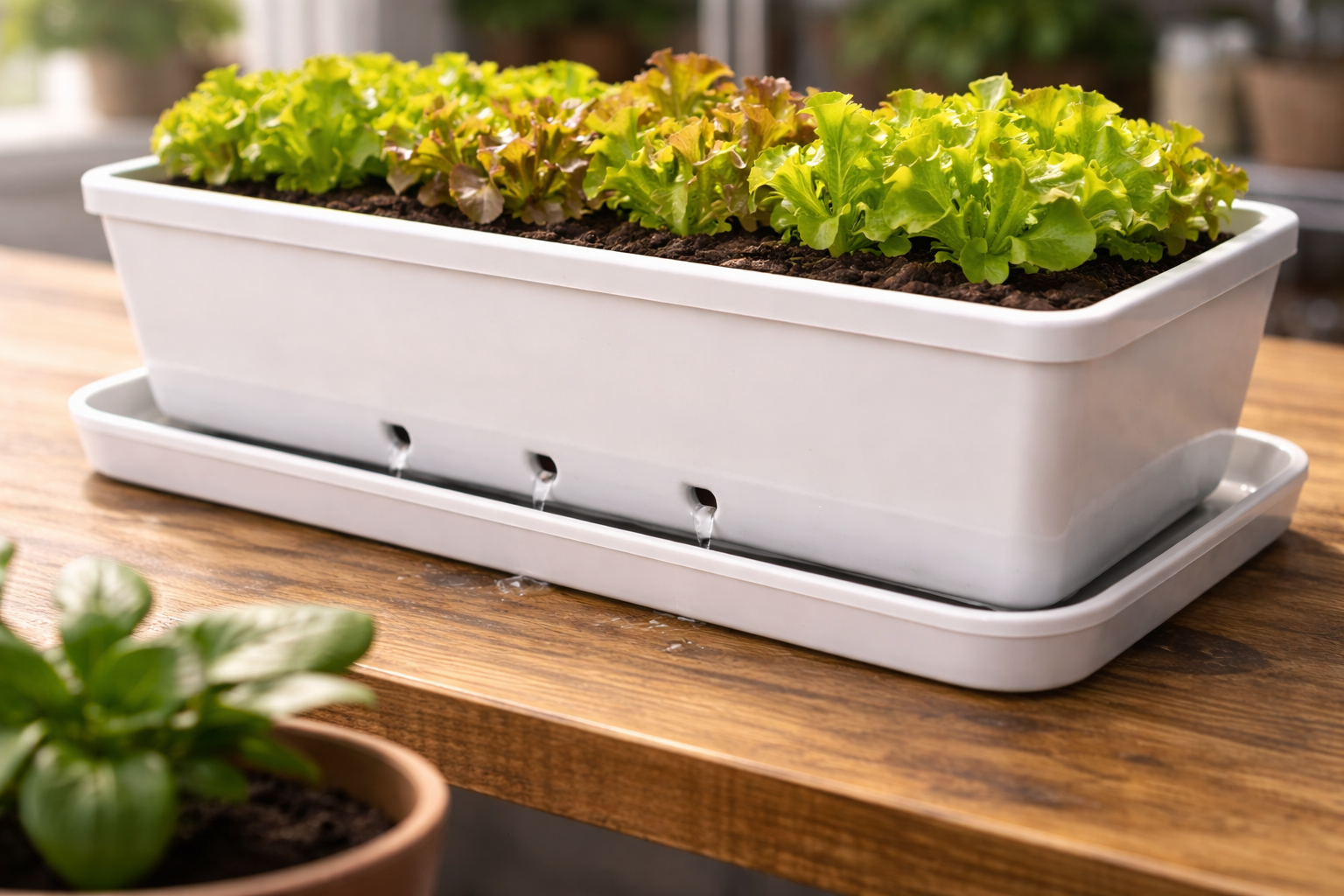
No drainage hole, no lettuce. That’s the clean version.
Illinois Extension is direct on two points that matter here: a pot needs drainage, and the old gravel-in-the-bottom trick does not fix poor drainage. Water perches above that coarse layer instead of slipping neatly away, which leaves the root zone wetter than people think.
That matters a lot indoors because lettuce roots like oxygen as much as they like moisture. A sealed decorative cachepot with a nursery pot hidden inside can work, but only if you actually empty excess water. A lot of people don’t. Then the inner pot sits in runoff and the roots sulk.
The basic setup is boring on purpose:
- a container with drainage holes
- a saucer or catch tray sized to the base
- container mix, not garden soil
- no gravel layer at the bottom
Small test. Big payoff.
Before sowing, water the filled container once in the sink. Check how fast excess water exits, how much the saucer catches, and whether water pools in odd spots. It’s a two-minute test that saves a lot of head-scratching later.
One more thing: recycled food tubs can work if you clean them well and add enough holes. Just don’t use a flimsy container that flexes, cracks, or traps stagnant water in corners. For edible crops, simple and washable beats clever.
The same drainage logic comes up in other kitchen herbs too. This piece on the best pot for basil makes the same point in a different crop: decorative convenience is usually a bad trade if the root zone stays wet.
Avoid the container mistakes that make indoor lettuce feel harder than it is
Indoor lettuce usually fails in very ordinary ways.
Not dramatic disease. Not some mystery deficiency. Just a string of small container mistakes that pile up.
Mistake 1: choosing by looks. Tall narrow pots are common because they look nice on a shelf. For lettuce, they waste useful growing width. You get one or two awkward plants where a broad trough would have given you repeated cuttings.
Mistake 2: buying too big in weak light. This one surprises people. A huge pot feels generous, but in a dim room it often keeps too much mix wet for too long. You are not buying “safety.” You are buying slower drying.
Mistake 3: using a container without real drainage. Not “a crack near the edge.” Not “I water carefully.” Real drainage.
Mistake 4: treating head lettuce like loose-leaf lettuce. Loose-leaf types forgive crowding and repeated cutting. Head lettuce asks for more spacing and more patience. If you want quick indoor success, leaf lettuce is the easy win.
Mistake 5: forgetting that light changes container behavior. Illinois Extension says lettuce indoors usually needs 6 to 8 hours of bright light, and supplemental lights often need to run longer than natural light. That means a pot that behaves nicely in a bright south window can stay too wet in a darker room.
| Symptom | Most likely container cause | What to do next |
|---|---|---|
| Leaves limp, mix still wet | Too much volume, poor drainage, weak light | Downsize, improve drainage, add light |
| Plants stall after first cut | Crowding in shallow patch | Thin harder or reseed more often |
| Mix dries too fast | Tray too shallow or pot material too porous | Move to deeper plastic or self-watering |
| Bitter leaves and fast bolting | Heat and stress, sometimes made worse by erratic moisture | Cool the setup, steady the watering, reseed leaf types |
Choose the best setup for your exact indoor scenario
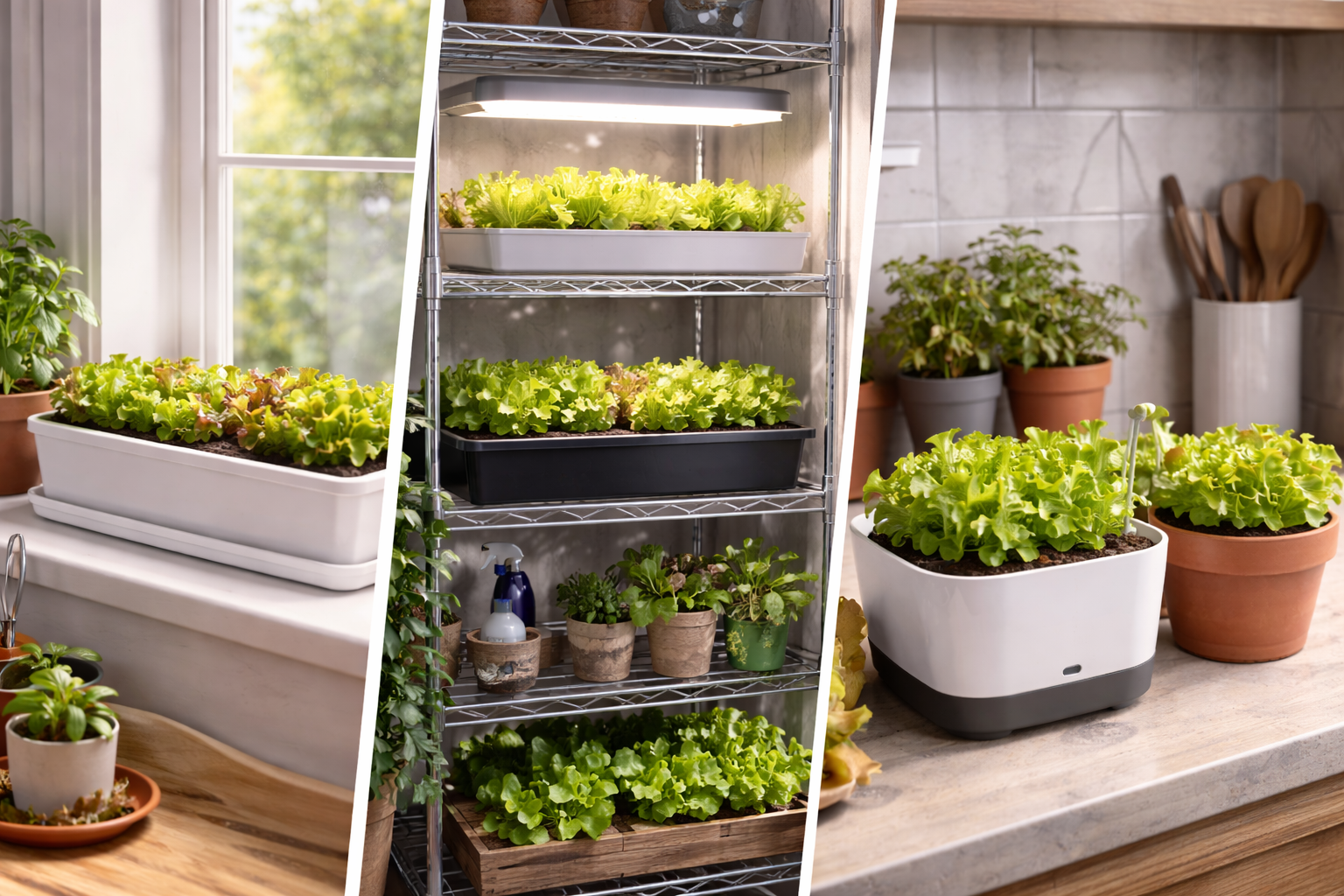
This is where the answer gets personal in a useful way.
Best for a sunny windowsill: a rectangular window box or trough. It uses the strip of light better than round pots. Go for a loose-leaf mix and harvest outer leaves often.
Best for a dim room with grow lights: a tray or flat. Under lights, shelf footprint matters more than decor, so wide shallow containers suddenly make a lot of sense. If the room is cool, they are even easier to keep happy.
Best for frequent salad eaters: two medium containers, not one huge one. Sow a second box about a week or two after the first. That overlap is what keeps the harvest steady without one patch getting tired and leggy.
Best for low-maintenance growers: a small self-watering planter in a bright spot. Not because self-watering is “better” in the abstract. Because it forgives the missed day or two that usually throws lettuce off.
Best for tiny spaces: one compact window box or a couple of 4- to 6-inch pots if you want separate plants. Avoid tall decorative pots here. They eat space without giving much back.
A quietly useful trick: if the windowsill is narrow, don’t force the container there. A shelf with a simple grow light often gives a better harvest and lets you use a smarter tray shape.
That is also why some readers end up happier with a hydroponic countertop unit than with potting mix. Not because soil fails, but because their room and routine don’t really suit it.
Use a simple fit test before you buy any lettuce container
You do not need a long checklist. Five checks are enough.
- Check drainage. If there is no real hole, move on.
- Check usable width. Can it hold several sowing lines or more than one plant without crowding?
- Check depth. Around 6 inches is the safe floor for most indoor lettuce containers.
- Check material. Does it match the way you actually water?
- Check the harvest style. Baby leaves, repeated cuttings, or bigger plants?
Fast buy rule
For most people, the no-regret choice is a wide plastic or resin planter with drainage, about 6 to 8 inches deep, plus a saucer.
Buy a self-watering pot if missed waterings are the main problem. Buy a seed-starting tray if you want a tidy rotation under lights. Skip sealed decorative containers for lettuce.
If I had to narrow it down to one sentence, it would be this: pick the container that makes steady moisture and easy harvesting more likely in your actual room. Not the prettiest one. Not the tallest one. The one that fits the job.
FAQ
Can lettuce grow in a bowl indoors if I am careful with watering?
Not well for long. A bowl without drainage traps water in the root zone, and indoor lettuce hates that more than it hates being a little cramped. Use a nursery pot inside the bowl if you want the look.
Is a self-watering planter good for lettuce indoors?
Yes, if the room is bright enough and the planter is not oversized. Self-watering planters are a good match for loose-leaf lettuce when missed waterings are the main problem. In weak light, they can keep the mix wet longer than you want.
How many lettuce plants fit in one indoor container?
That changes with the harvest goal. A baby-leaf patch can be sown densely and cut young. Larger leaf or mini-head types need more room. As a rough guide, a 24-inch window box works well for repeated loose-leaf harvests, while larger individual plants need wider spacing.

Michael Rowan is the founder and lead writer at The Garden Playbook. He has spent 10+ years growing plants across a range of settings — from indoor houseplants and container gardens to raised beds and in-ground plots — adapting methods to different light levels, seasons, and growing conditions.
Michael focuses on practical, experience-based guidance grounded in fundamentals: soil health, watering strategy, plant nutrition, pruning and propagation, and integrated pest management (IPM). His work aims to help readers diagnose common problems (such as yellowing leaves, stunted growth, or pest pressure) and apply straightforward solutions that are realistic for home gardeners.
At The Garden Playbook, Michael develops tutorials and plant guides using a consistent process: documenting real outcomes where possible, explaining the “why” behind each step, and verifying higher-risk topics (such as plant toxicity or pest treatment options) against reputable horticultural references.