
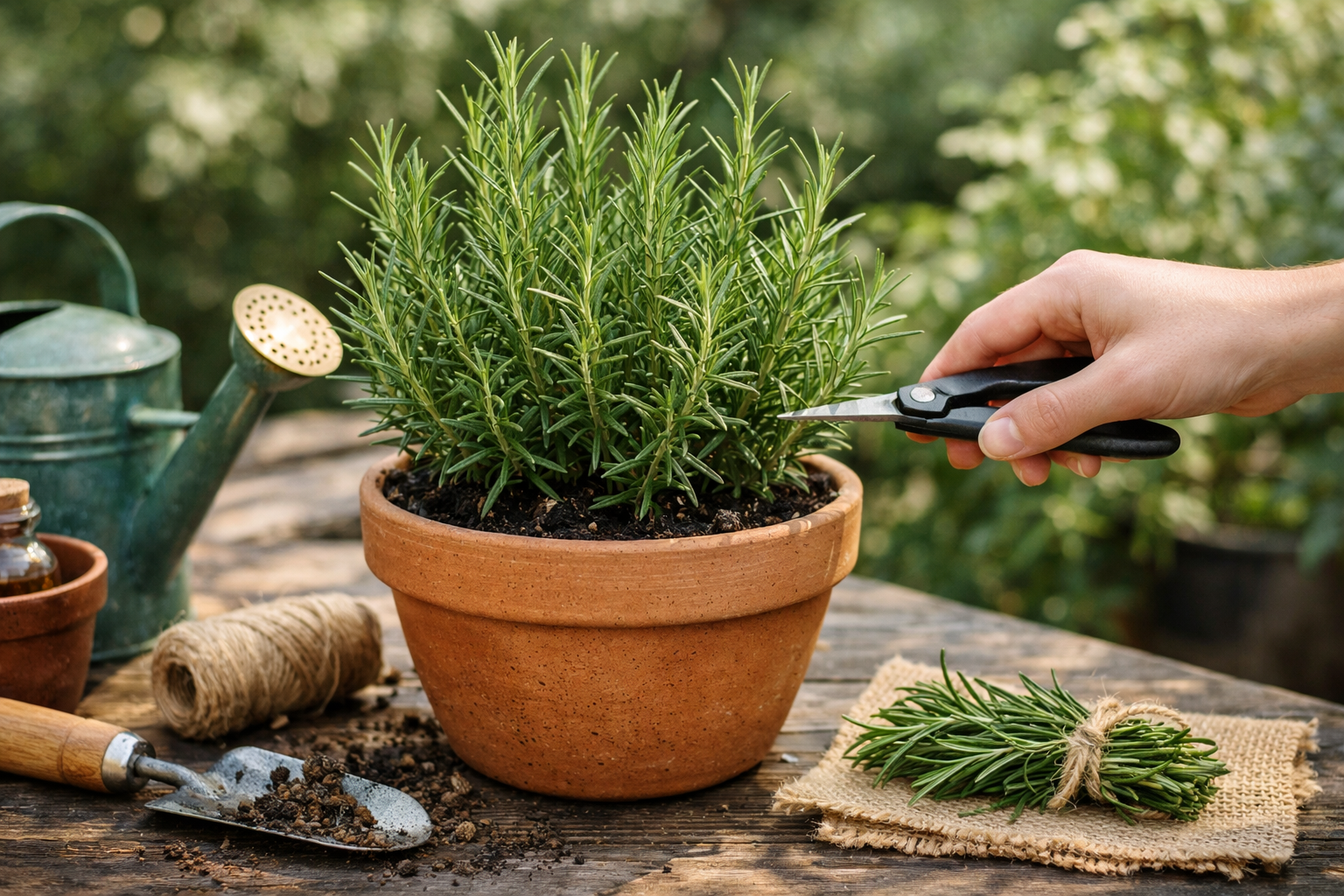
You bring home a rosemary plant looking thick, silver-green, and almost smug. Two weeks later it’s brittle on one side, floppy on the other, and somehow both dry and overwatered at once. That’s the part people skip.
Here’s the useful version of how to care for rosemary in a pot: give it real sun, fast drainage, a pot that doesn’t trap wet soil forever, and fewer waterings than your instincts probably want to give. Water deeply, then wait until the top inch or two of soil dries before watering again. Prune lightly, harvest often, and don’t baby it like basil.
The common advice is technically fine. “Full sun.” “Well-draining soil.” “Don’t overwater.” Sure. But that’s not enough when one rosemary is sitting in terracotta on a hot patio and another is in a glossy ceramic pot on an indoor windowsill pretending it gets “bright light.” Those plants are living in different countries.
If you want the short roadmap, this is what matters most:
- How to set up the pot and soil so the plant has a chance
- How to water by cues, not by calendar
- What full sun means when your plant is indoors
- How to keep rosemary bushy instead of leggy and half-wooden
- What brown tips, bare stems, and drooping growth are usually telling you
- What changes when winter hits or the plant comes inside
Key takeaway
Rosemary does best when the setup feels a little stingy. Sun-heavy. Airy. Quick to drain. It usually declines because the pot stays wet longer than the plant can forgive.
How to care for rosemary in a pot: the useful answer up front
If you only remember five things, make them these.
Use a pot with a drainage hole that actually drains. Put the plant where it gets at least 6 to 8 hours of direct sun, and more is better. Use a loose potting mix that dries fast instead of a dense, spongey blend. Water thoroughly, let the excess run out, then don’t water again until the top 1 to 2 inches are dry. Trim lightly through the growing season so it stays full instead of turning into a bare little shrub with a haircut problem.
That’s the whole thing. Mostly.
What makes rosemary tricky in containers isn’t complexity. It’s context. A thirsty-looking plant in poor light may not need water at all. It may need sun. A huge pot may seem generous, but if the root ball is small and the soil mass stays wet, that “upgrade” can quietly rot the roots. A bright kitchen can still be weak light by rosemary standards. Outdoors, the same plant may behave like a champion. Indoors, it can sulk like it’s paying rent.
Rosemary is a Mediterranean herb. It’s built for sun, airflow, and soil that doesn’t stay soggy. The closer your pot setup gets to that pattern, the easier this gets. The farther you drift into rich, damp, cozy conditions, the more the plant starts sending distress signals you can’t quite decode.
Get the setup right first, because bad setup makes every care tip fail
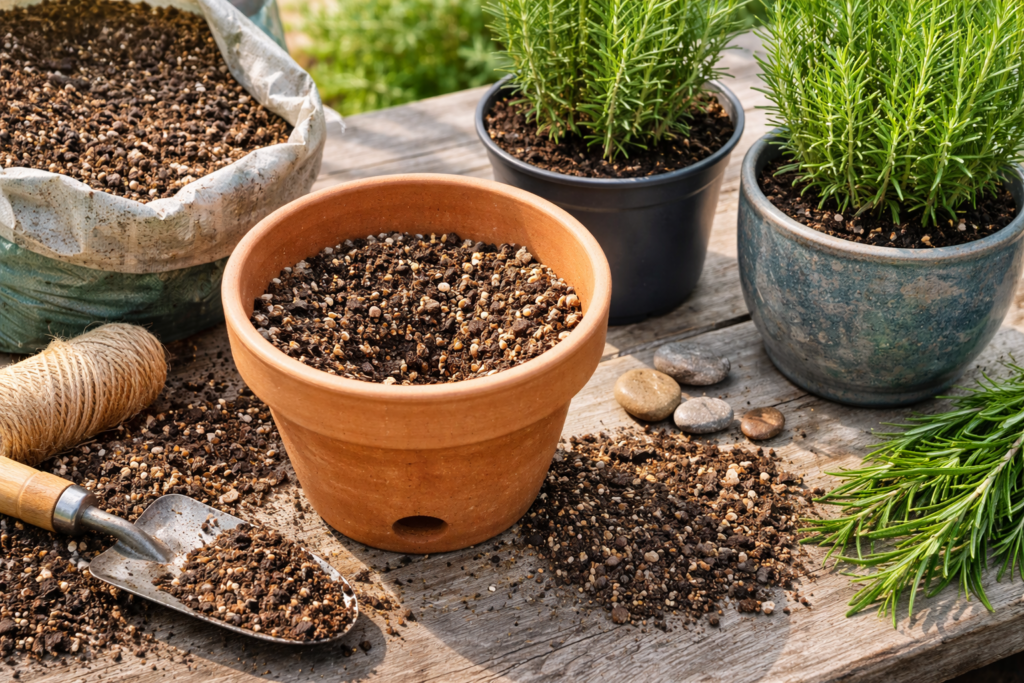
Most rosemary trouble starts before you ever water it. Pot choice and soil mix do more work than people think.
For a small nursery plant, a pot around 6 to 8 inches wide is usually fine. Once the plant is established, 10 to 12 inches is a good working size for many home gardeners. If you want a long-term container plant, around 12 inches wide and deep is a sensible baseline, which lines up with guidance from the Royal Horticultural Society. Bigger isn’t always better, though. If the root system is still modest, an oversized pot can hold wet soil like a grudge.
Material matters too.
Terracotta is the forgiving option for people who tend to overwater. It breathes, it dries faster, and it makes it harder to keep rosemary sitting in damp soil for too long. Plastic is lighter and cheaper, but it dries more slowly. That can be helpful in blazing summer heat, yet it becomes a liability in winter or indoors. Glazed ceramic lands somewhere in between depending on thickness and shape, though many ceramic pots still hold moisture longer than terracotta.
If I’m helping someone who has killed rosemary before, I usually point them toward terracotta first. Not because it’s magic. Because it corrects a very common human habit.
The soil should drain quickly. Not eventually. Quickly. Standard potting mix often needs help, especially the fluffy, moisture-retentive kind designed to hold onto water for longer. Mix in perlite, pumice, coarse sand, or horticultural grit until the texture feels lighter and less clingy. Rosemary wants running shoes, not rain boots.
Avoid garden soil in pots. It compacts too easily, drains poorly, and behaves like a brick after a few waterings. Also skip decorative outer containers that trap runoff unless you’re disciplined enough to empty them every time. Many people aren’t. The plant pays for that optimism.
Common mistake
A rosemary plant in the “right” soil can still struggle if the pot has poor drainage or the root ball is swimming in a container that is too large for it.
If you’re unsure about sizing, this deeper guide on what size pot for rosemary walks through the tradeoffs in a straightforward way.
Sun is not optional: where to place your pot so rosemary actually acts like rosemary
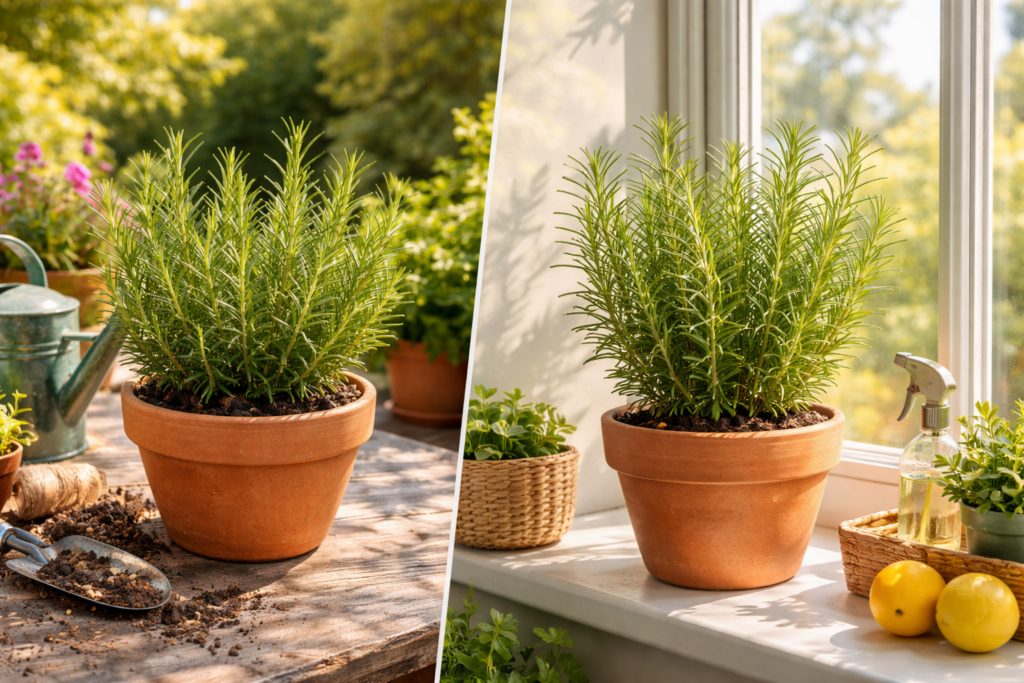
Rosemary doesn’t negotiate much on light. Outdoors, aim for at least 6 to 8 hours of direct sun. More is usually fine. Indoors, the phrase “bright light” gets abused so badly it’s almost useless. A cheerful room is not the same as direct sun on the plant itself.
If your rosemary lives outside on a sunny patio, balcony, doorstep, or terrace, you’re already working with the plant instead of against it. If it’s indoors, put it in your brightest window, ideally south-facing in the northern hemisphere, and watch how many actual hours of direct light hit the foliage. Not the floor nearby. The foliage.
This is where a lot of care routines go sideways. A plant in weak light uses water more slowly. The soil stays wet longer. The owner notices droop or discoloration and adds more water. The roots get less oxygen. Then the plant looks worse. Now it seems “mysterious.” It usually isn’t.
Here are the signs your rosemary isn’t getting enough light:
- Long, stretched stems with more space between leaves
- Pale or washed-out new growth
- A plant that feels loose and floppy instead of tight and sturdy
- Soil that stays damp for ages
- Growth slowing to a crawl even though temperatures are decent
If that sounds familiar, move the pot before you change anything else. Better light often solves what looks like a watering problem.
Key takeaway
Bad light makes good watering habits look bad. If the pot stays wet for too long, the first fix may be sun, not less water alone.
How often to water rosemary in a pot without turning it into a science project
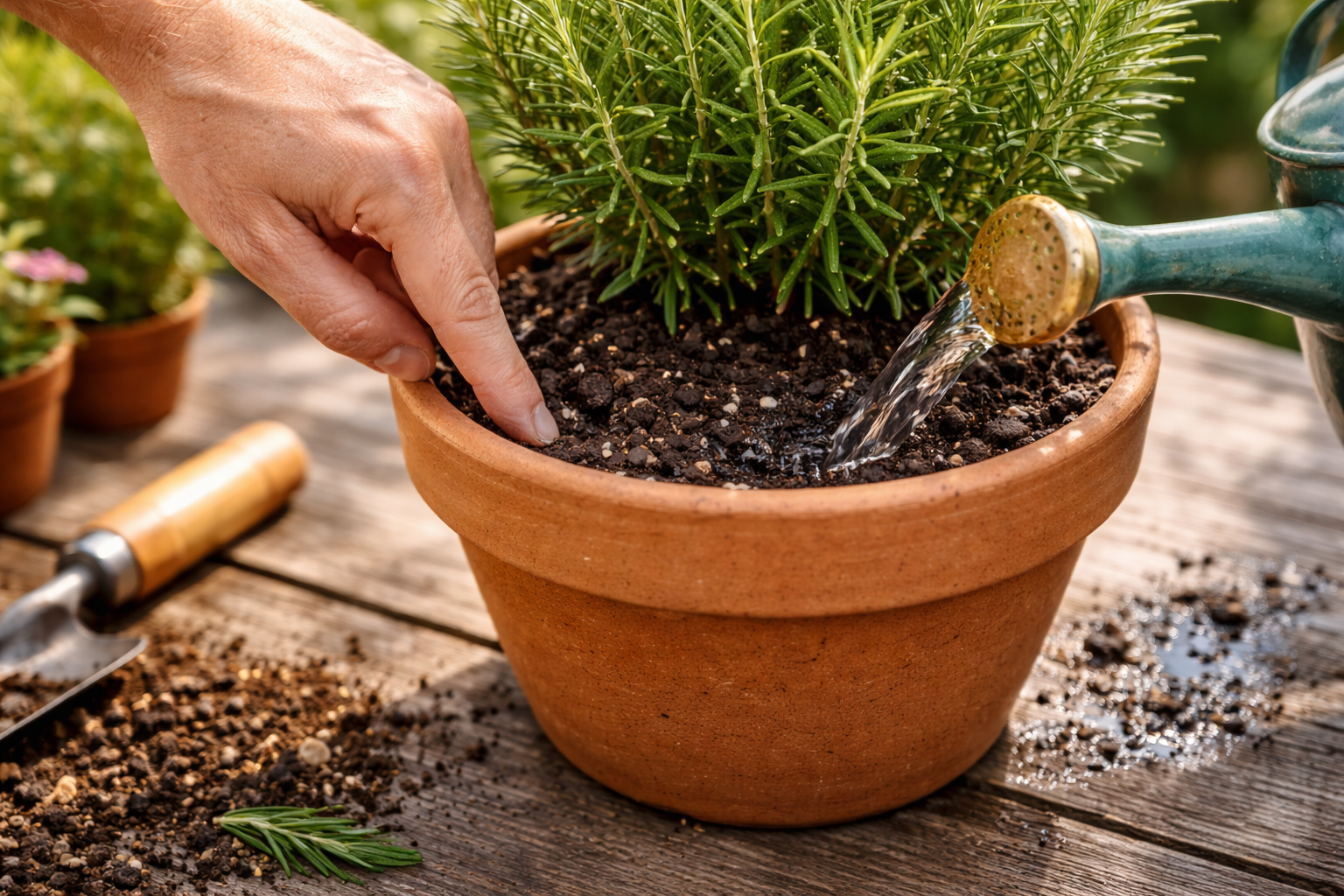
This is the question people really mean when they ask about potted rosemary. They want a schedule. Rosemary doesn’t care that you want a schedule.
Water when the top 1 to 2 inches of soil are dry. Then water deeply until excess drains out of the bottom. After that, wait again. That pattern lines up with container herb guidance from Illinois Extension and with how rosemary actually behaves in a pot.
What you should not do is water every Tuesday because that’s your “plant day.” Calendar watering is how people accidentally drown rosemary with terrific consistency.
Use these rules instead:
- If the pot is terracotta, in full summer sun, and exposed to wind, check moisture more often.
- If the pot is plastic, indoors, or in cooler weather, check much less often.
- If the pot still feels heavy when you lift it, leave it alone.
- If only the top surface is dry but the root zone lower down is still damp, wait.
- If water runs straight through instantly and the root ball seems dry anyway, the mix may have shrunk or become root-bound.
The best habit is a two-part check. First, stick a finger 1 to 2 inches into the soil. Second, lift the pot slightly. A just-watered pot and a ready-for-water pot feel very different once you learn the weight. A wooden skewer pushed into the root zone works too. Pull it out and check whether it comes out cool and damp or mostly dry.
Water slowly enough that the root ball gets soaked, not just the edges of the pot. Then let excess drain fully. If you use a saucer, empty it. Rosemary roots don’t want to marinate.
One small but useful observation: underwatering tends to make rosemary look dry, crisp, and tired. Overwatering often makes it look dull, limp, yellowish, or patchy in a more confusing way. Brown doesn’t automatically mean thirsty. Softness matters. So does the smell of the soil.
Common mistake
Giving small sips every few days keeps the upper soil damp and the roots shallow. Rosemary does better with a thorough watering followed by a real dry-down.
If you’re also interested in flowers we also highly recommend checking this guide on how to grow dahlias in pots as you’ll learn important knowledge that you’ll be able to apply to most types of flowers.
The care routine that keeps rosemary bushy instead of woody, sparse, or weirdly bare
Rosemary in a pot gets awkward when it’s left alone too long. You want light maintenance. Little nudges. Not a dramatic intervention every six months.
Trim soft new growth regularly during active growth. Snipping the tips encourages branching, which keeps the plant denser and more useful in the kitchen. That regular harvesting matters more than people think. A rosemary plant that is lightly used tends to hold a better shape than one that is admired from a distance and then hacked back in frustration.
Don’t cut deep into old, leafless wood unless you have no choice. Rosemary often struggles to push fresh growth from bare woody stems. Once a section goes old and hollow-looking, it may stay that way. That’s why light pruning early is better than heroic pruning late.
If the plant flowers, you can prune lightly after blooming to tidy the shape. If it’s mostly being grown for cooking, just keep pinching and harvesting enough to prevent legginess. Take a little from several stems rather than stripping one side bald like you’re settling a score.
As for feeding, go easy. Rosemary isn’t a hungry annual trying to bulk up. Too much fertilizer can push soft, floppy growth that looks impressive for about five minutes and then falls apart. If growth is weak, don’t assume the answer is fertilizer. Look at light first. Then drainage. Then pot size. Fertilizer is usually pretty far down the list.
A simple routine works:
- Give it as much direct sun as you can.
- Let the soil dry partway before watering again.
- Harvest and tip-prune often enough to keep it compact.
- Refresh the setup if the pot starts holding too much moisture.
That’s most of the game.
What changes in winter, indoors, and bad weather
Containers make everything more dramatic. The roots heat up faster in summer, cool down faster in winter, and dry out faster in wind. Rosemary can tolerate quite a bit in the ground, but pots remove that buffer.
In mild climates, rosemary can often stay outdoors year-round if the pot drains well and the plant gets strong sun. In colder climates, the bigger risk is prolonged freeze around the root ball. The top may look fine for a while, yet the roots are taking a beating. If hard frosts are common where you live, move the pot to a sheltered spot or bring it indoors before the weather gets ugly.
It struggles for the same reasons over and over: weak light, warm dry air, poor airflow, and overwatering. A cool bright room is much better than a cozy dim one. Keep it away from blasting heat vents. Water less often than you did outdoors. The plant is using less. That matters.
If the foliage starts looking dusty, dull, or stippled indoors, inspect for spider mites. They love dry indoor conditions and they show up right when your patience is already thin. A quick rinse and better airflow can help at the first sign, though severe infestations are rarely worth romanticizing.
Rosemary is generally considered non-toxic to dogs, cats, and horses according to the ASPCA, though that doesn’t mean a pet should snack on it freely. “Not toxic” and “good idea” are different categories.
Common mistake
Bringing rosemary indoors for winter and keeping the exact same watering routine. Lower light means slower drying. Slower drying means higher risk.
Why is my potted rosemary turning brown? A quick diagnosis guide
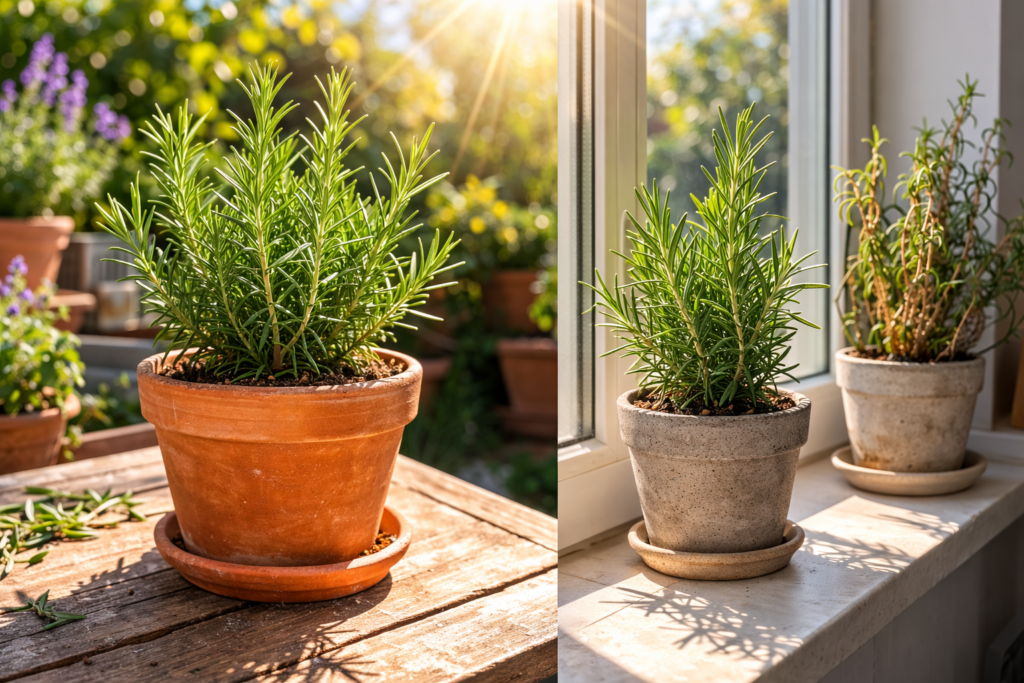
This is where generic advice falls apart. “Brown” covers several different problems, and the fix depends on what kind of brown you mean.
Brown tips with soft stems or a dark base
This often points to excess moisture and root stress. The plant may look thirsty because the roots are struggling, not because they need more water. Check the soil lower down. If it stays wet for days, the mix or pot is wrong for the conditions. Let it dry more between waterings, improve drainage, and consider repotting if the soil is dense or sour-smelling.
Crispy brown leaves or stems that feel dry and brittle
That usually suggests the plant got too dry, especially in a hot pot on a windy patio. Water thoroughly and watch how fast the container dries over the next few days. If it goes bone dry almost immediately, the plant may be root-bound or the mix may have become hydrophobic and started repelling water.
Pale growth with brown patches and a stretched shape
That’s often low light plus watering that hasn’t adjusted downward. Move it first. Then let the watering interval stretch naturally.
Brown sections after winter
Cold damage can hit potted rosemary harder than people expect. Trim back clearly dead tips once new growth starts and wait before cutting aggressively. A stem that looks questionable may still push growth lower down.
One-sided browning
Sometimes it’s simple. Wind exposure. Heat reflecting from a wall. A root problem on one side of the pot. I’ve seen rosemary look terrible on the side facing a glass door in summer and fine everywhere else. Not every ugly plant is sick in a dramatic way. Sometimes it’s just being cooked from one angle.
Powdery film, speckled leaves, or sticky residue
Poor airflow and indoor stress can invite mildew or pests. If the plant is crowded into a humid corner, the solution is usually less crowding and better conditions, not a flurry of products.
If the base is blackened, mushy, or smells rotten when you slide the root ball out, be honest with yourself. Rosemary can recover from a lot. It does not recover from everything. Sometimes the fastest route back to a healthy plant is replacing one that spent too long in bad conditions.
Key takeaway
Brown does not automatically mean “water me.” Check texture, stem firmness, soil moisture, and light before you do anything.
Repotting, root-bound plants, and when a bigger pot helps or hurts
Repotting solves some rosemary problems and creates others. That’s why it helps to know what you’re actually trying to fix.
If roots are circling hard around the inside of the pot, pushing through the drainage hole, or causing water to race straight through without soaking in, the plant may be root-bound. In that case, moving up one pot size is usually enough. Not three sizes. One.
If the current pot is already fairly large, the plant looks healthy enough, and the main issue is tired soil, you may not need a much bigger pot at all. Refreshing the mix can do more than upsizing. Too much fresh wet soil around a modest root ball is one of those “helpful” moves that backfires quietly.
Use this rule:
- If roots are crowded and the plant dries too fast, size up a little.
- If the plant is healthy but the mix has broken down, refresh the soil.
- If the pot already feels oversized for the root mass, don’t go bigger. Fix the mix and watering habits instead.
When you repot, keep the crown at the same level it was before. Don’t bury the stem deeper. Settle the plant in, water it once to seat the mix, then go back to normal dry-down rules. No pity watering.
If you’re thinking about pairing rosemary with other plants in a container, choose neighbors that like the same fast-draining, sun-heavy conditions. This guide to what to plant with rosemary in container gardens is useful if you want a mixed pot that won’t turn into a compromise nobody enjoys.
The no-regret checklist for a rosemary plant that lasts
If you want potted rosemary to stop feeling fussy, simplify the whole system.
- Use a pot with honest drainage.
- Choose terracotta if you tend to overwater.
- Give the plant direct sun, not vague brightness.
- Use a fast-draining mix, not a moisture-holding one.
- Water deeply, then wait until the top 1 to 2 inches dry.
- Empty runoff from saucers or outer pots.
- Harvest and trim lightly so the plant stays dense.
- Water less in winter and indoors.
- Don’t cut hard into old bare wood unless you accept the risk.
- Don’t assume a bigger pot is always kinder.
The non-obvious part is this: healthy rosemary often looks like a plant you’re almost neglecting. Not actually neglecting. Just not fussing over. It’s one of those plants that improves when your care gets a little less emotional and a little more observant.
And if your rosemary keeps dying in pots, it usually isn’t because rosemary is hard. It’s because the setup is holding onto water and shade longer than the plant can tolerate. Fix that, and the rest gets much easier.
FAQ
Can rosemary grow on a kitchen windowsill?
Sometimes, yes. Often, not well for long. A truly sunny window can work, especially if it gets several hours of direct light, but many indoor spots that feel bright to you are still too dim for rosemary. If growth gets thin or the soil stays wet too long, the location probably isn’t strong enough.
Should you mist rosemary indoors?
Usually no. Misting doesn’t solve the main indoor problems, which are usually weak light, poor airflow, and overly wet soil. It can also keep foliage damp without offering much benefit. Better light and air movement help more.
Can woody rosemary become full again?
Sometimes partly, but not always. Soft green growth responds well to trimming. Bare old wood is much less cooperative. You can improve shape by pruning live tips and encouraging branching where foliage remains, though a very old, hollow plant may never look dense again.

Michael Rowan is the founder and lead writer at The Garden Playbook. He has spent 10+ years growing plants across a range of settings — from indoor houseplants and container gardens to raised beds and in-ground plots — adapting methods to different light levels, seasons, and growing conditions.
Michael focuses on practical, experience-based guidance grounded in fundamentals: soil health, watering strategy, plant nutrition, pruning and propagation, and integrated pest management (IPM). His work aims to help readers diagnose common problems (such as yellowing leaves, stunted growth, or pest pressure) and apply straightforward solutions that are realistic for home gardeners.
At The Garden Playbook, Michael develops tutorials and plant guides using a consistent process: documenting real outcomes where possible, explaining the “why” behind each step, and verifying higher-risk topics (such as plant toxicity or pest treatment options) against reputable horticultural references.