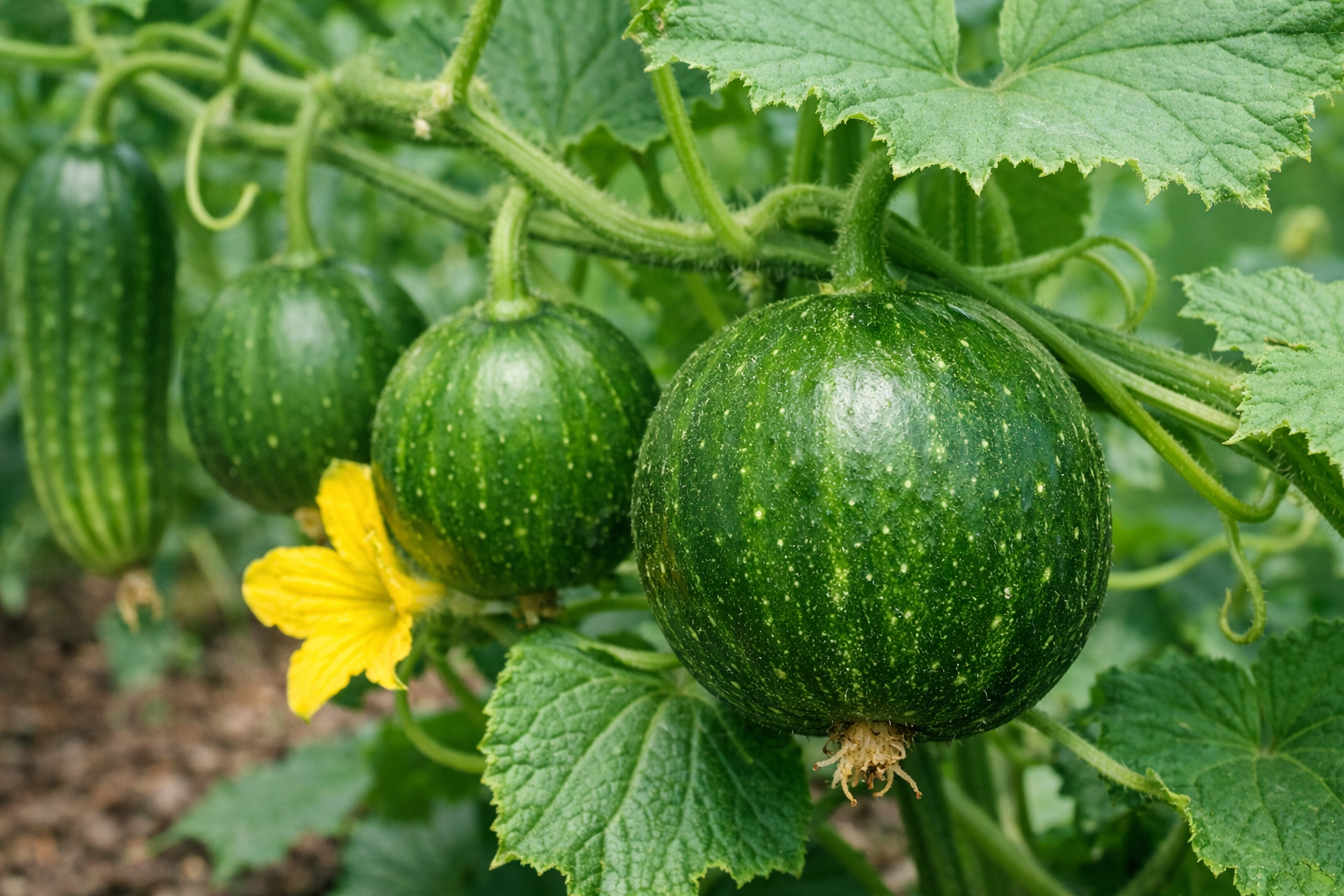
You walk out to the garden expecting cucumbers. Normal ones. Long-ish, green, boring in the best possible way. Instead you pick up something squat and round and suddenly your brain starts flipping through every mistake you might have made in the last two weeks.
Here’s the part that trips people up: the stock answer to why are my cucumbers round is usually “poor pollination.” That’s often true. It’s also not enough. Sometimes you bought a naturally round variety. Sometimes the plant got jerked around by heat and dry spells. Sometimes a pot that looked roomy enough turned into a hot little root prison by July. And sometimes, less often, the fruit shape is your first hint that something bigger is off.
This article will help you sort that out fast.
- How to tell a normal round variety from a real growing problem
- What the fruit shape, leaves, and recent weather are quietly telling you
- How to separate pollination trouble from watering trouble
- When heat, crowding, or low fertility are the real issue
- Whether the fruit is still worth eating
- What to fix first so the next cucumbers come out better
Quick answer: Round cucumbers usually come from one of two things. Either you are growing a naturally round variety, or the fruit developed unevenly because pollination or plant stress went sideways. Don’t change your whole routine until you rule out variety first.
Why are my cucumbers round? Here’s the useful answer first
If your cucumber plant was supposed to produce long slicing cucumbers, round fruit usually means the plant hit a snag during fruit development. In most gardens, that snag is incomplete pollination. Not always. Just often enough that people stop looking any further.
The better answer is this: round cucumbers come from either genetics or uneven development. Genetics means you planted something that is meant to be round or nearly round. Uneven development means the fruit started growing without the full set of conditions it needed, which usually points to pollination problems, moisture swings, heat stress, or a weaker plant overall.
I’ve seen this play out two very different ways in the same season. One plant kept making tidy, lemon-shaped fruit from the start because that was simply the variety. Another gave me one odd, ball-like flush right after a stretch of hot afternoons and patchy watering. Same shape at first glance. Completely different explanation.
That’s why one weird cucumber doesn’t tell you much by itself. You need to look at the pattern.
Key takeaway: If every fruit on the plant is consistently round, think variety. If shapes are inconsistent or suddenly changed, think stress or pollination.
First make sure you do not simply have a round cucumber variety
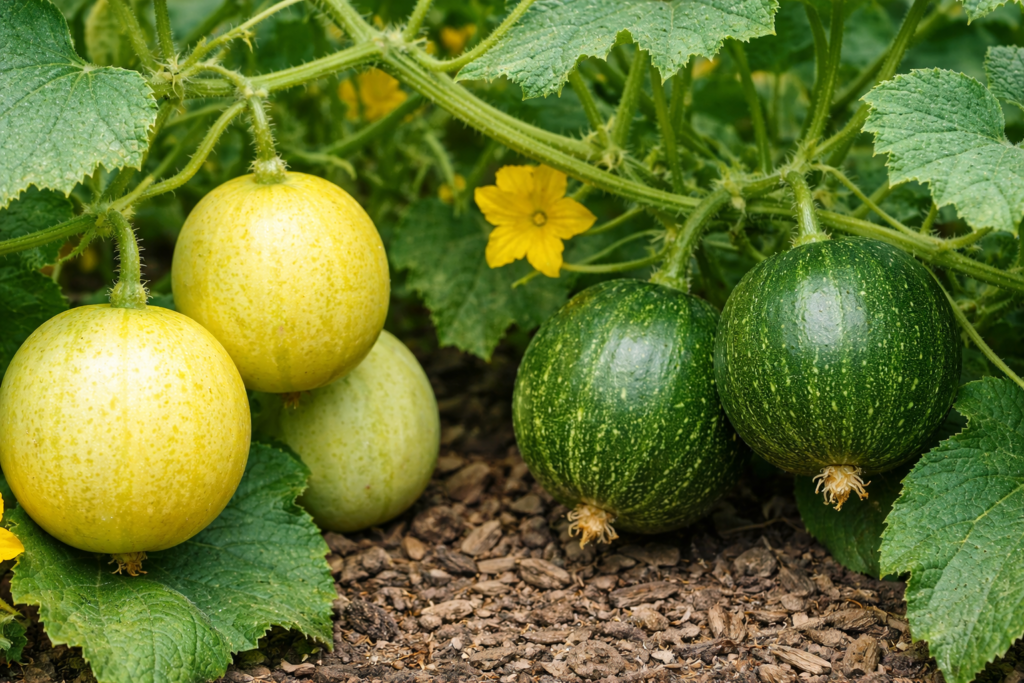
This sounds obvious until it happens to you. Plant tags get lost. Seed packets get tossed. Seedlings get mixed up. A lot of gardeners start troubleshooting a non-problem.
Some cucumbers are naturally round or close to round. Lemon cucumbers are the obvious example. They start pale green, shift toward yellow as they mature, and look more like a small citrus fruit than a store cucumber. A few pickling and specialty types can also run shorter and chunkier than people expect. South Dakota State Extension’s cucumber growing guide notes that fruit shape can vary a lot by cultivar, which is exactly why “round” isn’t automatically a diagnosis.
Here’s the easiest way to tell whether you have a variety issue or a garden issue:
- If nearly every fruit on the plant looks similar, genetics moves to the top of the list.
- If the fruit color and texture match what you’d expect from a specialty type, genetics moves even higher.
- If one cucumber is round, the next is club-shaped, and the next is mostly normal, that usually points away from variety and toward growing conditions.
Also, seed mix-ups happen more often than gardeners like to admit. Not constantly. Just enough to keep you humble. If everything else about the plant looks healthy and the fruit are consistently round, don’t force yourself into a rescue mission the plant does not need.
Common mistake: Assuming “round” means “bad pollination” before checking whether the plant was supposed to make round fruit in the first place.
If they are not supposed to be round, this is the diagnosis order that actually helps
A lot of advice on misshapen cucumbers reads like a junk drawer. Water. Pollination. Heat. Nutrients. Pests. Disease. Technically fine. Practically useless.
A better method is to diagnose in order. It saves time and it keeps you from making the classic panicked-gardener mistake of changing three things at once.
- Check the variety or plant label if you still have it.
- Look at more than one fruit. One oddball means less than a repeated pattern.
- Inspect the flowers and think about pollinator activity.
- Review your watering rhythm over the past week, not just today.
- Scan the leaves for mottling, puckering, distortion, or stunting.
- Think about the weather. Especially sudden heat.
That order matters. Fruit shape alone can fool you. Leaves and timing usually don’t.
Here’s a rough field guide:
- Evenly round fruit across the whole plant: likely variety
- Fruit with blunt ends, fat middles, or uneven swelling: likely pollination trouble
- Misshapen fruit after a hot, dry stretch: likely moisture stress or heat-linked pollination failure
- Deformed fruit plus weird leaves: move disease or pest pressure much higher on the list
- Pot-grown plant that dries fast: root and moisture stress become much more likely
The non-obvious part is this: the fruit is often the last thing to go wrong, not the first. By the time it turns round, the real problem may have started days earlier with heat, pollen failure, or roots cycling from too dry to too wet.
Use this rule: If the leaves look healthy and the timing lines up with rough weather, start with pollination and watering. If the leaves also look wrong, don’t keep treating it like a simple shape issue.
Poor pollination is the usual culprit, but you need to know what it looks like
This is the big one. Cucumbers need proper pollination for the fruit to develop evenly. When that doesn’t happen, parts of the fruit grow normally and other parts lag behind. The result can be club-shaped cucumbers, narrow-ended cucumbers, or fruit that puff up into odd little balls instead of stretching out cleanly.
Iowa State University Extension ties poorly shaped cucumbers closely to incomplete pollination, which tracks with what most gardeners actually see in the patch. A plant can look healthy. The vine can be strong. Then the fruit still turns out wrong because the flowers didn’t get the full job done.
What causes poor pollination?
- Low bee activity
- Wet weather that keeps pollinators away
- Very hot weather that interferes with pollen performance
- Spraying insecticides at the wrong time
- A flush of flowers before pollinator traffic really picks up
If you’ve never checked cucumber flowers closely, do that before you assume anything else. Male flowers usually sit on a thin stem. Female flowers have a tiny cucumber-shaped swelling behind the bloom. If female flowers are showing up and the plant is setting weird fruit, you’ve got a strong clue.
Hand pollination is boring, mildly fussy, and surprisingly effective. Use a small soft brush in the morning. Move pollen from the male flower to the center of the female flower. Don’t overcomplicate it. You’re not doing surgery. You’re just making up for a bad day in the pollinator department.
One useful detail that gets skipped a lot: heat can make pollination look like a bee problem when it really isn’t. The bees may still be around. The flower biology is just less cooperative than usual. So if misshapen fruit starts right after hot weather, don’t assume you’re dealing with a pollinator collapse.
Common mistake: Feeding the plant more fertilizer when the issue is pollen transfer. That’s like putting better gas in a car with a dead battery. Wrong system.
Water stress can make cucumbers swell oddly, especially in containers
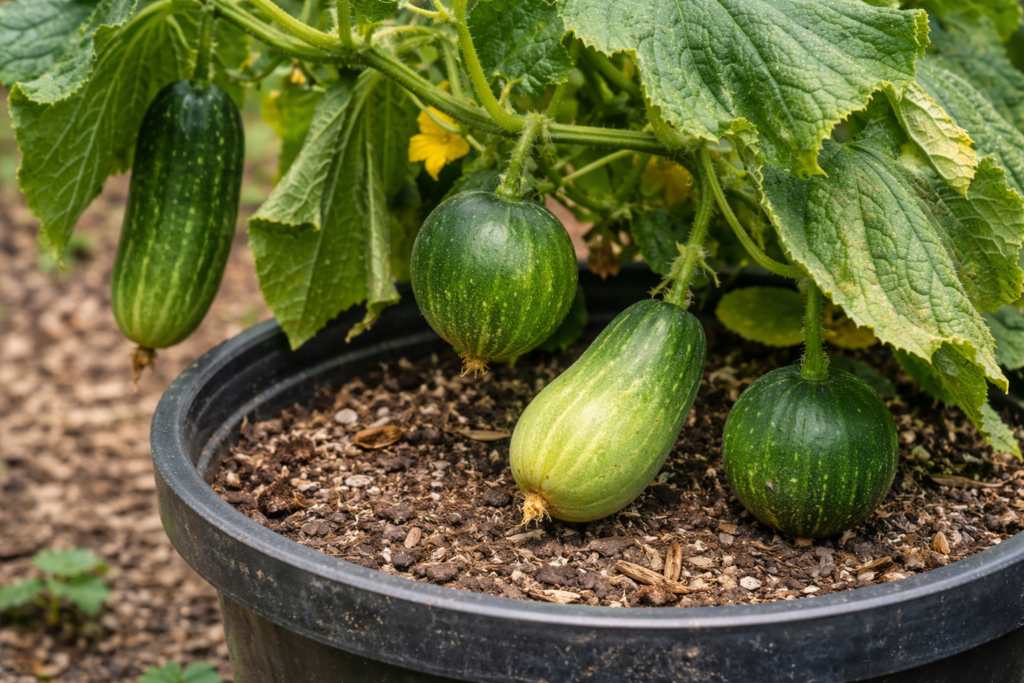
Cucumbers grow fast. That sounds like a strength until it doesn’t. Fast-growing fruit need a steady water supply, and they’re not especially forgiving when moisture bounces around. Dry, then soaked, then dry again. That stop-start rhythm can give you fruit that develop in weird proportions.
This is where a lot of gardeners misread the situation. They think the problem is simple underwatering. Sometimes it is. More often, the plant is getting enough water on paper and not enough consistency in practice.
Containers make this much worse. A cucumber in the ground has a bigger buffer. A cucumber in a pot lives closer to the edge. Small volume, warmer roots, quicker drying, bigger swings. If the plant is crowded, the effect gets sharper.
If your cucumber is in a pot and the fruit are turning round or otherwise misshapen, don’t ignore root space. A cramped root zone doesn’t just limit growth. It also removes your margin for error on moisture. That’s why it helps to know what size container actually works for cucumbers instead of guessing from whatever pot looked decent in spring.
Signs moisture stress is involved:
- The plant wilts hard in the afternoon and keeps repeating the pattern
- The pot feels light by midday even after a morning watering
- Fruit quality gets worse during hot spells and improves when weather settles
- The plant is packed into a small or crowded container
What to do:
- Water deeply rather than giving the plant frequent little sips
- Mulch the soil surface so it doesn’t flash-dry
- Check moisture before the hottest part of the day
- Give the plant more soil volume if it’s obviously cramped
There’s a practical gardening truth hiding here: root space is really water-buffer space. That’s why plants that look fine in June suddenly start acting finicky later. The plant didn’t get dramatic. Summer did.
If you’re growing more than one plant per pot, that changes the math too. Crowding speeds up the dry-down and makes fruit quality less predictable. This is exactly where it helps to know how many cucumber plants belong in one container before you spend the rest of the season chasing symptoms.
Key takeaway: In pots, a watering problem is often a container-size problem wearing a fake mustache.
Heat and low fertility can both distort fruit, but they leave different clues
These two get lumped together a lot because both can produce disappointing cucumbers. They are not the same problem.
Heat tends to show up fast. You get a stretch of rough weather. Flowers open under stress. Pollination gets patchier. Fruit quality slips before the plant necessarily looks terrible. That timing matters. If the plant was doing fine and then suddenly started throwing weird fruit during very hot afternoons, heat-linked pollination trouble is a stronger bet than nutrient deficiency.
Low fertility is slower and duller. The whole plant tends to look less vigorous. Growth slows. Leaves may look a bit pale. Vines don’t have the same push. The plant feels underfed in a broad way, not just in the shape of one bad cucumber.
University of Minnesota Extension is more focused on cucurbit viruses on that page than fertility, but it’s a useful reminder that fruit distortion always needs to be read alongside the rest of the plant. Shape by itself is a flimsy clue. Shape plus timing, leaf condition, and vigor is where the answer gets sharper.
Here’s the practical split:
- If the problem showed up suddenly after a heat wave and the leaves still look broadly healthy: focus first on stable moisture, flower set, and pollination support.
- If the whole plant looks weak, pale, and underpowered: a modest feeding makes more sense.
Don’t dump a heavy shot of high-nitrogen fertilizer onto a stressed cucumber plant just because the fruit look ugly. That move is common. It also has a way of giving you more vine and not necessarily better cucumbers. You want steady support, not a panic response.
If this, then that: Sudden problem plus rough weather usually points to heat or pollination. Slow decline plus weak growth points more toward fertility or root limitation.
When round cucumbers are a warning sign, not just an ugly one
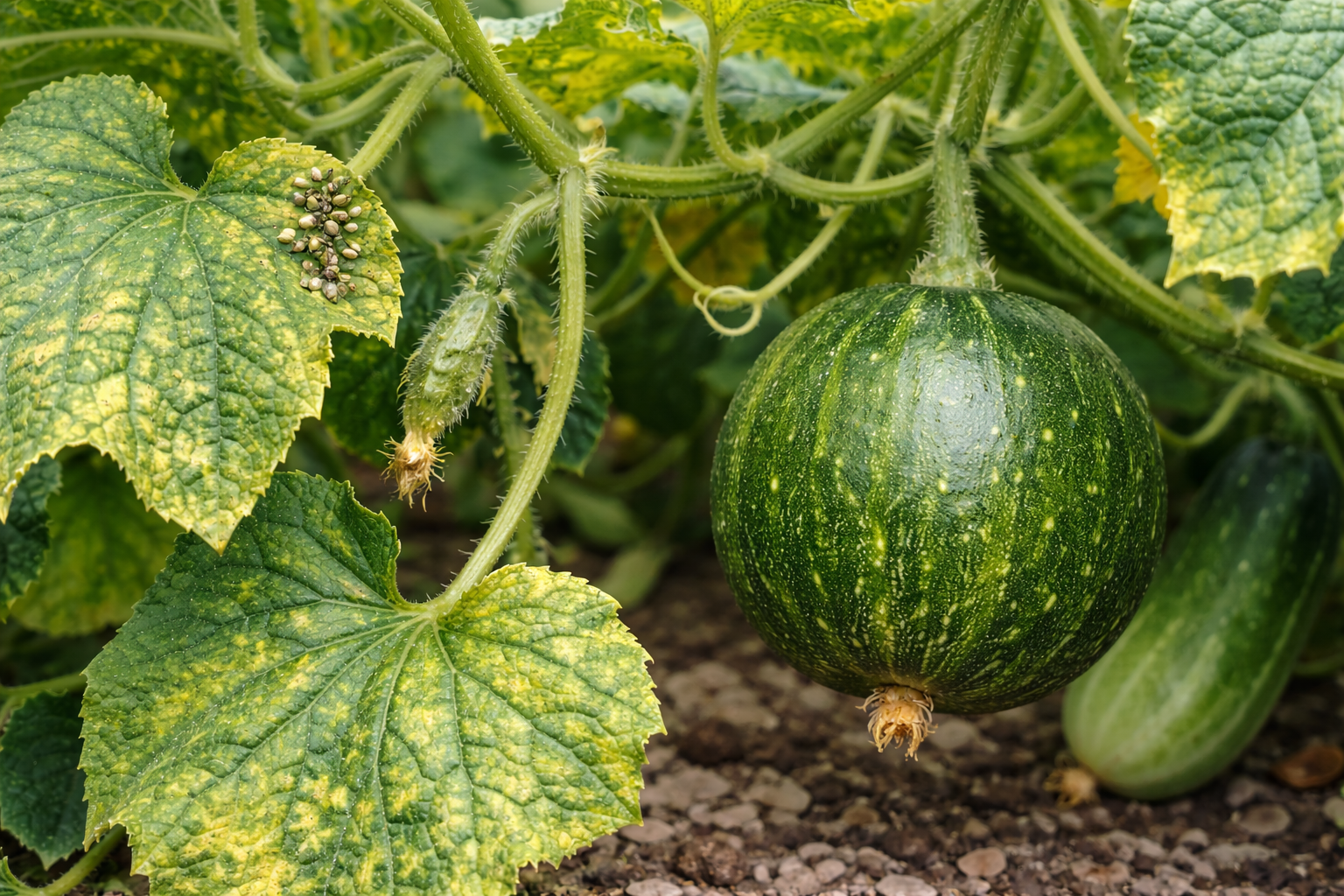
Most round cucumbers are not a crisis. They’re a nuisance. That said, there are moments when shape trouble is part of a bigger plant-health problem.
The big thing to watch is the leaves. If fruit are misshapen and the leaves are also mottled, puckered, twisted, stunted, or generally strange-looking, you need to widen the diagnosis. That’s when viruses and pest pressure move into the conversation.
University of Maryland Extension notes that cucumber issues need to be read as symptom clusters, which is exactly right. Shape alone doesn’t prove disease. Shape plus foliage distortion is different.
Watch for:
- Patchy yellow-green mottling on leaves
- Leaves that are crinkled or narrowed
- Stunted new growth
- Aphids hanging around the plant
- Fruit distortion paired with color abnormalities or poor overall vigor
There are also non-disease oddities that can fool you. Fruit can grow funny when they’re physically trapped in netting, pressed against a trellis, or crowded in dense foliage. That sort of distortion tends to look mechanical rather than systemic. The plant otherwise acts normal.
As for eating them, shape alone isn’t the issue. A cucumber that turned round because of pollination or watering is usually still fine if it’s firm and not rotting. A cucumber that is soft, damaged, or clearly deteriorating is another matter. That’s not about shape. That’s just common sense.
Safety note: Don’t jump to disease because the fruit look odd. Do pay attention if leaf symptoms show up at the same time. That combination deserves a closer look.
What to do this week if your cucumbers are coming out round
Don’t start over. Don’t rip plants out in a fit of honesty. Just work the problem in order.
- Confirm the variety. If the fruit are consistently round and the plant seems healthy, this may be the whole answer.
- Check flowers in the morning. Look for female blooms and think about whether pollinators are actually visiting.
- Watch the next few fruit, not just the current ones. A temporary rough patch can correct itself.
- Stabilize watering. Deep and even beats random and frequent.
- Reduce heat stress where you can. Mulch helps. So does not letting containers cook dry.
- Inspect the leaves. Healthy leaves point you back toward pollination or moisture. Odd leaves change the conversation.
- Don’t overfeed out of panic. Feed only if the whole plant looks like it needs it.
If you want the short version, here it is.
- If only one or two cucumbers are odd after rough weather: keep the plant and monitor.
- If most fruit are misshapen but the plant otherwise looks healthy: work on pollination and watering first.
- If the fruit are deformed and the foliage also looks wrong: start investigating disease or pest pressure.
One of the more useful gardening habits is resisting the urge to fix everything at once. A cucumber plant can recover from a brief bout of stress. It cannot tell you which change helped if you overhaul watering, feeding, pruning, and pest control all in the same weekend.
Common mistake: Pulling a productive plant after one ugly batch of fruit. Watch what the next wave does before making that call.
Are round cucumbers safe to eat, and will the next ones be normal?
Usually, yes. If the fruit is firm, sound, and not rotting, odd shape by itself does not make it unsafe. A naturally round variety is obviously fine. A stress-shaped cucumber is often fine too, though the texture can be less elegant and the seeds may be more noticeable.
You may also notice bitterness. That doesn’t come from the fruit being round. It tends to show up when the plant has been stressed, especially by heat or inconsistent watering. The shape and the flavor issue often travel together because they’re both downstream of the same rough week.
Will the next cucumbers be normal? Sometimes. Often, actually.
If the problem came from temporary pollination trouble, rough weather, or watering swings, later fruit can come out much better once conditions settle. If every cucumber remains round in a calm, healthy-looking pattern, you’re probably looking at variety rather than recovery failure.
That’s the whole logic in a nutshell:
- Check whether round is normal for the variety
- If not, look first at pollination
- Then look at watering consistency and heat
- Only move disease higher on the list if the leaves support that idea
Ugly isn’t always serious. In vegetable gardening, ugly is often just the plant’s way of keeping score.
FAQ
Why are only some cucumbers round while others on the same plant look normal?
That usually points to changing conditions rather than genetics. A few flowers may have been poorly pollinated, or the plant may have gone through a short stretch of heat or uneven watering. When shape varies fruit to fruit on the same plant, think temporary stress before you think permanent problem.
Can growing cucumbers in pots make the fruit round?
Indirectly, yes. Pots dry out faster and give roots less room, which makes moisture swings more likely. The pot isn’t shaping the cucumber by itself. The root and watering stress tied to container growing is what nudges fruit development off track.

Michael Rowan is the founder and lead writer at The Garden Playbook. He has spent 10+ years growing plants across a range of settings — from indoor houseplants and container gardens to raised beds and in-ground plots — adapting methods to different light levels, seasons, and growing conditions.
Michael focuses on practical, experience-based guidance grounded in fundamentals: soil health, watering strategy, plant nutrition, pruning and propagation, and integrated pest management (IPM). His work aims to help readers diagnose common problems (such as yellowing leaves, stunted growth, or pest pressure) and apply straightforward solutions that are realistic for home gardeners.
At The Garden Playbook, Michael develops tutorials and plant guides using a consistent process: documenting real outcomes where possible, explaining the “why” behind each step, and verifying higher-risk topics (such as plant toxicity or pest treatment options) against reputable horticultural references.