
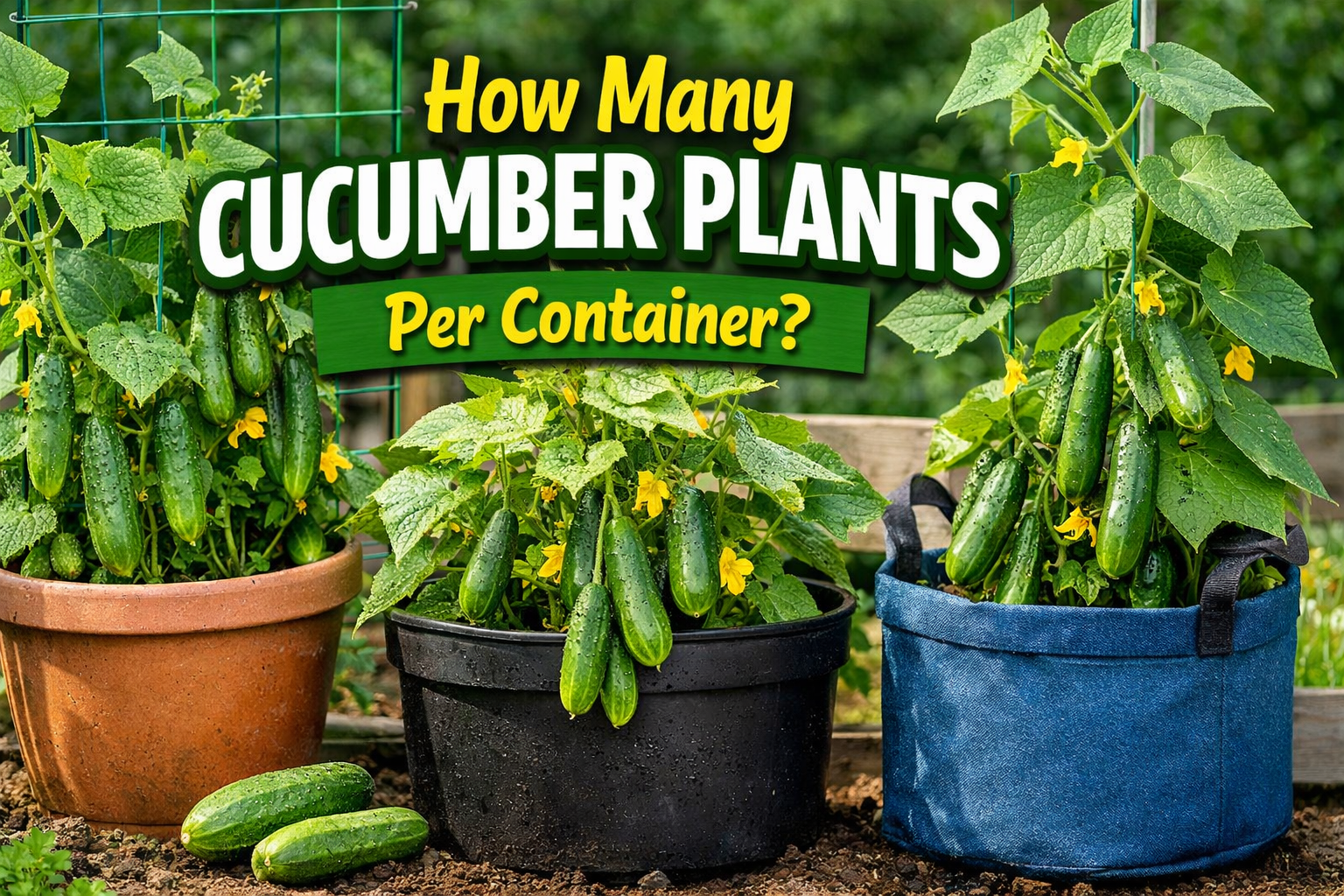
You buy a container that looks roomy, tuck in two or three cucumber seedlings, and picture a summer full of crisp fruit. Then July hits. The pot dries out by lunch, the leaves look tired, and the vines turn into a thirsty tangle that never quite delivers the harvest you expected. I have done exactly that on a hot patio, and it taught me a simple lesson fast: with container cucumbers, crowding feels efficient right up until the plants start competing like siblings sharing one tiny bedroom.
If you are wondering how many cucumber plants per container, the short answer is this: one standard vining cucumber plant per 5-gallon container is the safest rule. For compact bush or patio varieties, one plant per 2 to 3 gallons can work, though bigger containers are still easier to manage. That is the direct answer. The useful part is knowing when that rule changes, when two plants can work, and when squeezing in extra seedlings quietly costs you yield.
In this guide, you will learn how to match plant count to cucumber type, soil volume, and container style, plus what to do if you already planted too many. The goal is simple: help you get more cucumbers with less stress, not more vines with more problems.
What you’ll learn
- How many cucumber plants fit in common container sizes
- Why bush and vining cucumbers need different spacing rules
- When two plants in one pot can work and when it is a bad idea
- How trellising, watering, and pot depth change the real answer
- How to spot overcrowding before it ruins your harvest
How many cucumber plants per container? The answer that actually helps
Here is the practical rule I use:
- Standard vining cucumber: 1 plant per 5 gallons of potting mix
- Compact bush or patio cucumber: 1 plant per 2 to 3 gallons
- Large trough or rectangular planter: use total soil volume, not just length, and stay conservative
If you want the most forgiving setup, plant one cucumber per container unless you are working with a genuinely large planter and a compact variety. That might sound cautious, but in containers, root space is really water-storage space. A bigger root zone gives you more buffer when the weather turns hot, the plant starts flowering, and fruit production ramps up.
The common advice is not wrong. It is just incomplete. A 5-gallon bucket, a shallow decorative pot, and a long trough can all look “big enough” from above while behaving very differently once roots fill in. What matters is not just the top opening. What matters is soil volume, depth, moisture-holding capacity, and the growth habit of the variety you’re planting.
Key takeaway: When in doubt, plant fewer cucumber plants, not more. One healthy plant in the right container usually outperforms two crowded plants sharing the same root zone.
Why one plant often beats two, even when the pot looks big enough
A cucumber plant in a container is a little like a person living out of one backpack. There is only so much room for essentials. Add a second plant, and now both are competing for the same water, the same nutrients, and the same breathing room around the roots.
This is where a lot of gardeners get fooled. The container may look wide enough for two stems, but the root zone below the surface is what drives performance. In real life, overcrowding usually shows up in a predictable way. The pot dries faster. The leaves wilt earlier in the day. The plant grows plenty of vine and leaf, but fruit production becomes less consistent. Instead of getting double the harvest, you often get double the maintenance.
On one of my early patio setups, I planted two vigorous cucumber starts in a mid-size planter because the trellis made the whole thing look organized and spacious. Above the soil line, it looked tidy. Below the soil line, it turned into constant competition. I spent the rest of the season trying to catch up with watering. The lesson stuck: a neat-looking top growth does not mean the root system has enough room.
There is also an airflow issue. Dense, overlapping foliage traps humidity and makes it harder for leaves to dry after watering or rain. That does not guarantee disease, but it does make the setup less forgiving.
Common mistake: Planting by what fits visually above the soil instead of what the root zone can support below it.
Use this simple plant-count formula instead of guessing
If you want a fast decision framework, use this:
- If the cucumber is a standard vining type, plan 1 plant for every 5 gallons of soil.
- If it is a compact bush or patio type, plan 1 plant for every 2 to 3 gallons.
- If you miss watering now and then, reduce plant count rather than pushing the limit.
- If the container is shallow, treat it as smaller than its width suggests.
- If the variety is especially vigorous, size up the pot even if the packet says it is container-friendly.
That last point matters more than people think. “Good for containers” is not a magic phrase. It usually means the variety is more manageable than a full sprawling garden type, not that it can thrive in a cramped pot with no moisture buffer.
For spacing context, Penn State Extension’s container growing guidance reinforces the broader principle that vegetable success in containers depends heavily on matching plant size to soil volume and consistent moisture. Cucumbers are one of those crops that will reward generous root room almost immediately.
Quick cheat sheet by container
- 3-gallon pot: 1 compact bush cucumber
- 5-gallon bucket: 1 standard vining cucumber
- 7 to 10-gallon grow bag: 1 standard vine or possibly 2 compact plants if you are disciplined with water and support
- Large rectangular trough: multiple plants can work if total soil volume is generous and each plant still gets enough root room
- Shallow decorative pot: usually fewer plants than you first think
Bush vs vining cucumbers: this is where the real decision starts
Not all cucumbers grow the same way, and this is where a lot of blanket advice falls apart.
Bush cucumbers stay more compact. They are usually the better choice for balconies, patios, and smaller containers because they were bred to take up less space. Vining cucumbers are more vigorous and want both vertical support and a bigger root zone. They can absolutely grow beautifully in containers, but they are less forgiving if you undersize the pot or try to crowd more than one plant into it.
If you are deciding between the two, here is the simple version:
- Choose bush or patio types if your container is modest, your space is tight, or you want easier maintenance.
- Choose vining types if you have a larger pot, a trellis, and you want stronger vertical production.
Some patio cucumbers are specifically selected for smaller-space growing. For example, the Royal Horticultural Society’s profile for a patio cucumber type reflects the same basic pattern gardeners see in practice: compact selections are better matched to container culture than full-size vigorous vines.
There is also a practical pollination angle. In protected spaces like balconies or covered patios, gardeners often do better with varieties that set fruit reliably in container conditions. You do not need to turn this into a seed-catalog deep dive. Just know that “compact,” “patio,” and “bush” are useful labels when your main question is how many plants fit without trouble.
Key takeaway: Plant count starts with plant type. A compact bush cucumber and a vigorous vining cucumber should not be treated like they need the same amount of root space.
What to do with the container you already have
Most readers are not shopping from a blank slate. They already have a bucket, a grow bag, a trough, or a nice-looking planter on the patio and want to know what is realistic. Here is how I would handle the most common setups.
5-gallon bucket
This is the classic benchmark. For a standard cucumber vine, plant one. It is one of the easiest ways to keep the math simple. If you are growing a compact bush variety, the bucket still gives you useful moisture buffer, which usually means steadier growth and less daily stress.
7 to 10-gallon grow bag
This is where people start getting ambitious. For most gardeners, one vigorous vining cucumber is still the safest choice. If you are using a compact bush type, two plants can work in the larger end of that range, but only if the bag has enough depth, you have support in place, and you stay on top of water and feeding. Possible is not always smart.
12-inch decorative pot
This is usually where mistakes happen. A decorative pot may look roomy, but many are shallower than they appear and hold less soil than a plain bucket or grow bag. In most cases, stick to one compact bush cucumber, not two full vines.
Long trough or rectangular planter
This setup gives you more flexibility because the roots can spread horizontally, but total soil volume still matters. A long planter can support multiple cucumbers only if it is also deep enough and holds enough mix overall. Think in terms of gallons or liters, not just inches of length.
Self-watering planter
These can make container cucumbers much easier because they stabilize moisture. They do not eliminate root competition, but they do reduce one of the biggest failure points, which is uneven watering during flowering and fruiting. For gardeners who travel, work long days, or garden in full sun, that extra buffer is a genuine advantage.
A good rule for awkward containers
If the pot is shallow, narrow, or mostly decorative, treat it as smaller than it looks. If it is deep and plain, it often performs better than the prettier option beside it.
Starting from seed? Sow extra, then keep fewer plants
This is one of the biggest points of confusion for beginners. Seeing advice to sow two or three cucumber seeds does not mean you should keep two or three mature plants in the same container.
The standard approach is simple:
- Sow 2 to 3 seeds if you want to improve germination odds
- Keep the strongest seedling once they are established
- Thin the extras instead of letting them all compete
I know thinning feels wasteful the first few times you do it. Healthy seedlings are hard to sacrifice. But keeping every seedling is one of those decisions that feels kind in week one and creates trouble by week six.
Illinois Extension’s cucumber guidance supports the same practical idea gardeners use in the real world: sowing and final spacing are not the same thing. Extra seeds are insurance. They are not permission to overcrowd the final container.
If you are transplanting starts rather than direct sowing, try to move them while they are still young and before roots knit together. Cucumbers are not the best candidates for rough root disturbance. Once several seedlings have tangled in one pot, separating them cleanly gets harder fast.
Common mistake: Keeping every seedling because they all look healthy. In a container, that usually creates more competition, not more harvest.
Trellis, watering, and feeding: the three things that change what your container can really support
If you want container cucumbers to perform, these three factors matter almost as much as the plant count itself.
Trellising
A trellis helps cucumbers climb, improves airflow, keeps fruit cleaner, and makes harvest easier. It also makes a container setup look far more organized. What it does not do is reduce the amount of root space a plant needs. Trellising solves an above-ground space problem. It does not solve a below-ground crowding problem.
Watering
This is the one that usually decides whether two plants in one container will succeed or fail. Cucumbers are thirsty once they start flowering and setting fruit, and container growing amplifies every missed watering. In my own testing on a sun-baked deck, the same variety that looked relaxed in a larger pot could turn limp by early afternoon in a crowded one.
The broader watering principle is well established. According to University of Minnesota Extension guidance on crop water demand during flowering and fruiting, plants commonly need more consistent moisture during reproductive growth, which lines up exactly with what cucumber growers see in containers. Once the plant shifts from making leaves to making fruit, water stress becomes much more costly.
Feeding
Cucumbers in containers also run through nutrients faster than in-ground plants. Start with a rich, well-draining potting mix, then support the plant through the season with sensible feeding based on the product you use. The point is not to force growth. It is to avoid the stop-and-start stress that happens when a fast-growing fruiting plant runs short in a confined root zone.
Here’s what nobody tells you
Trellising makes a container feel bigger than it is. The plant looks tidy and vertical, so it is easy to think the setup is spacious. The roots do not care how organized the vines look. They only care how much soil, water, and oxygen they have access to.
When two cucumber plants in one container can work, and when it is a bad bet
Yes, there are situations where two cucumber plants in one container can work. That is the honest answer. The important part is understanding the conditions.
Two plants can work when:
- You are using a genuinely large container with plenty of total soil volume
- The varieties are compact bush or patio types
- You have a trellis or support system in place from the start
- You water consistently and do not let the container swing from soaked to bone-dry
- You are willing to stay on top of feeding and pruning where needed
Two plants are a bad bet when:
- The container is small, shallow, or mostly decorative
- You are growing full-size vigorous vines
- The space gets intense afternoon sun and wind
- You know your watering routine is not perfect
- You want a low-maintenance setup
This is really the decision in one sentence: if the setup is already demanding, do not make it more demanding by adding another cucumber plant.
I tend to recommend one plant to most home gardeners because it creates a wider margin for error. You can still get a strong harvest, and the whole growing experience feels steadier. That matters more than people expect. Gardening success is often about choosing the setup you can support consistently, not the setup that sounds most efficient on paper.
How to tell your container is overcrowded
Cucumbers usually give you warning signs before the setup fully unravels. Watch for these:
- Leaves wilting quickly in the heat even when the soil was watered recently
- The container drying out much faster than expected
- Lots of vine growth but disappointing fruit production
- Yellowing lower leaves from stress and uneven moisture
- Tangled stems and crowded foliage with poor airflow
- Fruit that develops slowly or inconsistently
None of these symptoms automatically prove overcrowding on their own, but when several show up together in a cramped container, crowding is often part of the story.
This is one of those areas where a little lived experience helps. Once you have seen one properly sized cucumber container next to one overcrowded setup, the difference becomes obvious. The well-sized plant looks calmer. Growth is steadier. The pot stays moist longer. The harvest comes in more evenly. The crowded pot always feels like it is on the edge of running short on something.
Key takeaway: Overcrowding rarely looks dramatic at first. It usually shows up as constant stress, faster dry-down, and a plant that never quite settles into productive growth.
How to fix an overcrowded cucumber container before yield slips
If you already planted too many cucumbers in one pot, all is not lost. The best fix depends on how far along the plants are.
If they are still seedlings
Thin them. This is the easiest and most effective rescue move. Keep the strongest plant and remove the rest at soil level if you do not want to disturb roots.
If they are young transplants
You may still be able to move one to its own container if the root ball has not become heavily tangled. Water first, transplant gently, and try to disturb the roots as little as possible.
If they are already established and climbing
At that point, major transplanting becomes riskier. Your best move is usually to keep the setup stable:
- Improve watering consistency
- Add mulch on the soil surface to slow evaporation
- Support the vines well to improve airflow
- Feed regularly but sensibly
- Remove badly damaged foliage if needed
You may not get the ideal yield from a crowded pot, but you can still salvage a decent season if you reduce stress quickly.
The biggest mistake here is hesitating too long because the plants look “fine for now.” In containers, problems can accelerate quickly once the roots fill the available mix and fruiting begins.
The best beginner setup if you want cucumbers without constant babysitting
If I were helping a new container gardener set this up for the first time, I would keep it simple:
- Choose one compact or patio cucumber variety
- Plant one cucumber per container
- Use a container with generous soil volume rather than the smallest pot you can get away with
- Add a trellis from the beginning
- Use quality potting mix and stay consistent with watering
That is the setup that gives beginners the best odds of success. It is forgiving, easier to manage in summer heat, and less likely to turn into a daily rescue mission. It also teaches you what a healthy container cucumber actually looks like. Once you have grown one well, you can experiment more confidently with larger planters or tighter spacing.
If your main goal is steady harvest with less fuss, bigger containers beat crowded containers almost every time. That has been true in my own patio growing, and it is the advice I would give even to experienced gardeners who are tempted to squeeze in “just one more plant.”
Quick planting cheat sheet
- Standard vining cucumber in a 5-gallon container: 1 plant
- Compact bush cucumber in a 2 to 3-gallon container: 1 plant
- Large grow bag or trough: possible to grow more than one, but only if total soil volume, depth, and watering discipline are all there
- Starting from seed: sow extra, then thin to the strongest seedling
- Using a trellis: great for vertical growth, but it does not reduce root-space needs
- When unsure: choose fewer plants and a bigger container
If I had to reduce the whole topic to one sentence, it would be this: plant for root room, not for optimism. That is the difference between a cucumber container that merely survives and one that actually produces.
FAQ
Is one cucumber plant enough to get a decent harvest?
Yes. One healthy cucumber plant in the right container can produce a surprisingly useful harvest, especially if it has steady moisture, vertical support, and enough sun. One strong plant usually beats two stressed plants sharing the same pot.
Do cucumbers need a deep container or just a wide one?
Both help, but depth matters more than many gardeners expect because it increases usable root space and moisture buffer. A shallow wide pot can still dry quickly and limit root development, even if it looks roomy from above.
Can I grow cucumbers with herbs or flowers in the same container?
You can, but mixed planting reduces the root space and moisture available to the cucumber. If you want to companion plant in the same container, size up the pot rather than trying to fit everything into the same footprint.

Michael Rowan is the founder and lead writer at The Garden Playbook. He has spent 10+ years growing plants across a range of settings — from indoor houseplants and container gardens to raised beds and in-ground plots — adapting methods to different light levels, seasons, and growing conditions.
Michael focuses on practical, experience-based guidance grounded in fundamentals: soil health, watering strategy, plant nutrition, pruning and propagation, and integrated pest management (IPM). His work aims to help readers diagnose common problems (such as yellowing leaves, stunted growth, or pest pressure) and apply straightforward solutions that are realistic for home gardeners.
At The Garden Playbook, Michael develops tutorials and plant guides using a consistent process: documenting real outcomes where possible, explaining the “why” behind each step, and verifying higher-risk topics (such as plant toxicity or pest treatment options) against reputable horticultural references.