
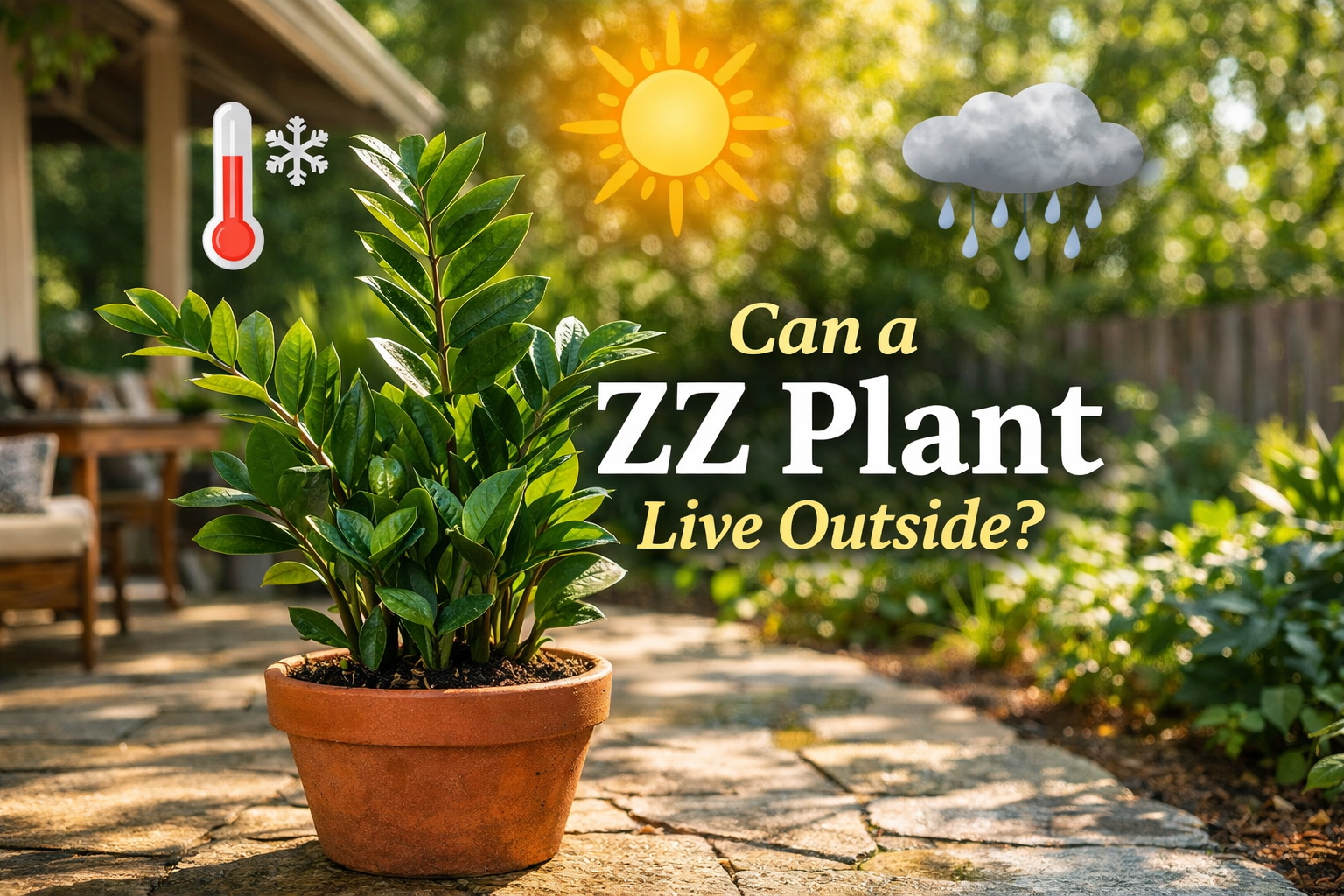
The first time I tried moving my ZZ plant outdoors, I did what most people do: I set it on the patio where it “looked bright,” admired it for two days, then noticed pale patches that turned into crispy scorch marks. The plant did not “suddenly get picky.” My placement was.
So, can a zz plant live outside? Yes, it can, but only if you match it to the right temperature, light, and drying conditions. The common answer is technically correct, but it is useless without context because “outside” can mean blazing afternoon sun, cold night swings, and soaking rain.
In this guide I’m gonna run you through a few important things to keep in mind when dealing with a ZZ plant:
- How to run a quick 3-check test for your porch, balcony, deck, or yard
- Exactly where to place a ZZ outdoors so it gets light without scorching
- How to handle rain and watering so the rhizomes do not rot
- What to do when the forecast dips and you need a fast plan
- How to troubleshoot scorch, yellowing, droop, and soft stems with clear if/then rules
Yes, a ZZ plant can live outside, but only if you pass the “3 checks”
If you want the clean answer: a ZZ plant can live outdoors when it is warm enough, protected from harsh direct sun, and able to dry out thoroughly between wettings. If any one of those is missing, the plant may survive for a while, but it will slowly rack up damage.
The 3-check test (use this before you move it outside)
- Temperature: No frost risk, and nights are not regularly cold. If you are getting repeated chilly nights, treat it as a seasonal patio plant and bring it in.
- Light: Bright shade or gentle morning sun only. Avoid harsh afternoon sun, especially on reflective surfaces like pale walls, glass, and paving.
- Drying: The potting mix can dry out fully between wettings. If rain or runoff keeps the soil damp for days, rot risk rises fast.
Key takeaway: Outdoor success is less about “tough plant” and more about “right spot plus dry rhythm.”
The two-lane decision: seasonal patio plant vs year-round outdoor plant
Most frustration comes from treating “outside” like a single setting. It is not. You have two practical lanes, and choosing the right one solves 80 percent of the problem.
Lane 1: Seasonal outdoor ZZ (the default for most homes)
This means your ZZ lives outdoors during the warm, stable part of the year, then comes back inside before nights trend cold. This lane works even if your area gets winter chills, as long as you can move the plant.
Lane 2: Year-round outdoor ZZ (only if you are reliably frost-free)
This is for climates where frost is not part of your year, and you can still provide shade and fast drainage. Even in warm regions, rain and harsh sun can be bigger problems than cold.
Common mistake: Planting in-ground because the ZZ “handles neglect,” then discovering the real enemy is winter weather and wet soil you cannot control.
Use this decision rule:
- If frost is possible where you live, choose Lane 1. Keep it in a container so you can bring it in.
- If you cannot keep it from staying wet for days, choose Lane 1. Containers and shelter are your safety net.
- If your outdoor light is mostly harsh afternoon sun, choose Lane 1. You will need flexibility to shift shade positions.
Temperature reality check: what ZZ plants tolerate, and what they do not
ZZ plants store water in thick underground rhizomes. That makes them forgiving of missed watering, but it does not make them frost-proof. Cold, especially combined with wet soil, is where “indestructible houseplant” turns into “why is the base getting soft?”
Here is the rule I actually use at home: if nights start trending cold for more than a couple of days in a row, I move the plant in before it shows stress. Waiting for visible damage is like waiting for a smoke alarm to finish the battery. You will hear it, but it is already annoying and already avoidable.
- If a frost warning is on the forecast: bring a potted ZZ inside. Do not gamble with cover alone.
- If nights are swinging a lot (warm day, much cooler night): place it in a more protected microclimate (near a wall, under an overhang) or keep it indoors until conditions stabilize.
- If it is cool and rainy: prioritize drying. Cold plus wet is worse than either one on its own.
For plant trait context and care basics, UF/IFAS Extension’s ZZ plant guidance is a solid reference point, especially for understanding why this plant is treated as a warm-climate ornamental and why moisture management matters so much. UF/IFAS Extension ZZ plant fact sheet.
Light outdoors is not “a little brighter,” it is a different planet
Indoor “bright light” and outdoor “bright light” are not cousins. They are different species. Moving a ZZ from indoors to outdoor sun is like going from a desk lamp to stadium lights.
What you want outdoors is bright shade or dappled shade. Think: under a covered porch, beneath a tree canopy that filters sun, or on a balcony where the plant gets plenty of daylight but not harsh rays.
Use the shadow test
- Soft-edged shadow: usually safe. This is the “bright shade” zone where ZZ plants tend to look their best outdoors.
- Hard-edged shadow: likely too intense unless it is brief morning sun. Harsh midday and afternoon sun can scorch leaves.
What sun scorch looks like (and what it is not)
- Scorch: bleached patches, tan or brown crispy areas, often on the most exposed leaflets.
- Normal aging: an older stem slowly yellowing from the base over time, usually not sudden and not patchy.
Common mistake: “It is shaded, so it is safe.” Reflected light off glass, pale walls, and paving can act like a magnifying mirror, especially in the afternoon.
What I do in practice: I start a ZZ under an overhang where it gets bright ambient light, then I shift it outward by small increments over a week. If the leaf color stays consistent and there is no patching, I keep going. If I see pale areas, I move it back immediately.
Rain and watering: the fastest way to kill a ZZ outside is to keep it wet
Indoors, your ZZ might go weeks without water and still look polite. Outdoors, the danger flips. Rain can quietly keep the potting mix damp for days, and ZZ rhizomes do not like sitting wet. That is when rot starts, often out of sight, right at the base.
Adopt this mindset: outdoors, your job is not “watering.” Your job is “making sure it dries.”
The dry rhythm rule (simple and effective)
- Only water when the potting mix is dry well below the surface, not just dry on top.
- After rain, do not “top up” out of habit. Let the pot dry fully again.
- If the pot stays damp for days, fix the setup before you fix the plant.
Three ways to prevent hidden soaking
- Stay out of runoff: avoid spots under roof edges where water pours down during storms.
- Elevate the pot: ensure drainage holes are not blocked by a flat surface.
- Choose real drainage: decorative cachepots outdoors are a trap unless the inner pot drains freely and never sits in water.
Rot warning signs you should not ignore
- Sudden yellowing after a wet period
- Softening stems near the soil line
- A mushy base or sour odor from the potting mix
If you want a quick confidence check, a basic moisture meter can help you learn what “dry enough” feels like in your specific pot and microclimate. Use it as a training tool, not a replacement for observation.
Container, soil, and placement: build a setup that forgives you
For most people, the best outdoor ZZ is a container ZZ. It lets you manage the three big variables: light, temperature swings, and rain exposure.
Pot choice: pick the one that matches your humidity and rain reality
- Terracotta: dries faster, more forgiving if your air is humid or you get regular rain.
- Plastic or glazed ceramic: holds moisture longer, better for very hot, dry spots, but riskier in rainy conditions.
Soil: aim for fast-draining and airy
You want a mix that does not collapse into a wet sponge. If your potting mix stays soggy, the rhizomes stay stressed. Many people use cactus or succulent-style mixes as a base, then add structure (chunky components) if needed to improve airflow and drainage.
Placement checklist (a ZZ-friendly outdoor microclimate)
- Bright shade or filtered light
- Shelter from pounding rain and strong wind
- No roof runoff directly above
- A stable surface that does not trap water under the pot
Common mistake: Sizing up the pot “for growth.” An oversized pot holds extra wet soil, and a ZZ does not need that much moisture reserve.
Brooklyn Botanic Garden’s ZZ plant overview is a helpful reminder of what this plant is built for: survival through drought-like stretches, thanks to those water-storing rhizomes. That is why drainage and drying matter so much when you take it outdoors. Brooklyn Botanic Garden ZZ plant guide.
How to move a ZZ plant outside without shock (the 7-day ramp-up)
When people say a ZZ “hates being moved,” they usually mean it hates sudden change. Outdoors adds stronger light, airflow, and temperature swings. A gradual ramp-up prevents permanent leaf damage.
The 7-day ramp-up (simple and realistic)
- Days 1 to 2: Bright shade only, protected from wind.
- Days 3 to 5: Add brief morning sun only if you want faster growth. Avoid afternoon sun.
- Days 6 to 7: Move to the final outdoor spot, still favoring bright shade or filtered light.
Watering during the ramp-up stays boring on purpose: wait for full drying before watering. Do not “help” it adjust by watering more. That is how rot begins.
For a broader, practical approach to transitioning houseplants outdoors (including gradual exposure and timing), the Royal Horticultural Society has clear guidance that aligns with this slow-and-steady method. Royal Horticultural Society guidance on moving houseplants outdoors.
Key takeaway: Acclimation is not babying. It is preventing leaf scorch you cannot undo.
“Help, something went wrong” troubleshooting by outdoor scenario
This is where most advice gets vague. Here are the scenarios I see most often when ZZ plants go outside, plus the fastest way to diagnose what is actually happening.
Scenario 1: Crispy patches after a day or two
- Most likely: sun scorch from direct or reflected light.
- Do this now: move the plant into brighter shade immediately.
- Do not do: remove every damaged leaflet at once. Keep healthy foliage to support recovery.
Scenario 2: Yellowing after a rainy week
- Most likely: soil stayed wet too long, early rot risk.
- Do this now: stop watering, move to a sheltered spot, and improve drainage and airflow.
- If stems feel soft near the base: unpot and inspect. Trim mushy tissue, let remaining healthy parts dry, then repot in a fast-draining mix.
Scenario 3: Drooping stems even though the leaves look green
- Check soil moisture first: if wet, treat as overwatering risk. If dry, it may be wind stress or recent movement.
- Do this now: stabilize the placement (less wind), keep to bright shade, and return to the dry rhythm.
Scenario 4: Soft base, mushy smell, or dark collapse at soil line
- Most likely: rot.
- Do this now: remove the plant from the pot, discard wet mix, trim compromised parts, and repot into dry, airy medium.
- Decision rule: if you cannot keep it from getting soaked outdoors, move it indoors until you can.
Scenario 5: No growth all season
- Most likely: light is still too low outdoors, or the plant is simply slow and stable.
- Do this now: increase brightness without adding direct afternoon sun, and confirm the pot is not staying wet.
Common mistake: Fertilizing to “fix” stress. Correct light and moisture first. Feed later, only when the plant is stable.
Pests, pets, and safety: the outdoor risks nobody mentions until it is late
Outdoors is not only more light. It is more life. Insects and spores are part of the deal. The trick is keeping small problems small, especially if you plan to bring the plant back indoors.
Outdoor pest reality (and how to avoid bringing trouble inside)
- Check stems and the undersides of leaflets weekly.
- Before moving indoors, do a 60-second inspection: look at joints, stems, and the soil surface.
- If you see sticky residue, cottony clusters, or small bumps on stems, isolate and treat before it joins your indoor plants.
Pets and kids
ZZ plants are commonly treated as toxic if chewed. The practical move is simple: place the plant out of reach of pets and curious toddlers, especially outdoors where supervision is looser.
Skin sensitivity
If you are pruning or repotting, wash hands afterward. If you know you react to plant sap, wear gloves. No drama needed, just good habits.
Key takeaway: The best pest control is a quick routine before you move the plant back inside.
Seasonal calendar: when to take it out, when to bring it back, and how to winter-proof your plan
A ZZ plant does well outdoors when conditions are stable. Your calendar is not about dates on a page. It is about patterns: warm nights, gentle light, and reliable drying.
When to move it outside
- Choose a stretch of settled weather, not a week of wild swings.
- Start with the 7-day ramp-up in bright shade.
When to bring it back inside
- Bring it in before cool nights become the norm, not after leaves yellow or stems soften.
- If a cold snap is predicted, move it in early. Do not wait for the last minute.
Reverse acclimation (the underrated step)
Before bringing it inside, shift it into deeper shade for a few days. That makes the jump back to indoor light feel less abrupt, which helps prevent leaf drop and sulking.
Common mistake: Leaving it out “one more week” because the days are warm, while nights quietly turn cold and damp.
Quick checklist: Is your ZZ plant an outdoor candidate this month?
- Temperature: Frost is not in play, and nights are not repeatedly cold.
- Light: You can give bright shade or filtered light, not harsh afternoon sun.
- Drying: The potting mix can dry fully between wettings, even if it rains.
- Mobility: You can move it quickly if the forecast changes.
- Monitoring: You can do quick weekly checks for pests and moisture.
Key takeaway:
If you cannot confidently say “it will dry,” keep it indoors or move it to a more sheltered outdoor spot. ZZ plants forgive missed water far more than they forgive staying wet.
FAQ
Can a ZZ plant live outside on a covered porch with no direct sun?
Usually, yes, as long as the porch still provides bright ambient light and the plant is not staying wet from humidity, misting, or rain blowing in. If it looks stretched (longer gaps between leaflets) or stops producing new growth entirely, it may need a brighter shaded position, not direct sun.
Will a ZZ plant recover after one cold night?
Sometimes, but treat it like a warning shot. Bring it into a stable indoor spot, keep it on the dry side, and do not fertilize while it is stressed. If the base stays firm and you see no new yellowing over the next week or two, it likely avoided serious damage. If stems soften near the soil line, shift into rot prevention mode: drying, drainage, and inspection.
How do I tell sunburn from overwatering on a ZZ plant?
Sunburn typically shows as bleached or tan crispy patches on exposed leaflets, often appearing quickly after bright sun exposure. Overwatering more often shows as overall yellowing, limp or drooping stems, and a damp potting mix that does not dry. When in doubt, check the soil first. Wet soil plus symptoms points to water issues. Bright exposure plus patchy crisping points to scorch.

Michael Rowan is the founder and lead writer at The Garden Playbook. He has spent 10+ years growing plants across a range of settings — from indoor houseplants and container gardens to raised beds and in-ground plots — adapting methods to different light levels, seasons, and growing conditions.
Michael focuses on practical, experience-based guidance grounded in fundamentals: soil health, watering strategy, plant nutrition, pruning and propagation, and integrated pest management (IPM). His work aims to help readers diagnose common problems (such as yellowing leaves, stunted growth, or pest pressure) and apply straightforward solutions that are realistic for home gardeners.
At The Garden Playbook, Michael develops tutorials and plant guides using a consistent process: documenting real outcomes where possible, explaining the “why” behind each step, and verifying higher-risk topics (such as plant toxicity or pest treatment options) against reputable horticultural references.