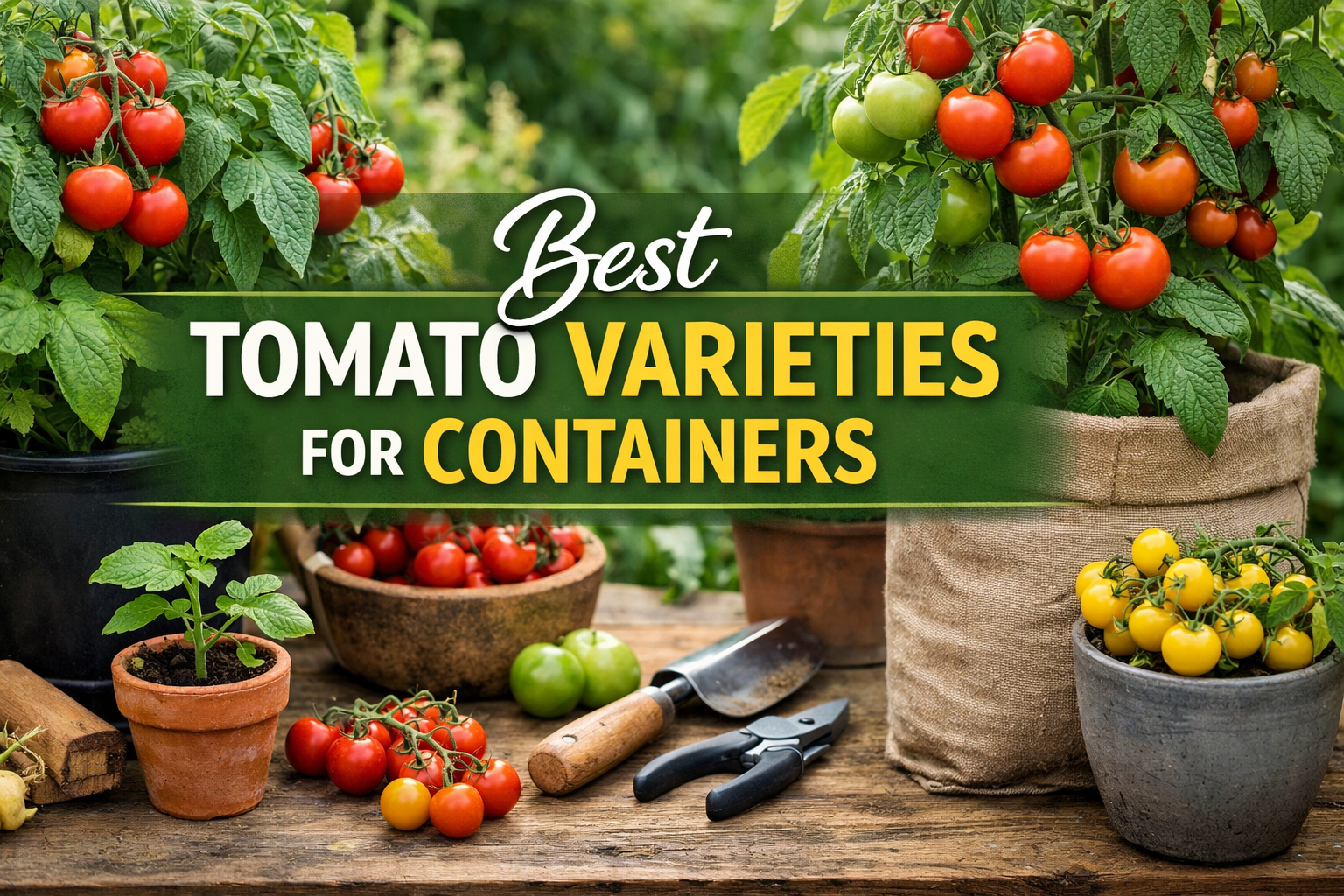
I still remember the first “container tomato” I bought like it was a houseplant. It was a cute little transplant in a small pot, already flowering, and it looked harmless on my balcony. Two months later, I was dragging a floppy tomato jungle around like a tangled phone charger, watering twice a day, and wondering why the fruit kept getting weird dark bottoms.
If you came here for the best tomato varieties for containers, here’s the straight answer: compact plants win. That usually means dwarf tomatoes, patio types, and many determinates. But that answer is only useful when you match the variety to the container size, sun, and the way you actually want to harvest and eat tomatoes.
In this guide, you will learn:
- How to pick a variety that fits your pot, sunlight, and schedule (not just your taste buds)
- Which tomato types are easiest in containers and when indeterminates still make sense
- A no-regret shortlist grouped by how you want to eat tomatoes (snacking, sandwiches, sauce)
- Container size rules that prevent most problems before they start
- Simple support, pruning, and watering systems that keep plants stable and productive
- Fast fixes for the five most common container tomato problems
The 60-Second Answer: Which Tomatoes Actually Thrive in Containers (And Why Most Advice Feels Vague)
Container tomatoes thrive when the plant’s growth habit matches two things: root room and moisture stability. In pots, the soil volume is your water tank and your nutrient pantry. When that tank is too small for the plant’s appetite, you get the classic container spiral: midday wilting, leaf stress, blossom drop, cracking fruit, and blossom-end rot.
So yes, compact tomatoes are usually “best.” But compact can mean different things:
- Micro-dwarf: tiny plants, small roots, small fruit, minimal support
- Dwarf: short plants with sturdy stems and real tomato flavor potential
- Determinate (bush): grows to a set size, fruits in a heavier wave
- Compact indeterminate: keeps producing longer, but needs more support and pot volume
Here’s what nobody tells you: “compact plant” does not always mean “easy plant.” A compact tomato in a too-small pot can still be a high-maintenance, twice-a-day watering job. The goal is not just a shorter plant. The goal is a plant that stays steady in your container and your life.
Key takeaway: Choose the plant that fits your container size first. Then choose flavor and fruit type.
The Container Tomato Fit Test (Pick the Right Plant Like You’re Picking the Right Shoes)
Picking tomatoes by variety name alone is like buying “medium shoes” because it sounds safe. Your feet do not care about the label. They care about fit. Tomatoes are the same. The label on the seed packet matters less than the match between growth habit and the pot.
Use this quick fit test. It takes a minute, and it saves an entire season.
Step 1: Start with your container size (this is your real filter)
- Under 12 inches (under 30 cm) wide: choose micro-dwarfs or very small patio cherries. Anything larger is a stress machine.
- 12 to 18 inches (30 to 45 cm) wide: choose dwarfs, patio types, and many compact determinates.
- 18 inches (45 cm) and up, or large grow bags: you can grow compact indeterminates and larger-fruited determinates with the right support.
For a practical benchmark, Clemson Extension notes that a 14-inch to 20-inch container suits most compact cultivars, and even a five-gallon bucket can work if it has drainage holes and enough root space. See Clemson HGIC’s tomatoes in containers guidance for the container sizing baseline.
Step 2: Check your sun hours (tomatoes are not “bright shade” plants)
- 8+ hours of direct sun: you can aim for slicers and heavier producers if your pot is big enough.
- 6 to 8 hours: ideal for most container tomatoes, especially cherries, dwarfs, and determinates.
- 4 to 6 hours: set expectations. Choose smaller-fruited types and compact plants, and accept that yields may be lighter.
Step 3: Factor in your microclimate (balcony wind and heat reflection are real)
- Windy balcony: shorter, sturdier plants beat tall vines. A top-heavy container can tip fast.
- Heat-reflecting wall: afternoon shade and bigger containers matter more than variety hype.
- Short season: earlier-maturing types and cherries are your safest bet.
Step 4: Decide how you want to eat tomatoes (this is your “fun” filter)
- Snacking: cherries and grapes
- Sandwiches: medium slicers, beefy saladettes
- Sauce: paste or plum types
Common mistake: Choosing a big-vine indeterminate slicer for a small pot, then treating the resulting stress as a “watering problem” instead of a “fit problem.”
Tomato Types That Win in Pots (Determinate vs Indeterminate vs Dwarf, Without the Confusion)
Most container frustration comes from mixing up fruit type with growth habit. “Cherry” describes fruit size. It does not guarantee a compact plant. Some cherry tomatoes are wildly vigorous indeterminates that will outgrow a patio fast.
Determinate (bush) tomatoes
Determinate plants grow to a more defined size and tend to set fruit in a heavier window. In containers, that often translates to a plant that is easier to manage, especially if you want a big harvest wave for salads or a batch of sauce.
What it means for you:
- Less endless vining
- Usually simpler support
- Pruning is minimal, sometimes none
Indeterminate tomatoes
Indeterminates keep growing and producing until cold ends the season. In containers, they can be fantastic if you have a large pot, strong support, and you like long, steady harvests.
What it means for you:
- More support needs
- More pruning and training choices
- More pot volume required to keep moisture stable
Dwarf and micro-dwarf tomatoes
Dwarf tomatoes are the sweet spot for many container growers. They stay compact but can still deliver serious flavor, especially when grown in a container that does not let them dry out like a sponge left in the sun.
Key takeaway: Growth habit predicts your maintenance job, not just plant height.
The Best Tomato Varieties for Containers, Grouped by What You Want to Eat
Instead of handing you a random list, here are container-friendly picks grouped by real-life goals. This is how most people actually decide.
Group A: Snackers (cherry and grape tomatoes that forgive small mistakes)
If you want the highest odds of success in a container, start here. Smaller fruit tends to set more reliably, and cherries often tolerate container ups and downs better than large beefsteaks.
- Tiny Tim: a classic micro-dwarf choice for small containers and quick gratification.
- Tumbling Tom (and similar trailing types): great for hanging baskets and rail planters if you can water consistently.
- Sweet Million: commonly grown as a heavy-producing cherry type, but pay attention to growth habit and support needs.
Who should pick this: first-time container gardeners, balcony growers, anyone who wants a steady snack supply.
Group B: Sandwich slicers (the “I want real tomato slices” category)
Slicers are where container gardeners get ambitious and sometimes get burned. The trick is not “avoid slicers.” The trick is “choose compact slicers and give them enough root room.”
- Bush Early Girl: a common compact option that many container gardeners use successfully.
- Celebrity: often recommended for its productivity and adaptability, but still needs support and decent container volume.
- Patio-type slicers (look for “patio,” “bush,” or “compact” in the name): these are bred for smaller spaces.
Who should pick this: you want slices for sandwiches and caprese, and you can commit to a larger pot and consistent watering.
Group C: Sauce and paste (for people who actually cook tomatoes)
Paste tomatoes can work in containers, but they are not automatically “easy.” They often produce heavily, and that fruit load demands steady water and feeding. If you choose paste types, do it with an appropriately sized container and support.
- Roma: commonly grown paste type and often container-friendly when given enough pot volume.
- San Marzano: beloved for sauce, but many strains grow as indeterminates and need more space and support than people expect.
- Plum Regal: frequently mentioned for disease resistance traits in some lines, but confirm the specific plant’s habit and needs when buying.
Who should pick this: you are willing to size up the container and you want concentrated harvests for sauce.
Group D: Hanging baskets and railing planters (trailing tomatoes)
Trailing tomatoes look fantastic and can be productive, but they demand a steady watering rhythm. Hanging containers dry quickly, especially in wind.
- Tumbling Tom (and other trailing cherries)
- Tumbler (often sold as a trailing basket tomato)
Common mistake: Picking paste tomatoes for a tiny pot because you want sauce, then getting stressed plants and blaming the variety.
Match the Variety to the Pot: Container Size Rules That Prevent Most Problems
In containers, bigger is not just “more yield.” Bigger is more stable water and nutrients. That stability is what prevents stress-related issues that look mysterious but are actually predictable.
Here are decision rules you can use today:
- If your pot is under 12 inches (30 cm) wide, choose micro-dwarf tomatoes or very small patio cherries.
- If your pot is 12 to 18 inches (30 to 45 cm), choose dwarfs, patio types, and compact determinates.
- If you want indeterminates in a container, use a large container or grow bag and plan support from day one.
For another solid benchmark, the Royal Horticultural Society advises planting one tomato per 30 to 45 cm (12 to 18 inch) pot for container growing. See RHS guidance on growing tomatoes in containers.
Why undersized containers cause so many “mystery” problems
- Soil dries quickly, so the plant swings between drought stress and flood recovery.
- Fertilizer salts and nutrients fluctuate more sharply.
- Roots hit the wall, circle, and lose efficiency.
- Fruit quality suffers first: cracking, blossom-end rot, and bland flavor are common outcomes.
Key takeaway: When in doubt, go bigger. Bigger containers make tomatoes easier, not harder.
Soil, Feeding, and Watering: The “Steady Supply” Method (So Your Plant Stops Throwing Tantrums)
When I finally stopped treating container tomatoes like patio decor and started treating them like a water-and-nutrient system, everything improved. The plant did not need heroic rescues. It needed consistency.
Potting mix: think “drains well, holds enough”
Do not use garden soil in containers. It compacts, drains poorly, and can bring disease issues into a pot. Use a potting mix intended for containers, then improve stability with:
- A small amount of compost for moisture buffering
- A slow-release fertilizer appropriate for vegetables (follow label directions)
- A light mulch layer on top to slow evaporation
Watering: deep and consistent beats frequent and shallow
Use a simple rhythm:
- Water until you see water run out the drainage holes.
- Do not water again until the top inch or two feels dry, then repeat.
- In hot, windy conditions, you may water more often. The goal is to avoid full dry-outs.
If your container dries out completely even once during heavy fruiting, you can trigger stress patterns that show up later as fruit disorders. The plant remembers stress through growth interruptions.
Feeding: small and steady
Containers leach nutrients faster than garden beds. A practical approach is to use a slow-release fertilizer at planting, then supplement with a tomato-appropriate feed according to the product label as the plant grows and fruits. Avoid overfeeding nitrogen, which can create lush leaves and fewer tomatoes.
Common mistake: “Saving” a wilted plant with a flood, then letting it swing back to dry again. That cycle is a container tomato’s worst routine.
Support and Pruning That Matches the Variety (Stop Over-Pruning Determinates)
In containers, support is not optional. It is load management. Even compact tomatoes can snap or topple when fruit loads build, especially in balcony wind.
Pick support based on growth habit
- Micro-dwarf: often minimal support, but a small stake can help if fruit clusters get heavy.
- Dwarf: usually a sturdy stake or a compact cage.
- Determinate: a cage or stake is often enough. The plant is not trying to climb the sky.
- Indeterminate: plan a stronger cage, trellis, or stake system and install it at planting.
Pruning rules that keep you out of trouble
- Determinate tomatoes: prune lightly or not at all. Heavy pruning can remove future fruit sites.
- Indeterminate tomatoes: selective pruning can improve airflow and keep the plant manageable in a container. Focus on removing suckers that create a chaotic interior, not stripping the plant bare.
- Dwarfs: minimal pruning. Let the plant do its compact thing.
Balcony stability tips
- Use a heavy pot or stabilize grow bags in a crate or corner.
- Install support early so you do not damage roots later.
- Rotate the pot occasionally for even growth, but avoid constant moving once the plant is loaded with fruit.
Key takeaway: Support first, then growth. If you wait until the plant is flopping, you are already doing emergency work.
Troubleshooting: The Big 5 Container Tomato Problems (And the Fast Fix)
Most container tomato issues are not random. They are predictable results of water, heat, airflow, and container volume. Here are the five you are most likely to see, plus what actually works.
1) Blossom-end rot (dark, sunken bottoms on fruit)
This one scares people because it looks like a disease, but it is a physiological disorder linked to calcium delivery issues in the fruit, often driven by inconsistent soil moisture. The fix is usually not dumping calcium into the pot. The fix is steady moisture and avoiding extreme dry-outs.
UC Agriculture and Natural Resources explains blossom-end rot as a physiological issue and describes how it appears and progresses. See UC ANR’s guidance on blossom-end rot.
Fast fix:
- Stop full dry-outs. Water consistently and deeply.
- Mulch the top of the pot to slow evaporation.
- Avoid overfertilizing, especially with high nitrogen.
- Remove damaged fruit so the plant redirects energy.
Common mistake: Chasing calcium “hacks” while the container keeps swinging between bone-dry and soaked.
2) Fruit cracking
Cracking usually happens when fruit rapidly rehydrates after a dry period. Think of it like skin stretching faster than it can handle.
Fast fix:
- Water before the plant reaches severe wilt.
- Use a larger container or add mulch to stabilize moisture.
- Harvest near-ripe fruit before a major watering shift.
3) Leaf curl and heat stress
In containers, heat stress is amplified. Pots warm quickly, roots heat up, and the plant curls leaves to reduce water loss.
Fast fix:
- Provide afternoon shade during extreme heat.
- Use light-colored containers where heat reflection is intense.
- Water early in the day so the plant enters heat with a full tank.
4) Pests in small spaces (aphids, whiteflies, occasional hornworms)
Balcony and patio tomatoes can still attract pests, especially when plants are stressed. Inspect the underside of leaves and growing tips weekly.
Fast fix:
- Knock pests off with a firm water spray.
- Remove heavily infested leaves.
- Use the least-toxic control options first, and always follow label directions for edible plants.
5) Fungus gnats in potting mix
Fungus gnats are usually a sign the top layer stays too wet. They are annoying, and they can stress seedlings and young plants.
Fast fix:
- Let the top inch of potting mix dry between waterings.
- Bottom-water when practical to keep the surface drier.
- Use sticky traps to reduce adults while you correct moisture habits.
If you want a focused breakdown on identifying the breeding source and stopping the cycle, see this practical guide to getting rid of gnats indoors. The same “remove the source first” logic applies when gnats start around planters.
Scenario Picks: What to Grow If You Have Partial Sun, Wind, Heat, or a Short Season
Containers turn your space into a microclimate. A balcony can be brighter, hotter, and windier than a garden bed three meters away. Match the plant to the reality you live in.
If you have partial sun (4 to 6 hours)
- Prioritize cherries, dwarfs, and compact determinates.
- Avoid large-fruited beefsteaks in small pots. They want more energy than you can reliably provide.
- Use reflective surfaces carefully. A bright wall can help, but heat can also spike.
If your balcony is windy
- Choose dwarfs and bush types over tall vines.
- Use heavier containers and stable support.
- Position pots near a windbreak if possible, even a railing panel can help.
If you get intense heat or a heat-reflecting wall
- Use larger containers or grow bags for root insulation.
- Water earlier in the day and maintain consistent moisture.
- Consider temporary afternoon shade during heat spikes to protect flowers and fruit set.
If your season is short
- Choose earlier-maturing varieties, especially cherries and compact types.
- Start with healthy transplants to shorten time to harvest.
- Use a larger pot early rather than potting up multiple times and stressing roots.
Key takeaway: In containers, microclimate often matters more than your region’s average conditions.
Buying Seeds or Starts: The “Healthy Transplant” Checklist (So You Don’t Start With a Problem)
When you buy a tomato start for a container, you are not just buying a plant. You are buying your season’s starting momentum. A stressed transplant can set you back weeks.
What a strong container-ready start looks like
- Stocky stem, not tall and floppy
- Healthy leaf color with no heavy spotting or curling
- No obvious pests on the underside of leaves
- Not severely root-bound (avoid plants with tight circling roots visible through drainage holes)
Planting depth: an easy advantage tomatoes give you
Tomatoes can form roots along buried stems. Planting a bit deeper can help build a stronger root system, which is exactly what you want in a container where roots are doing all the work.
The two-week checkpoint (a simple reality check)
Two weeks after planting, your tomato should show:
- New leaf growth at the top
- A stable watering rhythm where you are not rescuing a collapse every afternoon
- No chronic wilting that lasts into evening
If you are constantly fighting wilt in mild weather, it is often a container volume mismatch, not a personal failure.
Common mistake: Buying the biggest flowering transplant and squeezing it into a small pot. That front-loads stress and often reduces long-term yield.
The No-Regret Shortlist (Quick Recommendations by Container Size)
Use this as your final decision tool. Start with the container you actually have. Then choose the tomato type that fits.
Small containers and window boxes (under 12 inches, under 30 cm)
- Choose micro-dwarfs and very small patio cherries.
- Example: Tiny Tim is a classic micro-dwarf option often used for small pots.
- Expect smaller harvests, but fast and satisfying.
Standard patio pots (12 to 18 inches, 30 to 45 cm)
- Choose dwarf tomatoes, patio types, and compact determinates.
- Examples: Bush Early Girl, compact patio slicers, and many dwarf lines.
- Best balance of yield and workload for most people.
Large containers and grow bags (18 inches and up, 45 cm+, or large fabric bags)
- You can grow compact indeterminates and larger-fruited determinates if you add strong support.
- Examples: indeterminate cherries like Sweet Million can work well when you plan a trellis or sturdy cage.
- Best for long harvest windows and bigger fruit goals.
Final “if/then” wrap-up
- If you want the easiest win, choose a dwarf or compact determinate and a 12 to 18 inch pot.
- If you want nonstop snacking, choose a cherry type and plan support early.
- If you want sauce, choose a paste type only if you can size up the container and keep watering consistent.
- If your space is windy or hot, prioritize shorter plants and bigger containers for stability.
Key takeaway: Your container size is your variety filter. Everything else is preference and management.
FAQ
Why do my container tomatoes flower but not set fruit in hot weather?
Heat stress can interfere with pollination and fruit set, especially on hot balconies where containers and surrounding surfaces amplify temperature. Focus on watering earlier in the day, adding temporary afternoon shade during extreme heat, and keeping the plant steadily hydrated so it is not swinging between stress and recovery.
How many tomato plants should I put in one container?
Most of the time, one plant per pot is the safer rule for containers, because crowding increases competition for water and nutrients and reduces airflow. If you want multiple plants, use a large trough or growing bag with enough spacing so each plant has real root room and support.

Michael Rowan is the founder and lead writer at The Garden Playbook. He has spent 10+ years growing plants across a range of settings — from indoor houseplants and container gardens to raised beds and in-ground plots — adapting methods to different light levels, seasons, and growing conditions.
Michael focuses on practical, experience-based guidance grounded in fundamentals: soil health, watering strategy, plant nutrition, pruning and propagation, and integrated pest management (IPM). His work aims to help readers diagnose common problems (such as yellowing leaves, stunted growth, or pest pressure) and apply straightforward solutions that are realistic for home gardeners.
At The Garden Playbook, Michael develops tutorials and plant guides using a consistent process: documenting real outcomes where possible, explaining the “why” behind each step, and verifying higher-risk topics (such as plant toxicity or pest treatment options) against reputable horticultural references.