
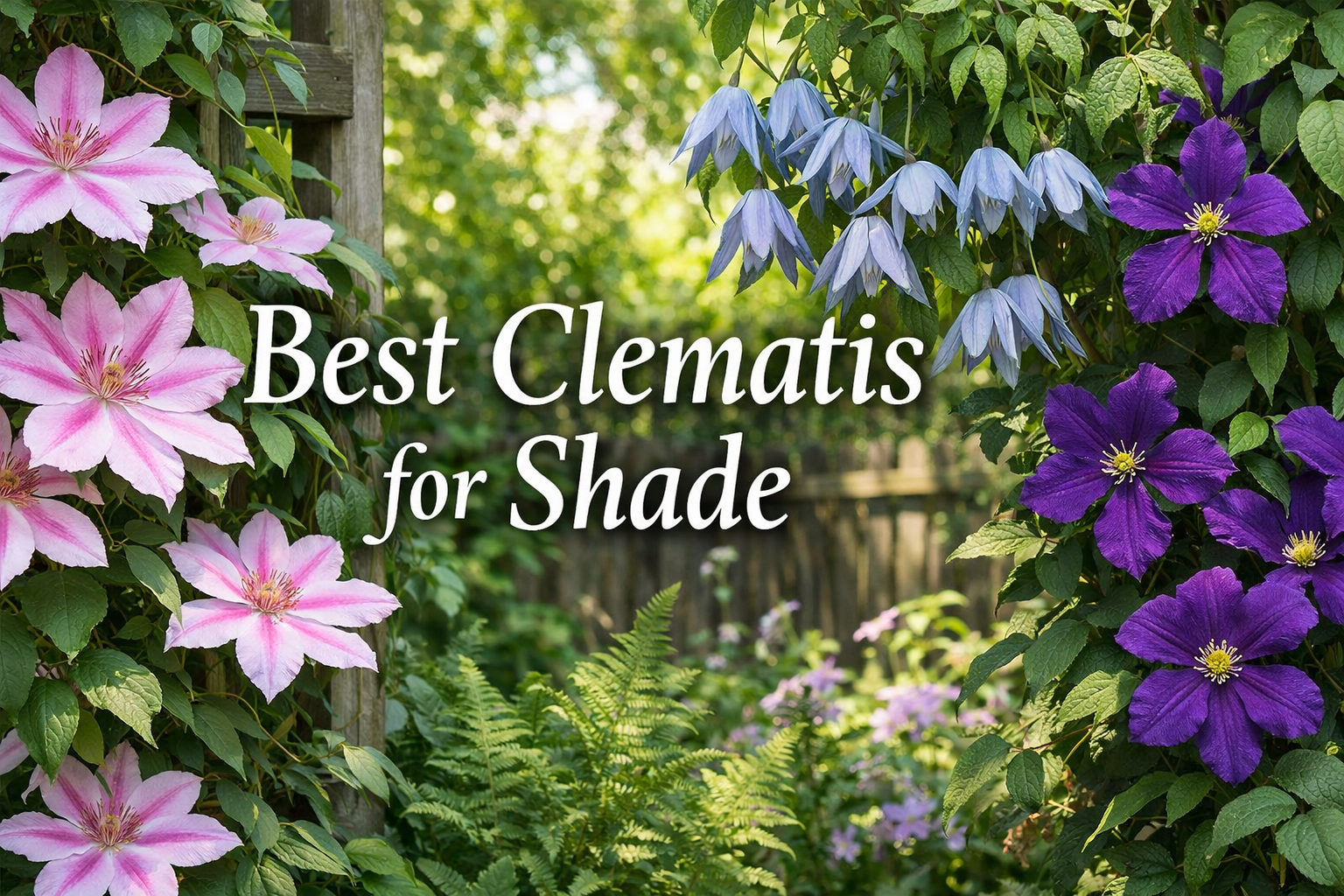
You can waste a whole season on the wrong kind of “shade”. I’ve done it with a clematis on an east fence that looked shady on paper and turned out to be fine. I’ve also watched one sulk under a maple where the tag’s “part shade” promise was never going to come true. Same plant family, same gardener, very different result.
So here’s the straight answer to the best clematis for shade: pick a clematis that can flower well in bright shade or part shade, not one you expect to perform miracles in deep gloom. The vines that make the most sense are usually early large-flowered hybrids such as “Nelly Moser” and “Fujimusume”, spring-flowering species such as Clematis alpina, and a few reliable later bloomers such as “Polish Spirit”. But the useful answer starts one step later. You need to match the vine to the kind of shade, the size of the space, and the amount of pruning you will actually do.
The tension is simple. A lot of pages treat shade like one thing. It isn’t. A bright north-facing wall, dappled shade under high branches, and a dry corner under a dense tree canopy are three different jobs. Clematis notices.
- How to tell whether the spot is workable before you buy
- Which clematis varieties suit different shade situations
- Which ones are easiest to live with year after year
- What goes wrong with weak flowering and how to fix it fast
- Which regret picks to avoid in small gardens and cold climates
Shade-fit shortcut
| Your spot | What usually works | What to watch for |
|---|---|---|
| Morning sun, afternoon shade | Large-flowered Group 2 types such as “Nelly Moser” or “Fujimusume” | Learn the pruning group or you can chop off next season’s flowers |
| Bright north wall or dappled shade | Clematis alpina, some montanas, selected hybrids | Bloom is still lighter than in stronger sun |
| Small trellis in partial shade | Compact to medium vines such as “Fujimusume” or “Hagley Hybrid” | Skip huge growers like montana and armandii |
| Dense shade under trees | Usually not the right clematis site if flowers are the goal | Dry roots and too little light can give lots of leaf and not much else |
A quick rule I trust: if the top growth gets little real light all day, lower your expectations or choose a different climber.
The quick answer: the best clematis for shade depend on what kind of shade you actually have
Evidence first. The University of Illinois Extension suggests a site with about 4 to 5 hours of sun a day for clematis, and the Royal Horticultural Society says most clematis grow well in sun or partial shade while flowering is usually disappointing in a very shady spot. Put those two points together and the answer gets much cleaner: shade-tolerant clematis are usually part-shade clematis, not full-shade superstars.
If you want one broad recommendation for a part-shade garden, “Nelly Moser” is still hard to beat. It is a medium climber, it carries large striped flowers, and the Royal Horticultural Society notes that the flower color fades in strong sun. That is a nice little clue. Some clematis are not just shade tolerant. They actually look better with a bit of protection from harsh afternoon light.
If the site is a bright north-facing wall or an east-facing fence, Clematis alpina is one of the easiest routes. It has a woodland-edge temperament, it flowers earlier, and it doesn’t ask for the same kind of fuss that some big-flowered hybrids do.
If you want a late-season flower show and the easiest pruning routine, a Group 3 clematis such as “Polish Spirit” makes more sense. The blooms are smaller than the giant dinner-plate hybrids. The maintenance is simpler. A lot simpler, actually.
If you want evergreen cover, Clematis armandii is the special-case pick. Not everywhere. Not for every garden. In mild climates it can be beautiful and fast. In a cold, exposed site it can turn into a bad idea pretty quick.
Plain answer: For most readers, the best clematis for shade is a part-shade clematis chosen by light level and pruning group. Start with “Nelly Moser”, “Fujimusume”, Clematis alpina, or “Polish Spirit”. Move to montana or armandii only if the space is big and the site really suits them.
Use the shade fit test so you stop buying the wrong vine
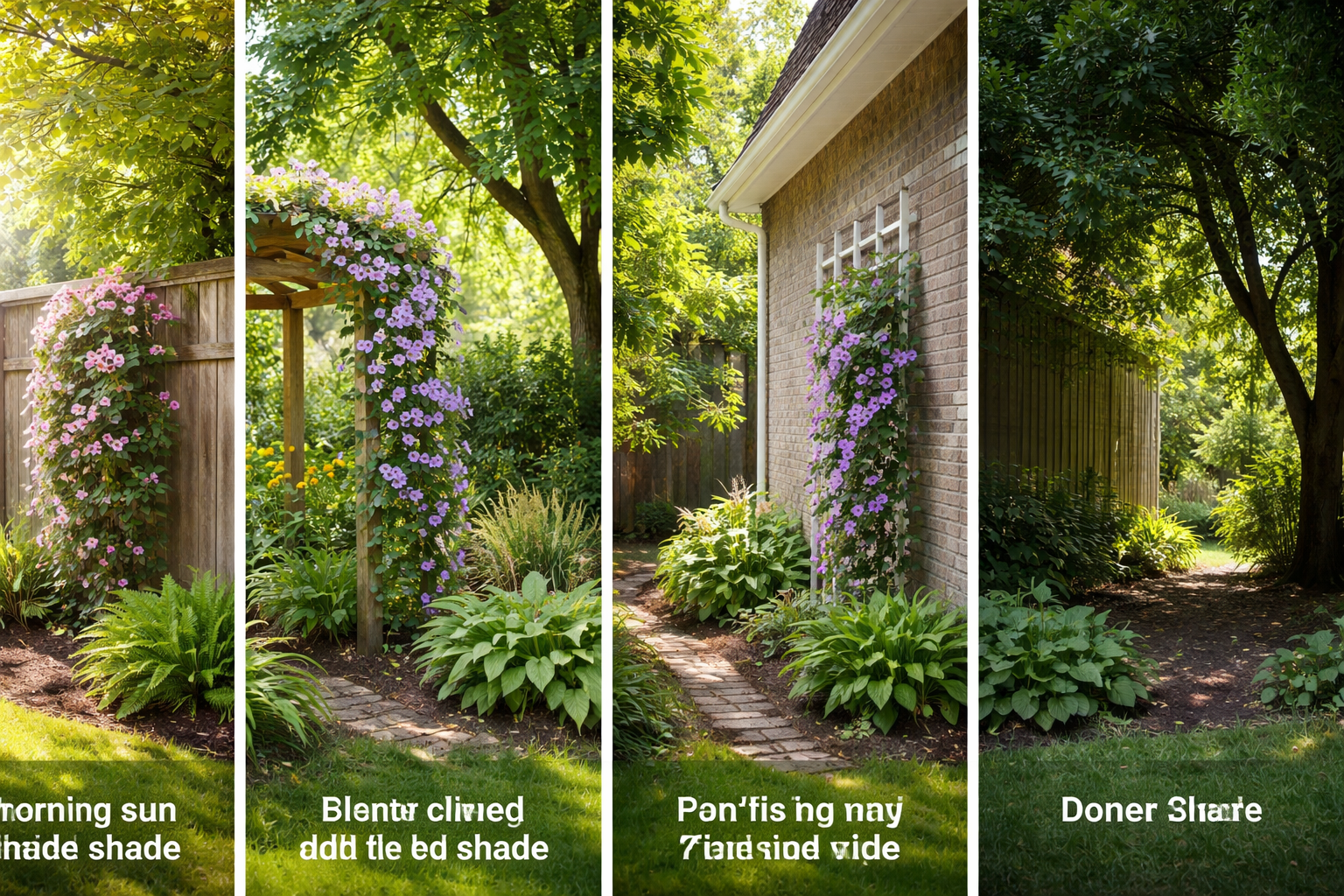
A clematis label can’t see your fence, your trees, or that dry patch under the eaves. You can. So before you choose a variety, run the site through a simple shade fit test.
Step 1. Name the light honestly and get a useful answer
Call it what it is.
- Morning sun and afternoon shade: excellent for many large-flowered clematis
- Bright shade or dappled shade: workable for several clematis, especially spring bloomers and some hybrids
- North-facing wall with reflected light: often better than people think
- Dense shade: poor bet if flowers are the main goal
If you struggle to name the light, watch the site for one clear day in late spring or early summer. Count the hours when the top of the future vine gets direct sun or strong filtered light. If you get around 4 to 5 hours, you are in business. If you get much less, flower count usually drops.
Step 2. Check the root zone and avoid the fake-shade trap
The RHS growing guide says clematis roots prefer cool, moist conditions, and Clemson’s clematis fact sheet says the soil should be moist but well drained. That’s where people get sloppy. “Cool roots” does not mean cramming the whole plant into a dark, dry corner. It means the root zone stays shaded or mulched while the top growth still gets useful light.
That distinction matters more than any flower photo.
Step 3. Decide how much pruning you will really do
I would not skip this. Gardeners talk about flower size. The plant remembers pruning.
If you know you won’t memorize a pruning chart in February, lean toward a Group 3 vine. If you enjoy a bit of plant housekeeping and want those big early flowers plus a second flush, Group 2 is fair game.
Step 4. Measure the space before a vigorous vine measures it for you
This is where a lot of regret starts. A compact or medium climber can fit a modest trellis or obelisk. A montana or armandii can eat a shed, a fence panel, and a nearby shrub while you are still admiring the first bloom flush.
Quick yes-or-no test
- Does the top growth get at least about 4 hours of direct or strong filtered light?
- Will the roots stay cool without staying soggy?
- Can the soil hold moisture but still drain?
- Do you know whether you want easy hard pruning or lighter seasonal pruning?
- Do you actually have room for the mature vine?
If you answered “no” to two or more of those, pause before buying.
Match the variety to the job, not just the flower photo
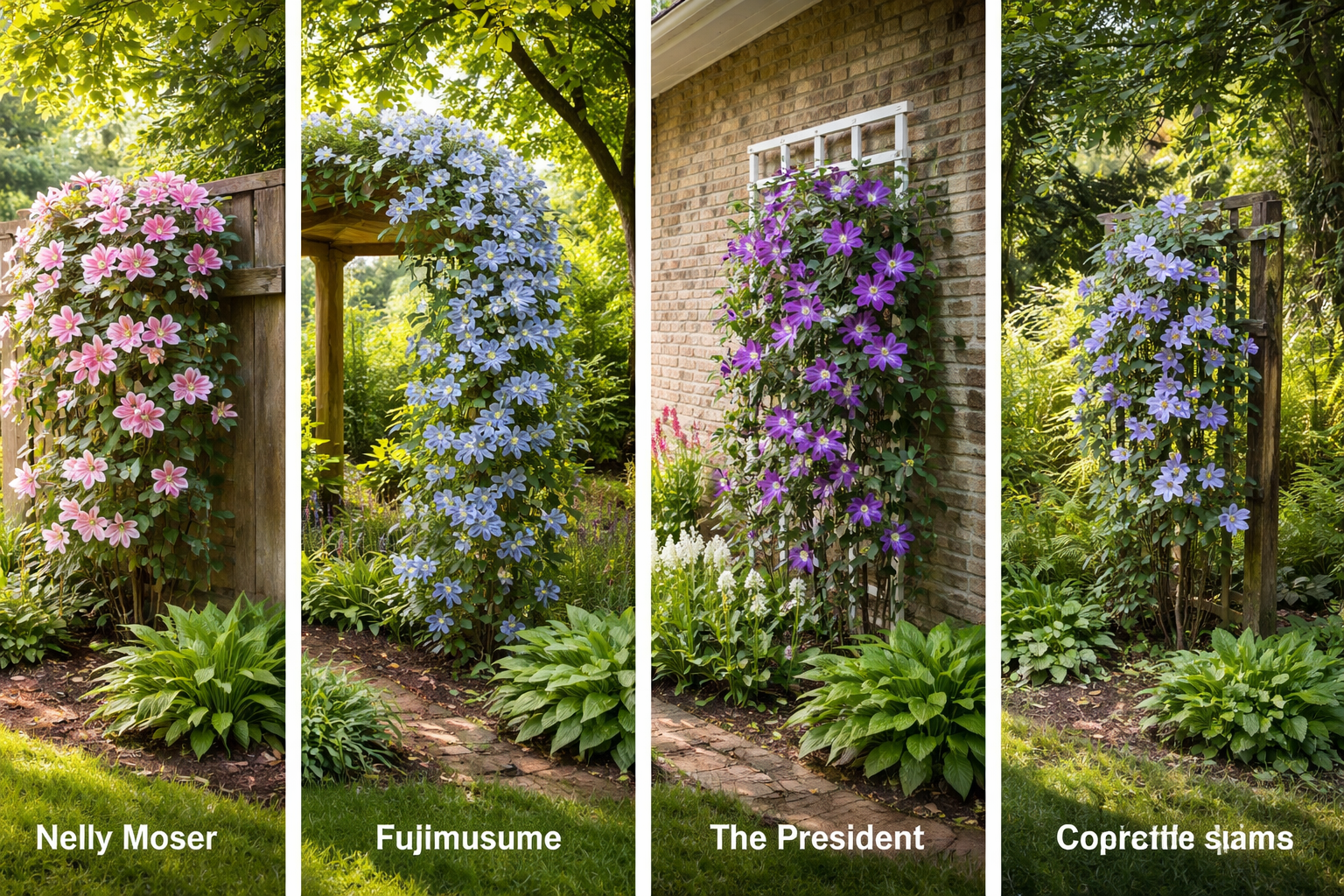
A better clematis article doesn’t dump names on you. It tells you which vine fits which job. That’s what changes the decision.
For big flowers in part shade
“Nelly Moser” is the classic example. The RHS plant profile for “Nelly Moser” describes it as a medium-sized climber with large rosy-lilac flowers up to 20 cm wide, and it notes that the flower color fades in strong sun. That makes it a smart pick for a spot with morning sun and afternoon shade. You still want decent light. You just don’t need the kind of all-day blast that can bleach the petals.
“Fujimusume” fits the same broad lane but in a slightly tidier way. The RHS profile calls it robust but compact, with light-blue flowers up to 20 cm wide and repeat bloom in late summer. If the space is not huge and you still want that large-flowered look, it is a very persuasive choice.
“The President” and “Doctor Ruppel” also belong on the shortlist when you want classic large-flowered clematis for partial shade. They are not magic shade plants. They are strong contenders in bright, workable shade.
For spring color on a bright north- or east-facing wall
Clematis alpina is often the calmer, saner pick. It suits the softer light of a north-facing wall and woodland-edge conditions better than many large-flowered show ponies. The flowers are smaller and more delicate. The payoff is that the plant often feels less dramatic in maintenance too.
Clematis montana gives you a different deal. You get energy, reach, and a broad spring show. You also get a much larger vine. That is a fine bargain on a long fence or big pergola. It is a rotten bargain on a little trellis by the back door.
For easy pruning and later flowers
“Polish Spirit” earns its place because it solves a different problem. The RHS description of “Polish Spirit” notes midsummer to late autumn bloom on a medium-sized vine. It is not the loudest flower in the genus, and that’s fine. Its strength is reliability plus the much friendlier Group 3 pruning routine.
“Hagley Hybrid” and “Prince Charles” can also make sense when you want a softer habit, moderate size, and a plant that doesn’t demand a giant support.
For evergreen cover or a native look
Clematis armandii is the evergreen special case. It gives you structure when deciduous clematis are bare, and that alone can make it the right answer in a mild-climate garden. The catch is size and hardiness.
Clematis virginiana, often called virgin’s bower or woodbine, is the native choice for many North American gardeners. The Missouri Botanical Garden profile for Clematis virginiana describes it as a vigorous, fall-blooming vine native to eastern North America, often found in moist low woodland areas and thickets. That’s useful context. It tells you the plant is at home in the sort of light and moisture pattern many garden clematis spend years complaining about.
What this means in practice: choose “Nelly Moser” or “Fujimusume” for showy flowers in part shade, Clematis alpina for gentler spring performance in bright shade, “Polish Spirit” for easier care and later bloom, and Clematis virginiana when a native vigorous vine fits the space.
Read the tradeoffs before you buy: pruning group, vigor, rebloom, and evergreen habit
The variety name gets the attention. The tradeoffs decide whether you’ll still like the plant in year three.
Pruning group: choose your maintenance relationship
Clemson’s clematis fact sheet lays this out cleanly. Group 2 large-flowered cultivars flower on old growth and often again on new growth, so pruning is light. Group 3 clematis flower on the season’s new growth and get cut back hard in late winter or early spring. The RHS says the same in its pruning guides for Groups 1 and 3. That is the evidence. The practical conclusion is simpler:
- Group 1: best if you want spring bloomers with little routine pruning, done after flowering if needed
- Group 2: best if you want large flowers and possible rebloom, and you do not mind gentler timing-sensitive pruning
- Group 3: best if you want the easiest yearly routine and late-season flowers
Pruning groups are a bit like laundry symbols. Easy to ignore. Annoying when you do.
Vigor: the plant’s strength can be either a gift or a problem
Not every vigorous clematis is a mistake. Some are exactly what a dead-looking fence needs. But scale matters. If a vine wants 15 to 30 feet and the support gives it 7, you are not buying beauty. You are buying pruning work.
I see this one a lot with montana. Gardeners fall for the spring show and forget that the plant is basically a long-term wall assignment.
Rebloom: lovely when it happens, but don’t build the whole decision around it
Reblooming clematis are worth having. Still, I would not choose a Group 2 vine only because a second flush is possible. Choose it because you love the flowers and the habit. Then treat the repeat bloom as a bonus, not a signed contract.
Evergreen habit: useful, but climate comes first
The NC State Extension page for Clematis armandii and Clemson’s evergreen clematis guidance both point the same way: this is a big evergreen vine for milder conditions. Clemson lists it around Zones 7b to 9 and around 15 to 25 feet high. That’s a strong clue that it belongs in sheltered, mild-climate gardens where evergreen cover is part of the plan, not just a nice extra.
Fast chooser
- If you want giant flowers and can handle lighter, timed pruning, pick Group 2.
- If you want the easiest pruning, pick Group 3.
- If you need year-round cover and live in a mild area, look at armandii.
- If the support is small, rule out the big bullies first.
Plant it so shade helps instead of hurts
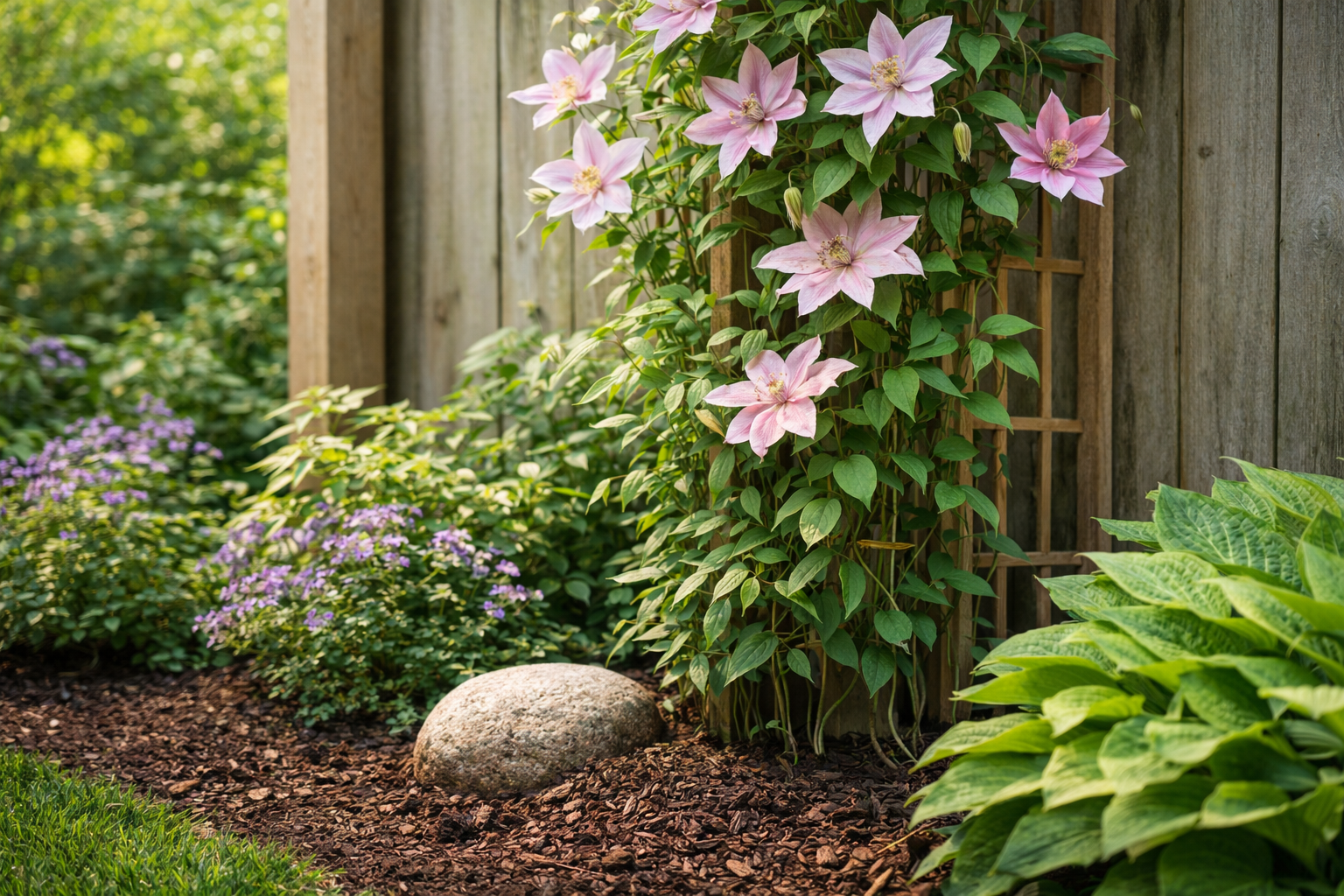
The evidence here is boring in the best way. Clemson says the soil should be moist and well drained. The RHS says the roots should be cool and moist, with the base in light shade or shaded by other plants or pebbles. None of that is glamorous. All of it matters.
Step 1. Shade the roots and keep the top growth in the light
This is the classic rule because it works. Mulch the base. Let a low perennial or a stone shade the root zone. Just don’t create a little cave around the whole plant. Flowering drops when the top stays in deep shade. The RHS says that plainly in its clematis FAQ.
Step 2. Build support from day one and spare yourself the wrestling match later
Clematis stems are not thick, self-clinging ropes. They need something they can wrap around. Fine trellis, taut wire, a rose, a shrub, or an obelisk all work if the scale matches the vine. What does not work is deciding on the support after the plant has already turned itself into a knot.
For containers, the setup matters more than most tags admit. A big clematis in a stingy pot is a cranky plant. A roomy container with real drainage gives you a wider margin for summer heat and watering swings. The article on how to fill a large plant container covers the drainage side of that job well.
Step 3. Mulch for cooler roots and steadier moisture
A roughly 2-inch layer of mulch is enough to make a real difference. It cools the root zone, slows moisture loss, and keeps the soil from swinging so wildly between wet and dry. Bark, leaf mold, and composted material all do the job.
Step 4. Water deeply and stop skimming the surface
Clematis is not a shallow sprinkle plant. Deep-rooted vines respond better when water moves into the root zone instead of damping the top inch and calling it done. This matters even more under eaves, along a wall, or beneath trees where rain never really reaches the soil.
Step 5. Feed with a light hand and do not chase flowers with too much nitrogen
You want steady growth, not a huge rush of soft stems. Rich, improved soil plus sensible feeding does more good than repeated heavy fertilizer hits. If the plant is green and racing upward with little bloom, extra nitrogen is not the answer.
Remember: “Cool roots” is a root-zone instruction. It is not permission to plant the whole clematis in a dark corner and hope for the best.
Fix weak flowering fast: the shade, pruning, and soil checks that matter
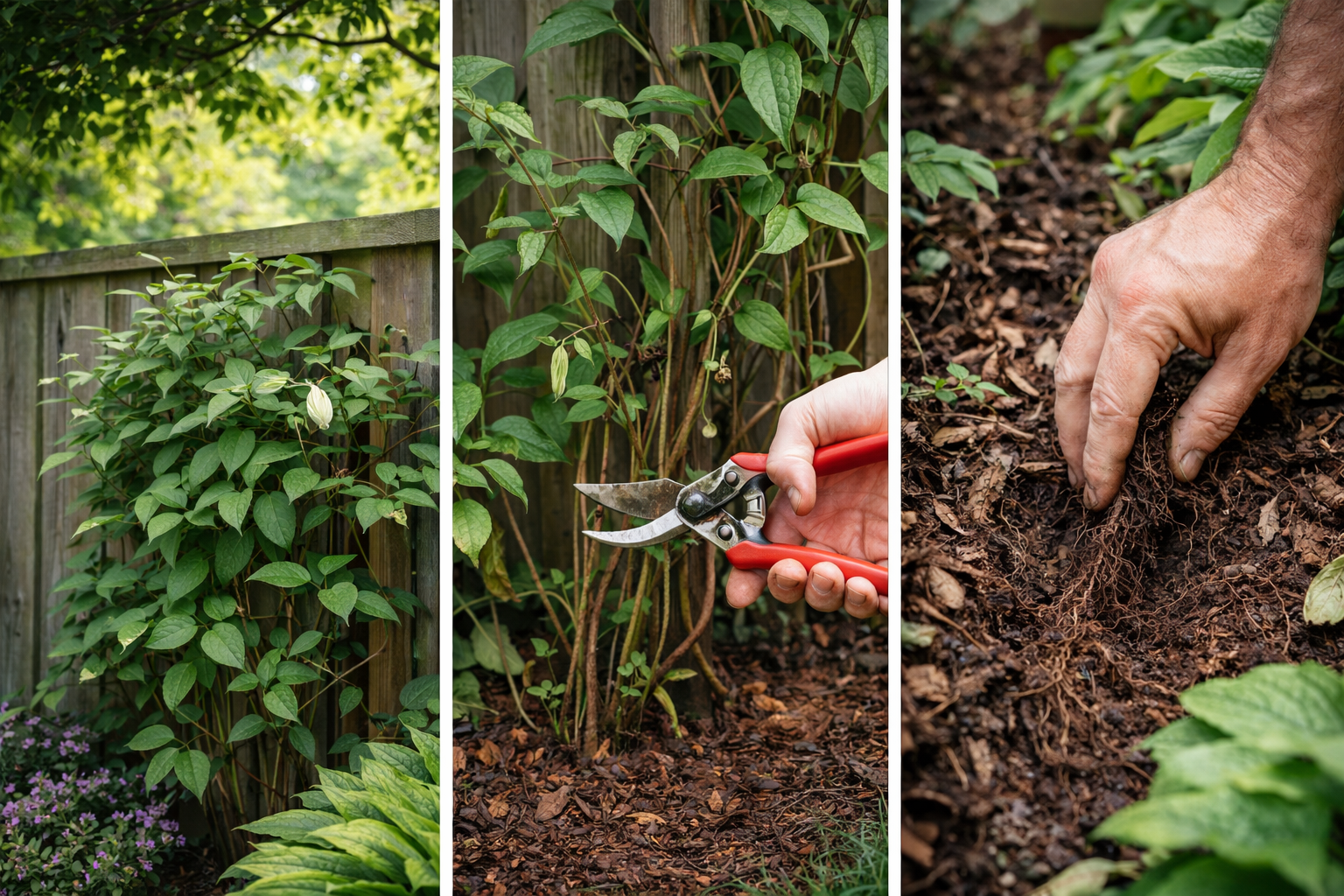
The complaint usually sounds like this: “It grows fine. It just doesn’t bloom much.”
Good. That narrows things down.
Check the light first and rule out the obvious
The RHS clematis FAQ says growth and flowering are impaired if the top of the plant is kept in deep shade. That should be your first checkpoint. If the vine makes plenty of foliage but few flowers, suspect light before anything exotic. A lot of “mystery” clematis problems are not mysterious at all. The site is simply too dark.
Check pruning second and catch the calendar mistake
This one stings because it is easy to do once and then spend months blaming the plant.
If you have a Group 2 clematis and prune it like a Group 3 in late winter, you can remove much of the wood that was about to flower. Clemson says Group 2 pruning should be light, usually removing dead or weak stems and cutting back to strong buds. Group 3 is the one you cut hard.
If the plant bloomed well before you pruned it “tidily” last year and sulked after that, the pruning group is suddenly the lead suspect.
Check moisture and root competition third
A clematis under a tree can fail for two reasons at once. Light is lower and root competition is fierce. The result is a vine that never gets the combination it wants: cool roots, steady moisture, and enough light on the top growth.
I’ve seen gardeners keep pouring water on the surface while a mature tree quietly drinks it first. That doesn’t end with more flowers. It ends with annoyance.
Check for wilt, but don’t blame wilt for every collapse
Large-flowered hybrids can suffer clematis wilt, and the RHS FAQ covers that issue directly. But not every weak or collapsing stem is wilt. Dry soil, mechanical damage, and poor siting can mimic bigger trouble. If stems blacken and collapse quickly on a susceptible large-flowered hybrid, look into wilt. If the plant is simply leafy and stingy, look back at light, pruning, and moisture.
Fast diagnosis
- Leafy, not flowery: too little light is the first thing to check.
- Healthy growth after a hard late-winter cut, but almost no spring flowers: wrong pruning group is likely.
- Struggling under a tree: root competition and dry soil may be doing half the damage.
- Sudden blackened stem collapse on a large-flowered hybrid: investigate wilt.
Avoid the regret picks for your situation
A lot of clematis disappointment starts before planting. The vine was never right for the job.
Small-garden regret: buying a giant for a modest support
Montana and armandii are attractive for good reason. They cover space fast and look impressive doing it. But if the support is small or the garden is tight, they can become a yearly management chore. The flower show is not worth much if the plant spends the rest of the year trying to swallow the structure.
Cold-climate regret: choosing evergreen clematis for exposure it cannot handle
Evergreen clematis is tempting because winter structure feels like such a bonus. Still, armandii is not the universal answer. Clemson’s evergreen clematis guidance places it in milder zones, and the RHS notes that winter- and spring-flowering evergreen types need a sheltered spot because they are less hardy. If the site is cold, windy, and exposed, pick a deciduous type and move on.
Expectation regret: reading “shade tolerant” as “flowers beautifully in deep shade”
This is the biggest one. “Shade tolerant” means the vine can cope with partial shade better than many others. It does not mean a dense, dark corner suddenly becomes a flower factory.
Ecology regret: defaulting to sweet autumn clematis because it will grow in more shade
The awkward truth is that Clematis terniflora, often called sweet autumn clematis, can bloom well in considerable shade. The Missouri Botanical Garden entry for Clematis terniflora says exactly that, and it also says the plant can be quite aggressive and self-seed readily. That’s the kind of tradeoff readers deserve to see before planting. In regions where it behaves badly, a vigorous native such as Clematis virginiana is often the smarter path.
If I were narrowing this down for a friend, I’d put it like this:
- Choose “Nelly Moser” if you want large striped flowers in part shade.
- Choose Clematis alpina if the site is bright shade and you want a calmer spring-blooming vine.
- Choose “Polish Spirit” if you want simpler pruning and flowers later in the season.
- Choose Clematis armandii only if the climate is mild and the support is generous.
- Choose Clematis virginiana if a vigorous native vine fits the space and style.
The right clematis is not the prettiest one on the tag. It’s the one that still makes sense after you factor in the site, the support, and the work.
FAQ
Can I plant clematis right against a wall or fence?
Yes, but wall-side planting often means drier soil. Leave a little room from the base, improve the soil well, and water more deliberately because rain may not reach the roots properly.
Can two clematis share one support in partial shade?
They can if the support is stout and the varieties are matched for vigor. Pairing one medium grower with one giant is how you end up with one plant and one memory.
Are pale clematis better than dark purple ones in shade?
Pale, striped, or light blue flowers often read more clearly in shade, which is one reason “Nelly Moser” and “Fujimusume” are so appealing there. Darker flowers can still work well, but they tend to need enough light to keep the display from looking swallowed by the background.

Michael Rowan is the founder and lead writer at The Garden Playbook. He has spent 10+ years growing plants across a range of settings — from indoor houseplants and container gardens to raised beds and in-ground plots — adapting methods to different light levels, seasons, and growing conditions.
Michael focuses on practical, experience-based guidance grounded in fundamentals: soil health, watering strategy, plant nutrition, pruning and propagation, and integrated pest management (IPM). His work aims to help readers diagnose common problems (such as yellowing leaves, stunted growth, or pest pressure) and apply straightforward solutions that are realistic for home gardeners.
At The Garden Playbook, Michael develops tutorials and plant guides using a consistent process: documenting real outcomes where possible, explaining the “why” behind each step, and verifying higher-risk topics (such as plant toxicity or pest treatment options) against reputable horticultural references.