
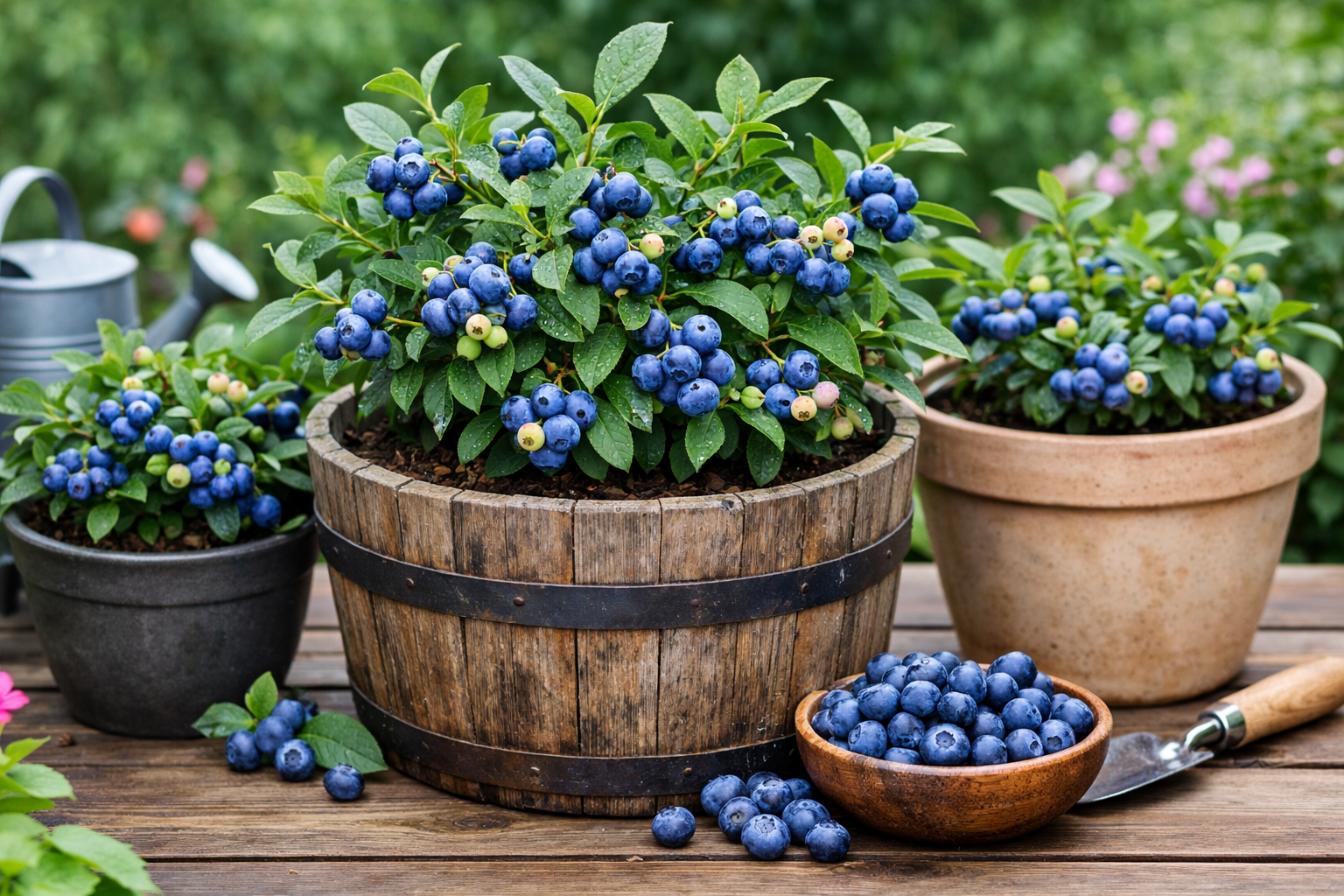
If you’re looking for the best blueberries for containers, the short answer is this: pick a compact or half-high blueberry if space is tight, and pick a region-suited highbush if you have a genuinely big pot and care more about harvest than miniature size.
That sounds tidy. It usually isn’t.
The snag is that “best” can mean three different things. Best for a balcony. Best for a cold winter. Best for bowls of berries instead of one polite handful in July. I see people buy the smallest plant with the nicest tag, tuck it into a decorative pot, and then wonder why the crop feels stingy. I’ve made that same mistake with container fruit, and it is annoying because the plant is not exactly failing. It is just doing what a cramped root system and the wrong variety told it to do.
The Royal Horticultural Society notes that standard blueberries can crop very well in large containers, while very dwarf choices can stay small, sparse, and less satisfying to eat. That one point changes the whole conversation. So the real job is not “find the cutest patio blueberry.” It is “match the blueberry type to your climate, pot size, and crop expectations.”
- Which blueberry type fits cold winters, mild winters, and small-space growing
- How pot size changes what counts as a smart variety pick
- Which cultivars make sense for a tiny patio, a half barrel, or a better harvest
- When one plant is fine and when two make a real difference
- Why potted blueberries turn yellow, stall out, or sulk
Fast pick: start here, not in the nursery aisle
| Your situation | Best starting point | What to avoid |
|---|---|---|
| Small patio or balcony | Compact or half-high cultivar in an acidic mix | Full-sized highbush in a shallow decorative pot |
| Cold winter climate | Half-high or cold-hardy northern type | Low-chill southern highbush picked for looks |
| Mild winter climate | Southern highbush or a low-chill compact choice | High-chill northern cultivar that never gets enough winter rest |
| You want a real crop, not a novelty plant | Region-suited highbush in a big pot, or two compatible compact plants | Choosing the smallest plant just because it says “patio” |
The best blueberries for containers, if you want the direct answer first
For most readers, the safest picks are compact blueberries and half-high blueberries. They are easier to place, easier to protect in winter, and less likely to outgrow the container before you get your bearings.
That said, a compact plant is not always the best plant.
When the Royal Horticultural Society lists cultivars for pot growing, it includes compact names like ‘Sunshine Blue’ and ‘Bluetta’. When the same organization talks about crops in pots, it also points out that standard blueberries can do very well in larger containers. Put those two ideas together and the practical answer gets clearer: if you have only a modest patio container, stay compact. If you have room for a large planter, a bigger highbush can be the more rewarding choice.
So here is the clean version.
Best all-around answer: choose a compact or half-high cultivar matched to your winter chill and grow it in a properly acidic mix.
Better harvest answer: choose a region-suited highbush and give it a much bigger container than the nursery tag makes you think you need.
If you live where winters are cold and a container will sit exposed, compact half-high types often make more sense than fussy low-chill ornamentals. If you live where winters stay mild, a low-chill southern highbush or compact cultivar is the smarter lane. And if your goal is flavor and crop size, not patio decor, don’t write off a larger blueberry bush just because so many list posts talk only about dwarfs.
That is the first fork in the road. Tiny footprint, or bigger payoff.
Judge a container blueberry by these six factors so you do not buy the prettiest mismatch
I judge container blueberries on six things, and the order matters more than people think.
- Climate fit and chill hours. A blueberry that needs a long cold winter will never be happy in a warm-winter yard, no matter how expensive the pot is.
- Mature size. The plant tag often describes the young plant you are holding, not the bush you will be dealing with later.
- Real container volume. A pot can look large and still have too little usable root room.
- Pollination needs. Some cultivars fruit alone. Many crop better with a partner nearby.
- Berry quality. Some compact ornamental selections are tidy and attractive but not the first name you’d pick for flavor.
- Maintenance tolerance. In a pot, a blueberry that copes better with swings in moisture and winter exposure is worth more than a pretty catalog photo.
Oregon State University Extension lays out the big distinctions: southern highbush often needs only around 200 to 300 chill hours, northern highbush can need 800 hours or more, and half-high types are especially useful in colder places and container culture. Read that before you read any top-10 roundup and half the bad choices fall away on their own.
A simple scoring rule that actually helps
If climate fit is wrong, stop there.
If the pot is too small for the mature plant, downgrade it.
Only after those two should flavor, berry size, harvest window, and ornamental looks decide the winner.
This is where a lot of readers get tripped up. They compare berry color or plant height before they ask whether the plant can even do its job in their winter and their pot. That is like shopping for running shoes by lace color and forgetting your size.
And yes, the list of named cultivars matters. It just matters after the fundamentals.
Choose the blueberry type that matches your climate so the plant can actually fruit
Blueberries are not one thing. “Blueberry bush” sounds simple, but for containers you are really choosing among a few useful groups, and each group behaves differently.
Northern highbush
These are the classic cold-winter blueberries. They can be excellent in containers if the pot is large enough, and the fruit quality can be superb. The catch is chill requirement. If your winters are mild, they may leaf out poorly, flower weakly, or never settle into a good rhythm.
Southern highbush
These make much more sense in mild-winter areas. Oregon State’s cultivar guide puts many southern highbush selections in the low-chill camp, around 200 to 300 hours. If you garden in a warm region and keep trying northern highbush because the variety is famous, that’s usually the wrong fight.
Half-high
This is the sweet spot for lots of container gardeners in colder climates. Half-high blueberries stay more compact, handle cold better, and fit the reality of patio growing. They don’t feel like a compromise when the site is exposed and winter hits hard.
Rabbiteye
Rabbiteye blueberries are handy in warmer regions, but they often grow larger and need more thought around pollination. For containers, they are not the first type I steer most small-space gardeners toward unless the climate points there and the grower is ready for a bigger setup.
Use this shortcut: cold winter and small patio, start with half-high. Mild winter, start with southern highbush or a low-chill compact choice. Room for a barrel planter, a larger highbush jumps back into the running.
The tricky part is that plant marketing blurs all this. A nursery may sell a cultivar as a “patio blueberry” because it is compact in shape, but that says very little about whether it suits a cold Minneapolis winter or a warm coastal California one. A pot doesn’t erase climate. It just gives you more control over the root zone.
That’s why this step comes before the variety shortlist. Type first. Name second.
Match the plant to the pot so a small-space pick does not turn into a small crop
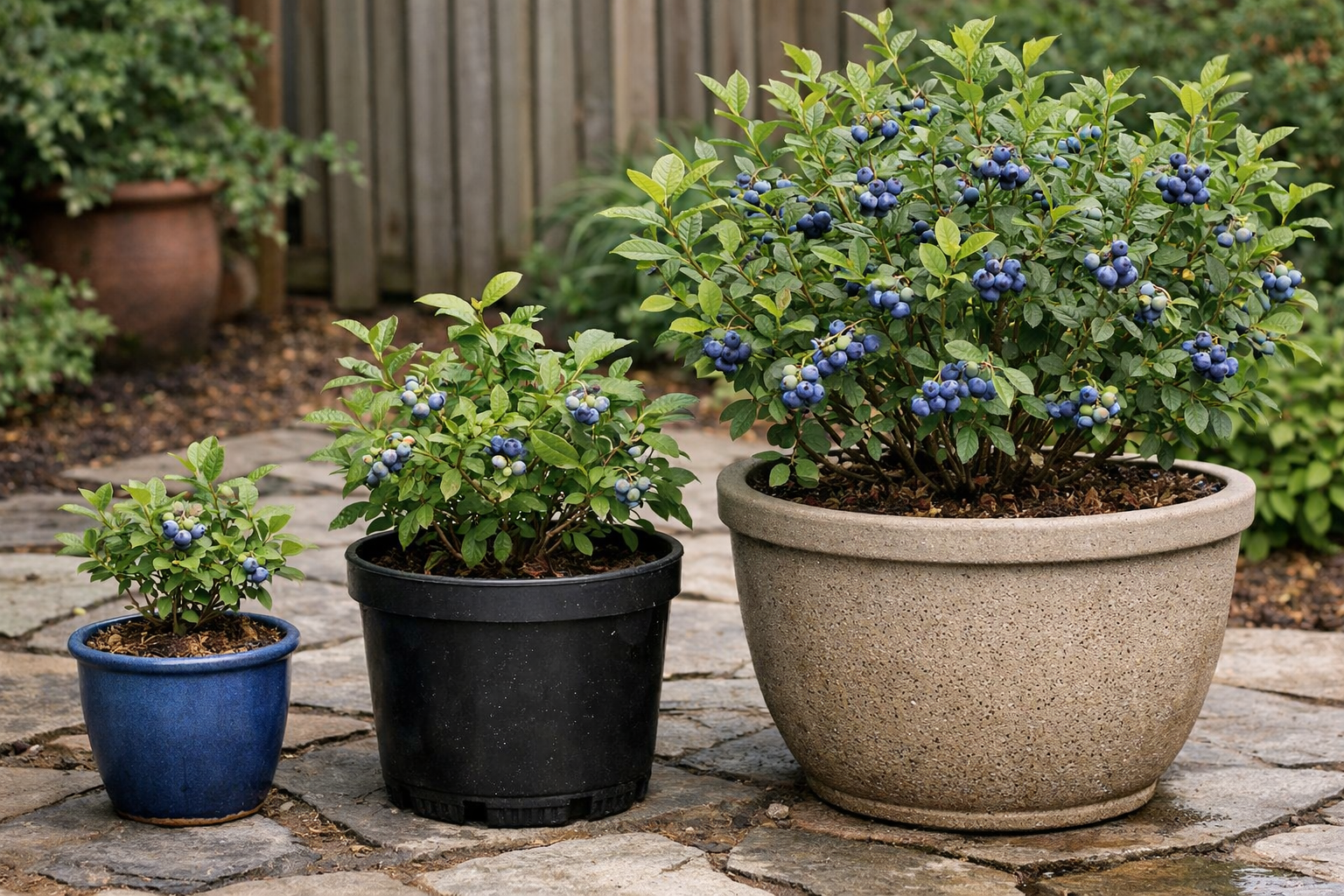
The University of Maryland’s container blueberry guidance is refreshingly concrete here. Half-high blueberries tend to do best in containers of at least 10 gallons. Larger types, including many northern highbush selections, need 15 to 20 gallons and, once mature, something in the ballpark of 24 inches deep and 24 to 30 inches wide.
That sounds big because it is big.
And that is where the garden-center display pot misleads people. A 12-inch glazed pot looks generous on a shelf. For a blueberry meant to fruit well over time, it often is not.
I’ve seen the same pattern again and again. The bush survives. It puts on leaves. It even fruits a little. But the pot dries too fast in heat, the roots hit the wall early, and the plant spends more energy coping than cropping. You feel like you’re one watering miss away from punishment.
Use container size in three tiers:
- Minimum workable: good for getting started, but the plant will ask more from you.
- Smarter long-term: enough volume to buffer moisture swings and let the plant settle in.
- Easiest to manage: large enough that the bush can crop without acting like a diva every hot afternoon.
There is another subtle point people miss. Blueberries have shallow roots, but shallow-rooted does not mean tiny-pot-loving. Shallow roots dry out faster, and in a container that makes extra volume more helpful, not less.
Pot-size rule of thumb
If the plant is sold as compact or half-high, think 10 gallons as a floor and larger if you can manage it.
If the plant is a full-sized highbush, think 15 to 20 gallons and real depth, not a wide-but-shallow bowl.
If a large decorative planter is part of the plan, this guide on how to fill a large plant container is worth a quick look. The useful part is not the filler trick itself. It is the reminder that usable root room still matters. A huge pot can still be wrong if the lower half is packed in a way that steals the depth your blueberry needs.
One more number that matters here is soil reaction. Container blueberries want acidic media, usually around pH 4.5 to 5.5. Miss that, and a large pot won’t save you.
Use this shortlist by scenario so you buy the right blueberry the first time
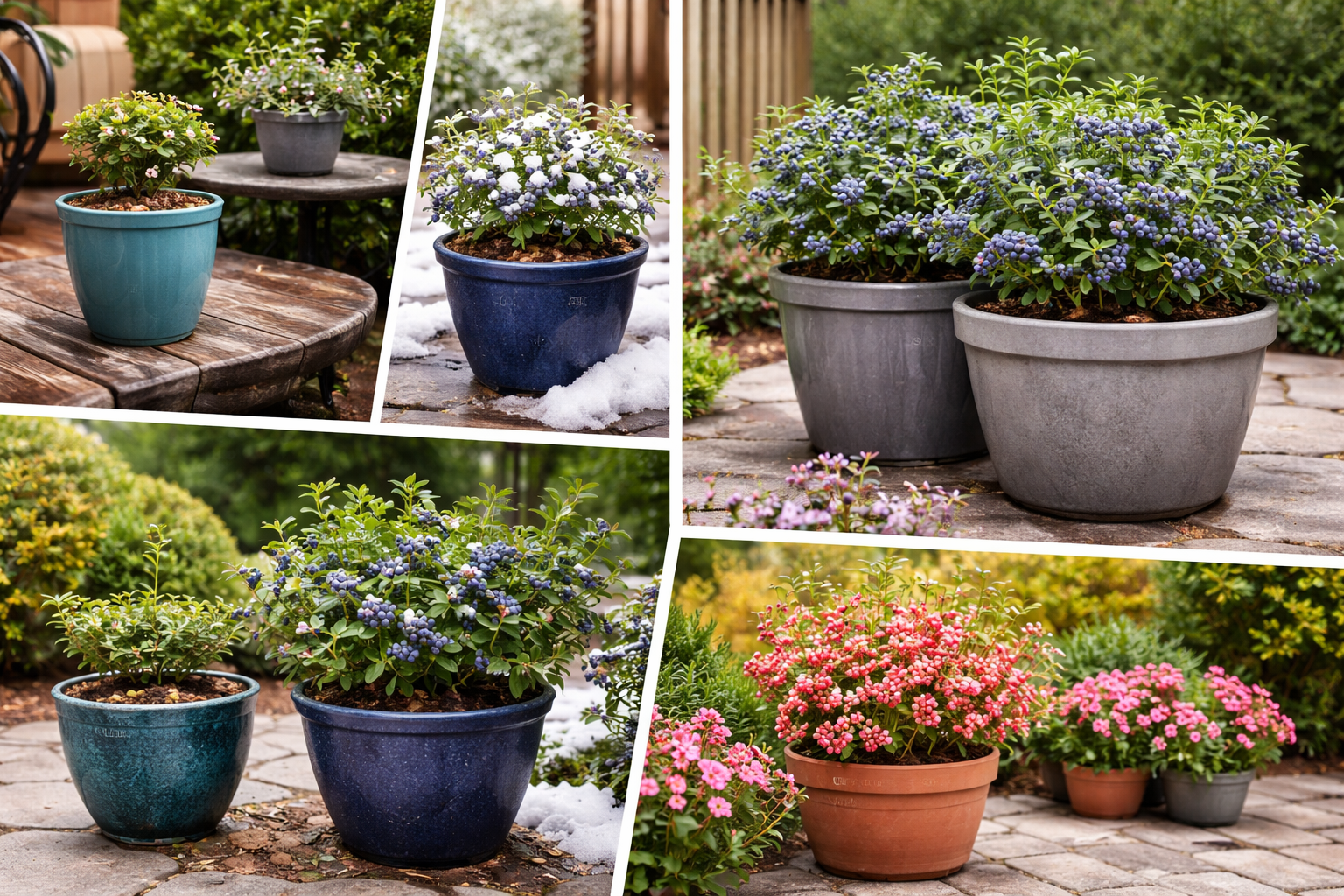
A shortlist works better than a bloated roundup because the decision is not “which of these 23 names looks fun?” It is “which one fits the exact version of container growing I’m doing?”
| Cultivar | Best fit | What to know |
|---|---|---|
| Sunshine Blue | Compact all-around pick for mild climates and patio growing | Popular in containers, tidy habit, low-chill reputation |
| Northsky | Cold climates and smaller spaces | Half-high type, useful where winter exposure matters |
| Northblue | Cold climates and a bit more crop ambition | Hardy, compact enough for containers with decent volume |
| Top Hat | Tiny patio and ornamental use | Very small plant, but don’t expect a big harvest |
| Pink Lemonade | Ornamental interest and novelty | Fun fruit color, but choose it for the full package, not just crop size |
| Duke or Bluecrop | Large containers and better crop potential | More room needed, but often a stronger answer for serious blueberry eaters |
Best all-around compact pick: Sunshine Blue
‘Sunshine Blue’ keeps coming up for a reason. It is compact, well known for container growing, and makes sense for mild-winter regions where low chill matters. If you want a patio blueberry that looks neat and still feels like a fruit plant, not just an edible shrub, this is one of the safest names to start with.
The catch is climate. In a hard-cold region, a half-high can be a better bet.
Best for very cold climates: Northsky or Northblue
When container roots will sit through real winter cold, half-high names like ‘Northsky’ and ‘Northblue’ start to look much more practical. They stay compact enough for pots and fit the cold-climate piece better than many low-chill patio favorites. ‘Northblue’ often gets the nod when gardeners want a bit more crop potential. ‘Northsky’ makes sense when footprint matters more.
Best for the tiniest patio: Top Hat
‘Top Hat’ works when the container has to stay genuinely small and the plant is doing double duty as an ornamental. I like it best when expectations are honest. It is not the choice for someone dreaming of freezer bags full of berries. It is the choice for a tidy pot, a handful of fruit, and a blueberry bush that does not boss the whole balcony around.
Best ornamental pick: Pink Lemonade
‘Pink Lemonade’ is fun. No point pretending it isn’t. The berries are pink, people notice it, and it gives you something different from the usual blue-black crop. But Oregon State notes that some ornamental container favorites do not match commercial cultivars for eating quality. That is the frame I’d use here. Buy it because you like the look and the novelty, not because it is the clearest path to the heaviest, best-tasting bowl of berries.
Best for bigger harvests in a real planter: Duke or Bluecrop
This is the category many articles duck. If you have room for a large pot, a region-suited highbush like ‘Duke’ or ‘Bluecrop’ can be a better answer than a dwarf selection. You get a more substantial bush and often better eating quality, but the pot has to be generous and the climate has to fit.
The honest tradeoff: the smallest bush is not the same thing as the best container blueberry. Tiny bushes win on placement. Bigger bushes often win on satisfaction.
Pair varieties the smart way for heavier crops and a longer harvest
Oregon State’s cultivar guide makes two helpful points that are easy to miss in quick shopping lists. One, different blueberry types handle pollination differently. Two, fruit on a cultivar often ripens over about two to five weeks, and a full crop can take several years to build. Those details change how you should plan your pots.
If you can grow only one bush, choose a self-fertile cultivar that matches your climate and container size. That is the low-fuss route and it is perfectly reasonable.
If you want more berries, bigger berries, or a longer picking season, a second compatible variety nearby usually pays off. The good news is that “nearby” does not mean “in the same container.” Separate pots work fine. You just want bloom times that overlap.
Here is the easy version:
- One pot only: choose a self-fertile compact or half-high cultivar and accept a modest crop at first.
- Two pots, best crop: pair compatible cultivars with overlapping bloom.
- Longer harvest: pair an early or midseason cultivar with another that still overlaps in bloom but ripens later.
Where people go wrong is simple. They buy two random blueberry bushes because “two is better than one.” Sometimes that works. Sometimes the bloom timing is off, the types are mismatched, or one bush fits the climate better than the other and the pair never really clicks.
Keep it boring here. Boring is good. Same blueberry type, same climate fit, overlapping bloom, separate containers. That setup does the job.
Build the acidic setup that keeps potted blueberries productive instead of cranky
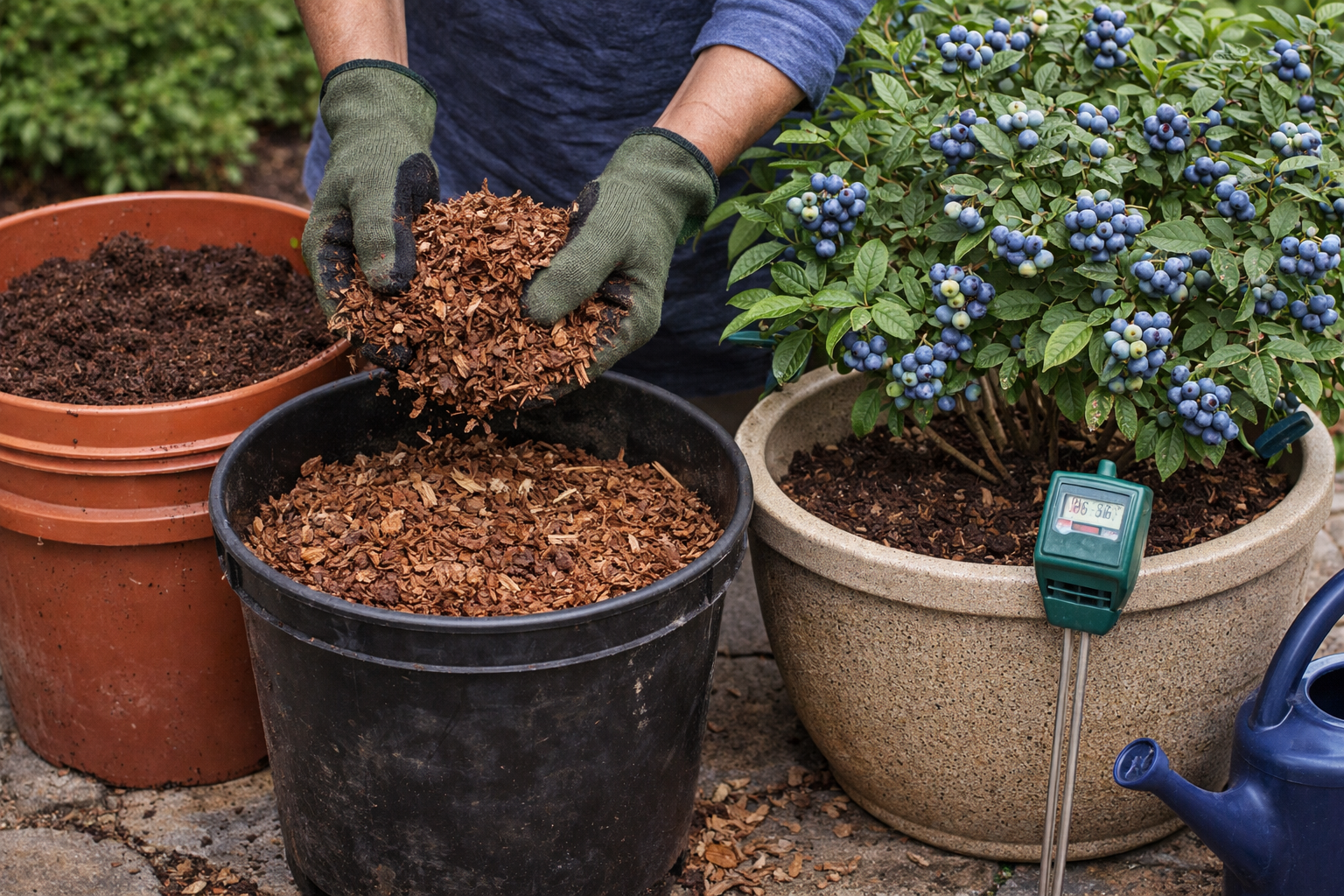
The University of Wisconsin’s container guidance gives the right baseline: blueberries in pots want an acidic, free-draining medium, with pH usually in the 4.5 to 5.5 range. That is not decorative trivia. It is the root of most success and most failure.
Step 1. Use an acidic mix so roots can feed.
A bark-and-peat based medium works well. Wisconsin Extension gives one workable example of equal parts peat moss and shredded pine bark. The exact recipe can shift, but the principle does not. Regular potting soil built for geraniums and tomatoes is usually not the right home.
Step 2. Keep drainage open so roots do not sit sour.
Blueberries like steady moisture, not swamp. That means a container with proper drainage holes and a mix that holds moisture without packing down into muck.
Step 3. Water evenly so the plant stops lurching between drought and drench.
Container blueberries are thirsty in warm weather because the root system sits close to the pot wall. Let the mix dry hard and the plant stalls. Keep it waterlogged and the roots sulk for a different reason.
Step 4. Watch the water source so pH does not creep up.
This catches people off guard. The potting mix starts acidic, then months of alkaline tap water slowly drag it upward. That is one reason the Royal Horticultural Society suggests rainwater for acid-loving plants where the tap runs alkaline. If your blueberry keeps yellowing in a decent mix, the water itself might be nudging the root zone the wrong way.
Step 5. Feed lightly, then watch the leaves.
An acid-loving fertilizer can help, but fertilizer is not a magic eraser for high pH. If the mix or water is wrong, more feed often just makes the plant look confused in a different way.
Remember
If you are fixing a blueberry in a pot, test or at least verify the pH before throwing sulfur, fertilizer, and hope at the problem. The sequence matters.
One little nuance here. Full sun is still the best setup for fruiting, but in hot climates a bit of afternoon relief can be kinder to container plants than punishing all-day reflected heat off a wall or deck.
Diagnose weak growth fast and avoid the mistakes that waste a season
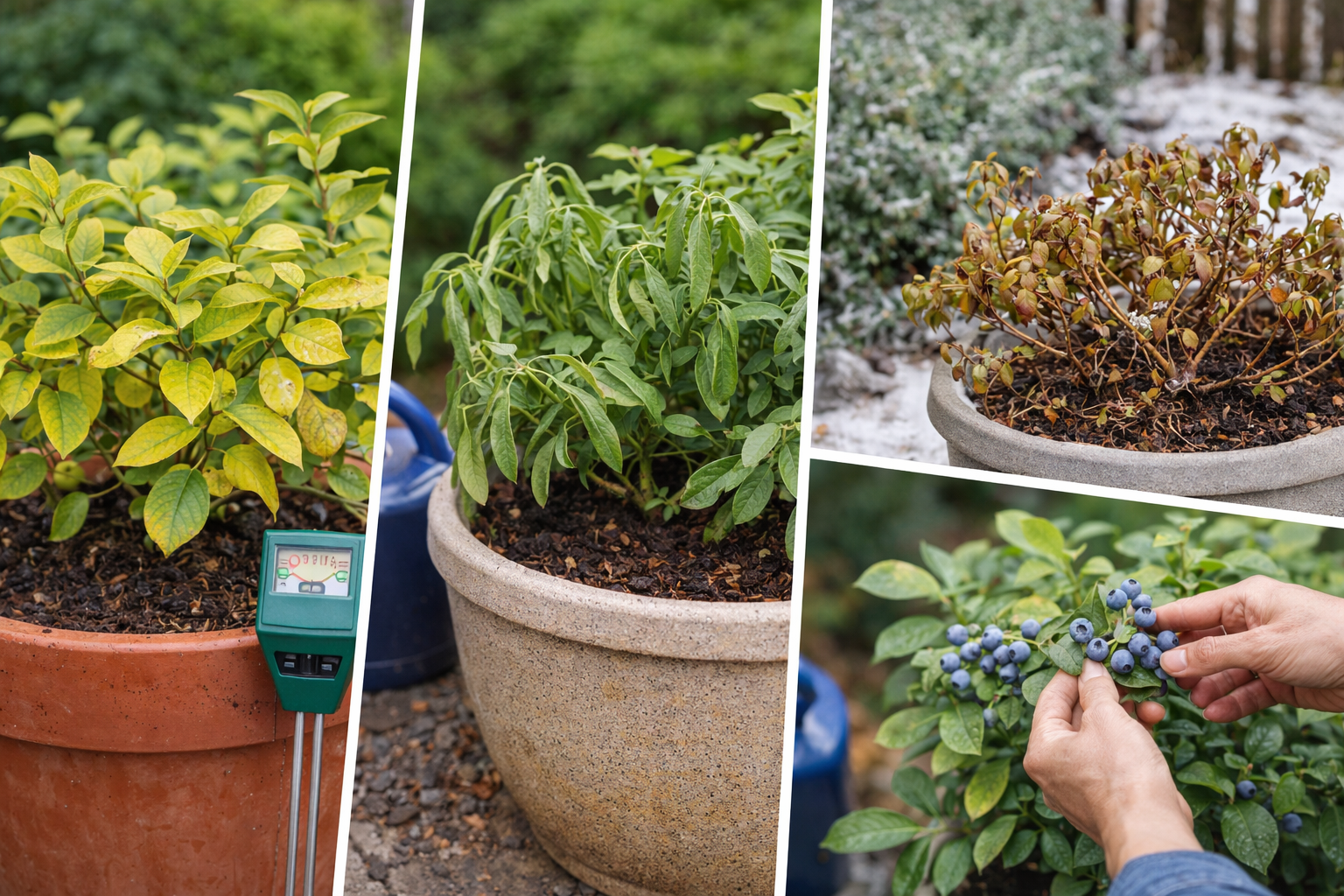
This is the section I wish more container fruit articles took seriously. Most blueberry problems in pots are not mysterious. They are just easy to misread.
Yellow leaves
First suspect the pH, not the fertilizer brand. An alkaline mix or alkaline water can lock up nutrients even when you are feeding. Check the root-zone reaction and the water source before you start piling on more plant food.
Weak fruit set
Look at sun, plant age, spring frost, and pollination. A young bush will not crop like a settled one. A shady site will cut fruiting. A lone bush may still fruit, but a compatible partner often helps.
Leaves look fine, but the plant wilts all the time
That usually points to container size, hot exposure, or a bark-heavy mix that is drying faster than you think. The plant is telling you the pot has too little buffer. If the weather turns warm and you feel chained to the watering can, that is not just summer being summer. It is a setup clue.
Winter dieback
The root zone in a container gets colder than the same plant would in the ground. A cultivar can be winter-hardy on paper and still suffer if the pot sits exposed on a windy deck. In colder places, moving the container to a more protected spot, insulating the pot, or choosing half-high types from the start saves a lot of grief.
Plenty of leaves, weak crop
This one fools people because the bush does not look unhappy. Often the plant is still young, the pot is tight, or the variety was chosen for compact looks over fruit quality. Healthy foliage is not a guarantee of a satisfying crop.
The mistake list, trimmed to the ones that matter most: underpotting, using the wrong mix, ignoring water alkalinity, treating “self-fertile” as “equally productive alone,” and expecting a tiny novelty blueberry to behave like a full crop plant.
If I had to pick one mistake above the rest, it would be buying by label language instead of by growing conditions. “Patio,” “dwarf,” and “ornamental” are handy hints, but they are not the same thing as climate fit, crop quality, or long-term ease.
FAQ
Can two blueberry bushes share one large container?
They can, but I wouldn’t make that the default plan. Two bushes in one pot compete for the same root room and the same water buffer, which makes feeding and moisture harder to manage. Two separate containers set close together usually work better and make pollination just as easy.
Do potted blueberries need rainwater?
Not always. If the tap water is soft or close to neutral, it may be fine. Where the tap runs alkaline, rainwater helps keep the root zone from drifting upward over time. If leaves yellow and the mix was correct to begin with, the water source is worth checking.
Are fabric grow bags a good long-term choice for blueberries?
They can work, but they dry faster than rigid pots, which is not always what a shallow-rooted blueberry wants in summer. For short-term growing or mild climates, they are usable. For long-term container blueberries, I still prefer a stable pot with enough depth and a little more moisture buffer.

Michael Rowan is the founder and lead writer at The Garden Playbook. He has spent 10+ years growing plants across a range of settings — from indoor houseplants and container gardens to raised beds and in-ground plots — adapting methods to different light levels, seasons, and growing conditions.
Michael focuses on practical, experience-based guidance grounded in fundamentals: soil health, watering strategy, plant nutrition, pruning and propagation, and integrated pest management (IPM). His work aims to help readers diagnose common problems (such as yellowing leaves, stunted growth, or pest pressure) and apply straightforward solutions that are realistic for home gardeners.
At The Garden Playbook, Michael develops tutorials and plant guides using a consistent process: documenting real outcomes where possible, explaining the “why” behind each step, and verifying higher-risk topics (such as plant toxicity or pest treatment options) against reputable horticultural references.